
Replacement parts • Custom FDM • Managed manufacturing
When replacement parts disappear, we make the next one.
Bring Kevin a broken original, rough sketch, measurements, or digital model. He will evaluate the job, develop a practical path, and either produce it with his Northern Kentucky FDM equipment or coordinate a specialized process through a vetted outside manufacturing provider.
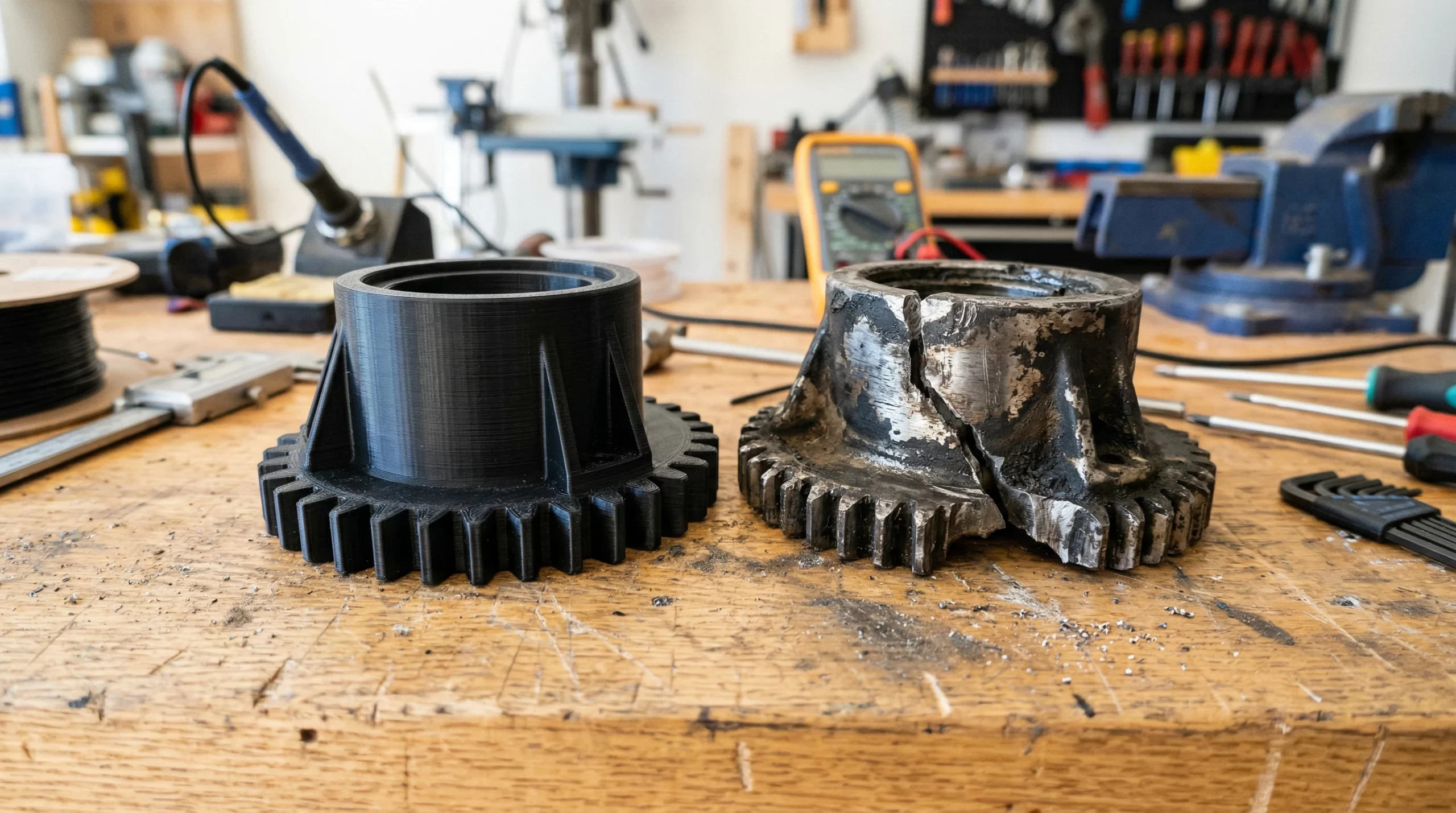
What does 3D Printing by Kevin do? Kevin evaluates, designs, produces, and coordinates practical custom parts—including discontinued replacements, brackets, holders, prototypes, fixtures, and small batches. FDM work is produced in Kevin’s shop. When another process is a better fit, Kevin can manage qualified projects through a vetted outside manufacturing provider and inspect the completed parts before delivery.
Choose the path that fits your goal
Do you need the finished part—or the skill to make it yourself?
Both paths begin with the same principle: understand the problem before choosing the printer, material, or setting.
You want Kevin to evaluate and manage the part
Start with an STL, STEP, OBJ, broken original, clear photographs, measurements, a sketch, or a description of what the part must accomplish. Kevin will help determine whether in-house FDM or a managed specialized process is the practical route.
You want to become more capable with your printer
Begin with the free step-by-step guide, then use the P.R.I.N.T. It ebook when you want a structured reference for setup, slicers, materials, calibration, replacement parts, maintenance, and troubleshooting.
Explore the P.R.I.N.T. It ebook →Custom 3D printing services
Built around the part you need—not a single printing process.
The goal is not to print something merely because a machine can make it. The goal is to understand the job, select a sensible process, and manage the work from first review through final inspection.
Replacement and Discontinued Parts
Recreate a plastic component that is broken, unavailable, or no longer supported when its function, interfaces, and operating conditions can be evaluated safely.
Explore discontinued-part replacement → See broken bracket and clip solutions →Custom Mounts, Holders, and Organizers
Build around the dimensions of a particular tool, device, machine, drawer, bench, or workspace instead of settling for a generic fit.
See custom mounts and holders →Rapid Prototypes
Turn an early design into a physical object that can be held, checked, discussed, and revised before committing to a larger production decision or specialized process.
Explore precision parts and prototypes →Small-Batch Functional Parts
Produce a limited quantity of repeatable parts when injection molding, tooling, or large production minimums do not make economic sense. The route may be in-house FDM or a managed production process.
Discuss quantity and project fit →Design and File Refinement
Evaluate existing geometry, adjust practical features, or model a new part around measured requirements and real attachment points.
Learn what measurements help →Managed Advanced Manufacturing
When FDM is not the right fit, qualified projects may be coordinated through a vetted outside manufacturing provider for processes such as SLA, PolyJet, Carbon DLS, SLS, MJF, metal additive manufacturing, CNC machining, or urethane casting.
Ask Kevin to evaluate the right process →Why additive manufacturing fits this work: The National Institute of Standards and Technology explains how additive manufacturing can improve the economics of low-volume production, end-of-life components, repair parts, customization, and rapid design iteration.
One project lead, more manufacturing options
Kevin helps choose the process before anyone commits to production.
You do not need to know whether your part belongs on an FDM printer, in a resin system, in a powder bed, or with another manufacturing method. Start with what the part must accomplish.
| Project need | Possible route | How Kevin helps |
|---|---|---|
| Functional replacement, bracket, holder, fixture, or prototype | In-house FDM | Design review, material selection, production, inspection, and controlled revision in Kevin’s shop |
| Fine detail, smooth surfaces, or specialized resin behavior | Managed SLA, PolyJet, or Carbon DLS | Requirements, file preparation, outside production coordination, and incoming inspection |
| Complex nylon parts or efficient short production runs | Managed SLS or MJF | Process comparison, quote coordination, specification review, and part inspection |
| Metal, machining, casting, certification, or another specialized need | Managed advanced manufacturing | Project screening and coordination when the requirements, budget, and risk are suitable |
Clear distinction: Kevin does not operate resin, powder-bed, or metal printing equipment in his shop. Those processes are considered only when they offer a better project fit and can be managed responsibly through a vetted outside manufacturing provider.
Project-fit check
A practical route starts with fit, function, environment, and risk.
Final suitability depends on the geometry, material, appearance, quantity, operating environment, consequences of failure, and available alternatives.
Often a strong in-house FDM fit
- A discontinued plastic cover, clip, spacer, knob, foot, or bracket
- A custom holder, guide, jig, fixture, tray, or organizer
- A prototype that needs fit, scale, or usability feedback
- A low-volume part with no practical off-the-shelf match
- A component that can be tested without creating unacceptable risk
May benefit from a managed process
- Fine details or smoother surfaces beyond a practical FDM result
- Complex nylon geometry suited to SLS or MJF
- Engineering resin, metal, machining, casting, or specialty finishing
- Inspection documents, material records, or controlled repeat production
- A project where Kevin can define the requirements and inspect the result
Needs extra review—or may be declined
- Parts that support a person or protect someone from injury
- Fuel, flame, pressure, high-voltage, or critical electrical applications
- Medical, regulated, certified, or legally controlled components
- High-temperature or chemically aggressive environments without suitable data
- Very high quantities where another manufacturing method may cost less
Important: Access to another process does not make every project acceptable. A finished part is not automatically safe or suitable. Kevin may recommend testing, a design change, a different material or method, qualified engineering review, or declining the project when the consequences of failure are too high.
A repeatable decision process
The 3D Printing by Kevin P.R.I.N.T. Method™
A useful part begins with the problem and its requirements—not with a random material or printer setting.
Define what is broken, missing, awkward, or worth improving.
Identify load, heat, weather, movement, flexibility, appearance, and risk.
Measure every place the part fits, clips, slides, screws, seals, or supports.
Choose the material, geometry, and process—including whether work belongs in Kevin’s shop or with a managed provider.
Produce, inspect, fit, revise, and document what the result teaches.
From first message to tested part
One clear project path—even when the production method changes.
Share the problem
Send the file, photos, measurements, quantity, intended use, and any deadline that affects the decision.
Review the requirements
Kevin evaluates geometry, material demands, appearance, quantity, safety concerns, design work, and the consequences of failure.
Choose and prepare the route
The file may be prepared for in-house FDM, or the project may require modeling, an initial prototype, quote coordination, or specifications for a managed process.
Produce, inspect, and refine
Whether produced in-house or by a vetted provider, the result is reviewed against the project requirements. Fit or function may call for a controlled revision.
Help Kevin evaluate the job
The most useful details to include with your request.
Describe the result
- What the part must do
- Where and how it attaches
- Approximate size and desired quantity
- What happened to the original part and whether the file or design is yours to manufacture
Describe the environment
- Indoor, outdoor, vehicle, shop, or equipment use
- Expected heat, sunlight, moisture, chemicals, or impact
- Static load, repeated movement, vibration, or flexing
- The consequence if the part bends, loosens, or fails
- Surface, tolerance, color, documentation, or deadline requirements
Material decisions
The process and material follow the job—not the other way around.
These common in-house FDM materials are starting points, not universal promises. Geometry, orientation, wall design, printer setup, and testing can matter as much as the material name.
| Material | Often considered for | Important caution |
|---|---|---|
| PLA | Indoor prototypes, organizers, models, fixtures, and moderate-use parts | Limited heat resistance can rule it out for vehicles, hot shops, or sun-exposed use |
| PETG | Tougher everyday parts, moisture exposure, covers, brackets, and holders | Flexibility, creep, surface finish, and print behavior still depend on the design |
| ASA | Outdoor parts where weather and ultraviolet exposure matter | Requires controlled printing conditions and is not automatically right for every load |
| TPU | Flexible feet, bumpers, grips, guards, and compliant features | Softness, wall thickness, and geometry strongly affect the final behavior |
When these are not enough: Kevin can compare the requirements against managed resin, nylon, metal, machining, casting, and finishing options. Availability, specifications, inspection needs, lead time, and price are confirmed for each qualified project before production.
Practical 3D printing education
Learn the craft without trying to master every setting at once.
Kevin’s educational resources connect printer setup, material behavior, measurements, calibration, troubleshooting, and design decisions to the result you are actually trying to produce.
3D Printing for Absolute Beginners
Follow the complete path from digital model to sliced file, first layer, finished print, and practical next step.
Read the beginner guide →P.R.I.N.T. It: Practical 3D Printing for Beginners
Build a reusable reference around setup, slicers, materials, calibration, replacement parts, maintenance, troubleshooting, and Kevin’s P.R.I.N.T. Method™.
See what is inside the ebook →Calibrate With a Reason
Use a symptom-first sequence to separate mechanical setup, filament tuning, slicer choices, and fit compensation.
Open the calibration guide →Continue learning: For another experienced perspective on design, printer decisions, CAD, and practical project work, explore the educational resources from Maker’s Muse.
Practical experience
Repair judgment, modeling experience, and real print testing belong in the same workflow.
Kevin’s background includes industrial machine repair, more than 14 years at Xavier University, 8+ years of FDM printing, 8+ years working with 3D models, and 4+ years using Shapr3D. In-house equipment includes the Bambu Lab X1 Carbon, Raise3D Pro2, Creality CR-M4, and MakerGear M3. When another process is the better route, Kevin applies the same observation-first judgment to requirements, provider coordination, and incoming inspection.
Frequently asked questions
Start with the answer that matches your goal.
What custom 3D printing services does Kevin offer?
Kevin focuses on discontinued replacement parts, brackets, clips, custom mounts, holders, prototypes, fixtures, design refinement, and small batches. Suitable FDM work is produced in-house. Qualified projects needing another process may be coordinated through a vetted outside manufacturing provider.
Does Kevin produce resin, SLS, MJF, or metal parts in-house?
No. Kevin does not operate resin, powder-bed, or metal printing equipment in his shop. When one of those processes is a better fit, he may manage the project through a vetted outside manufacturing provider, coordinate the specifications, and inspect the completed parts before delivery.
Can Kevin help if I do not have a 3D model?
Possibly. Many projects begin with photographs, measurements, a sketch, a broken sample, or a clear description. The first review determines whether the part can be measured or modeled accurately enough and whether the design work makes practical and economic sense.
How much does a custom 3D-printed part cost?
Cost depends on design time, part size, material, process, production time, cleanup, quantity, inspection, risk, and whether test revisions are required. A ready-to-print FDM file is different from recreating a discontinued component or coordinating specialized outside manufacturing.
Do you work only with customers in Northern Kentucky?
No. Local projects are convenient when a physical sample or fit check is useful, but suitable digital-file projects can be reviewed remotely and completed parts can be shipped.
Can beginners learn 3D printing here?
Yes. Start with the free beginner guide for the basic workflow. The P.R.I.N.T. It ebook provides a more structured reference for setup, slicers, first prints, materials, troubleshooting, calibration, replacement parts, maintenance, and practical project work.
Does Kevin accept every project?
No. Parts involving personal safety, pressure, fuel, flame, high voltage, regulated medical use, certification, extreme environments, or unacceptable consequences of failure may require specialized review, another manufacturing process, or a decision not to proceed.
The next useful step
Start with the problem. Choose the practical next step.
Tell Kevin what the part needs to accomplish. He will evaluate whether it belongs in his FDM shop, with a managed manufacturing provider, or on a different path entirely.
Submitting a request does not guarantee acceptance. Projects are reviewed for feasibility, safety, file and design permissions, scheduling, budget, and fit with the available in-house or managed workflow.