
A plain-English FDM starter guide
Your first successful 3D print starts with a simple workflow
You do not need to master every setting, material, or upgrade. You need a safe setup, a small model, a dependable baseline profile, and the patience to change one thing at a time.
Beginner shortcut: Start with PLA, your printer manufacturer’s current default profile, a clean build plate, and a small model that needs little or no support. Watch the entire first layer. If it looks wrong, stop and fix the foundation before wasting time and filament.
How FDM 3D printing works
This guide focuses on fused deposition modeling, usually shortened to FDM or FFF. A printer heats thermoplastic filament and places it in thin paths. Each new layer bonds to the one below until the digital model becomes a physical object.
- 1. ModelDownload or design a 3D object.
- 2. SliceTurn the model into printer instructions.
- 3. PrintThe machine builds the object layer by layer.
- 4. TestClean, measure, and revise the part if needed.
The slicer is the bridge between the model and the machine. It controls layer height, walls, infill, temperature, speed, supports, and orientation, then exports the file your printer reads. A downloaded STL does not contain a universal set of safe printer settings. UltiMaker’s official design-for-3D-printing guide explains why orientation, wall thickness, supports, tolerances, and material choice must be evaluated together.
First decide: do you want the skill, the part, or both?
Learn the skill
A printer makes sense if you enjoy testing, maintenance, design, and repeated projects. Expect a learning curve even with a modern machine.
Get one finished part
If you need one bracket, replacement piece, prototype, or short run, a service may cost less than buying equipment and learning the entire workflow.
Learn through a real project
You can have the first version designed or printed, then use it as a reference while building your own skills.
Recreate an existing object
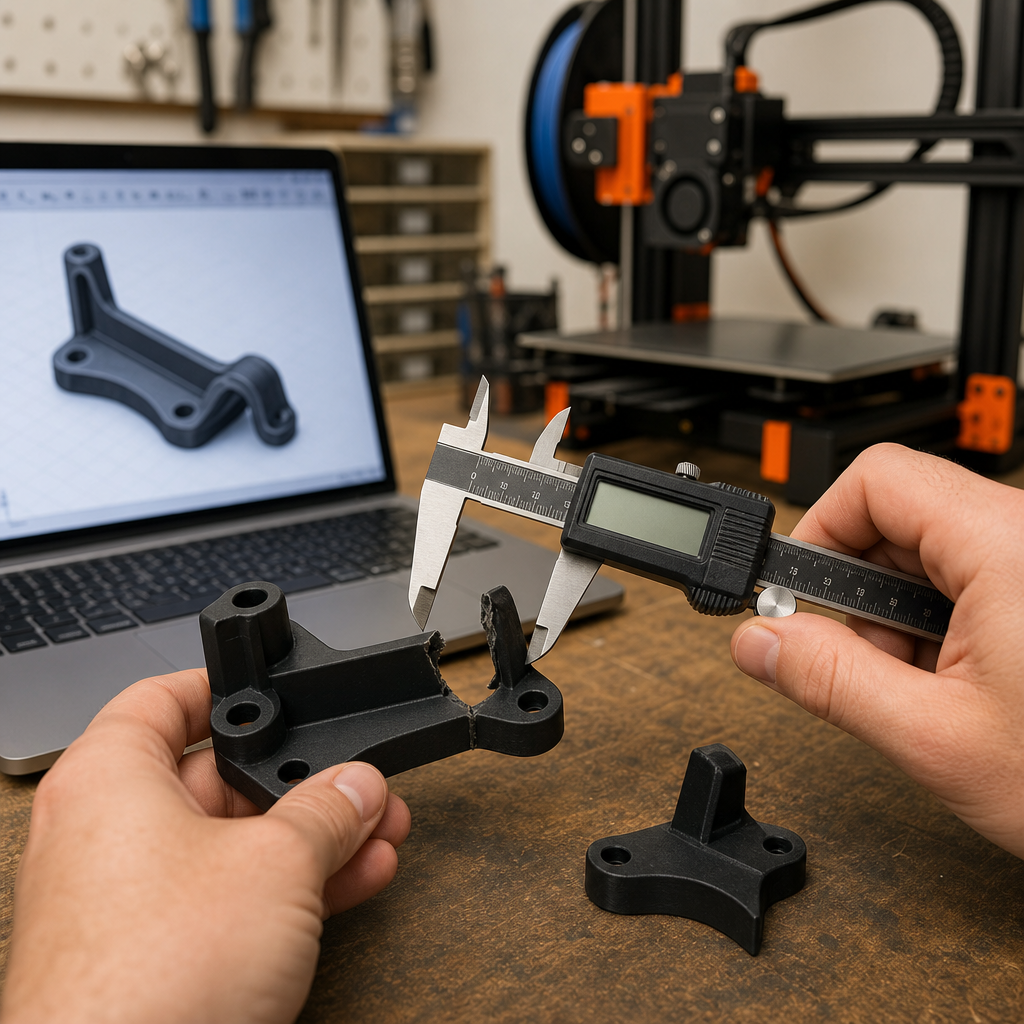
A scan is rarely a finished printable model by itself. Functional replacement parts often need careful measurement, CAD reconstruction, tolerances, and testing.
If your goal is a time-sensitive functional part, use the project intake form. A sketch, photograph, broken sample, STL, STEP, or OBJ file can be enough to begin evaluating the job.
What a beginner actually needs
- An assembled, inspected FDM printer with its current manual
- The slicer recommended by the manufacturer
- A spool of ordinary PLA from a consistent supplier
- A simple model with a broad, flat base
- A clean build plate and the manufacturer-approved cleaning method
- Flush cutters and a suitable print-removal tool
- Eye protection for trimming supports or brittle plastic
- A ventilated location with a stable surface and space around the printer
You do not need a drawer full of upgrades. Use the stock machine long enough to recognize a real limitation before replacing parts. For a deeper reference on tools, slicing, materials, calibration, and troubleshooting, see The Practical Guide to 3D Printing: 2026 Expanded Edition.
Kevin’s shop note: After years of printing functional parts and troubleshooting machines, I still get the best results by returning to a known-good profile, inspecting the first layer, and changing one variable at a time. Beginners do not need more settings—they need a repeatable baseline.
Build your first-print plan
Check each item before sending the file. If one answer is uncertain, pause and verify it in the printer or slicer documentation.
Your first 3D print, step by step
-
Read the setup and safety instructions
Confirm shipping restraints are removed, cables are seated, the machine is stable, and the correct mains voltage is selected if your model uses a manual selector. Complete the manufacturer’s initial calibration rather than following a random video for a different printer revision.
-
Choose a small, forgiving model
Pick a part that prints in less than two hours, has a flat base, and does not require supports. Avoid giant articulated models, tall narrow objects, tight assemblies, and safety-critical parts for the first attempt. When downloading a file, inspect its license, comments, successful makes, required hardware, and units.
-
Import and orient the model
Place the broadest useful face on the build plate. Orientation affects strength, surface quality, support needs, and print time. Because FDM parts behave differently along and across layer bonds, orientation becomes especially important for functional parts.
-
Use a conservative PLA profile
Select the profile for your exact printer, nozzle size, and material. Keep the manufacturer’s default temperatures and speeds for the first run. A 0.20 mm layer-height preset is a practical baseline for many standard 0.4 mm-nozzle machines, but your official profile takes priority.
-
Preview every layer before printing
Use the slicer preview to look for unsupported islands, an unexpected scale, missing walls, excessive supports, or a model floating above the plate. Confirm the selected printer, build plate, filament, and nozzle are correct.
-
Prepare the build surface
Handle the print area as little as possible. Finger oils can weaken adhesion. Clean the plate only with methods approved by its manufacturer, install it correctly, and run bed probing or leveling when the printer requires it.
-
Load filament and begin the print
Feed the filament through the correct path, keep the spool free to turn, and verify that material extrudes normally. Never reach near moving parts or the hot nozzle while the machine is operating.
-
Watch the entire first layer
Lines should adhere consistently and touch their neighbors without deep nozzle scraping or loose round strands. Stop the print if the material follows the nozzle, gathers into a blob, or the nozzle contacts the plate. Prusa’s model-specific first-layer calibration guide provides a useful visual reference for too-high, too-low, and correct lines; use your own manufacturer’s controls and values.
-
Let the part and plate cool
Many parts release more easily after cooling. Forcing a hot part can damage the surface or bend the print. Remove supports carefully, trim sharp edges, and inspect the object before use.
-
Record what happened
Save the model, slicer profile, filament, and result. One successful print is a baseline. If something failed, change one variable and run a small test instead of rebuilding the entire profile.
What the first layer is telling you
| What you see | Likely meaning | First response |
|---|---|---|
| Loose, round lines with gaps | Nozzle may be too far from the plate, surface may be contaminated, or extrusion may not be ready | Stop, clean as directed, and rerun the printer’s first-layer or bed calibration |
| Very thin or translucent lines; nozzle drags | Nozzle may be too close or the surface/profile selection may be wrong | Stop before damage; confirm plate type and calibration |
| Lines stick and gently meet | A healthy first-layer baseline | Continue watching for lifted corners or loose sections |
| One region looks good and another does not | Plate seating, contamination, mesh, or mechanical alignment may be uneven | Inspect and clean the plate, then follow model-specific leveling guidance |
The visual clues above align with manufacturer guidance: gaps commonly indicate insufficient contact, while ridges, scraping, or translucent lines can indicate excessive compression. Always use the calibration process for your exact printer and plate.
Common beginner problems—and the first thing to check
Print will not stick
Check the plate is correct, seated, clean, and calibrated. Then check first-layer height and material profile. Read why prints keep warping before adding adhesives or extreme temperatures.
Stringing
Confirm the filament is dry enough for use and the temperature matches the material. Use a small temperature or retraction test; do not change both at once.
Weak or separated layers
Check material temperature, cooling, speed, filament condition, and orientation. A mechanically loaded part may need redesign, not just a hotter profile.
Rough or incomplete surfaces
Inspect the sliced preview, nozzle condition, flow, filament path, and top-layer settings. Use the symptom-based troubleshooting guide for the next test.
Do not calibrate everything at once. Modern printers and current profiles often provide a useful baseline. Diagnose a visible symptom, consult documentation for your exact machine, test one likely cause, and keep notes.
Beginner safety basics
- Hotends and build plates can cause burns. Let parts cool before touching them.
- Keep hair, clothing, tools, children, and pets away from moving machinery.
- Operate the printer on a stable, nonflammable surface with appropriate ventilation.
- Do not leave a new or unproven setup running unattended.
- Stop using equipment that has damaged wiring, unusual heat, smoke, arcing, or a persistent electrical smell.
- Wear eye protection when cutting filament or supports. Cut away from your hands and body.
- A printed item is not automatically food-safe, medical-safe, child-safe, electrically safe, or suitable for structural loads.
- Follow the printer and material manufacturers’ instructions when they differ from general advice.
The concern is not limited to burns and moving parts. Desktop material-extrusion printers can release ultrafine particles and chemicals. The CDC/NIOSH guide to safer 3D printing in makerspaces and small businesses discusses ventilation, enclosure, filtration, material selection, and work-practice controls. PLA is beginner-friendly, but it is not a reason to print in an unventilated living or sleeping space.
Choose a useful second project
Your next part should add only one new challenge. If the first print was flat and simple, try a small overhang. If that works, try a basic two-piece fit. Save long bridges, threaded assemblies, flexible filament, engineering materials, and large multi-day prints for later.
If you want to design a replacement or mating part, begin with how to measure a part for 3D printing. Measurements, interfaces, and tolerances matter more than making the CAD model look impressive.
Use the P.R.I.N.T. Method™
- P — Problem
- State what the part must solve.
- R — Requirements
- List size, load, heat, environment, appearance, budget, and deadline.
- I — Interfaces
- Identify mating faces, fasteners, clearances, and measurement references.
- N — Next-Best Materials & Methods
- Select a material, process, orientation, and baseline profile that match the job.
- T — Test & Tune
- Prototype the riskiest feature, measure it, and change one variable at a time.
Quick knowledge check
Why should a first model have a broad, flat base?
It gives the print a forgiving contact area, reduces support needs, and lets you focus on first-layer quality instead of balancing several difficult variables.
When should you stop a first layer?
Stop if the nozzle scrapes the plate, filament follows the nozzle, a blob begins forming, or large sections fail to adhere. Correct the cause before restarting.
Why preview the sliced file?
The preview can reveal missing walls, unsupported islands, wrong scale, unexpected supports, floating geometry, and an incorrect printer or nozzle selection before material is wasted.
What is the best first troubleshooting rule?
Return to a known-good baseline, name the symptom, and change only one relevant variable per test.
Frequently asked questions
Is 3D printing difficult for a complete beginner?
The basic workflow is approachable when you use a current printer profile and a simple model. Designing precise functional parts, tuning unfamiliar materials, and diagnosing complex failures take more time.
What material should a beginner use first?
PLA is a practical starting material for many FDM printers because it generally prints at moderate temperatures and is available in well-tested profiles. Confirm that PLA is supported by your specific printer and build surface.
Do I need to design my own 3D model?
No. You can begin with a properly licensed model from a reputable library. Design skills become important when you need a unique fit, repair, or functional solution.
How long does a first 3D print take?
A useful beginner test can take less than two hours, but time depends on size, layer height, speed, and geometry. Use the slicer estimate as a planning aid, not an exact guarantee.
Can I leave my 3D printer running overnight?
Do not leave a new or unproven setup unattended. Follow the manufacturer’s operating guidance, keep safety features enabled, inspect the machine regularly, and use appropriate monitoring and fire-safety practices.
When should I use a 3D printing service instead?
Consider a service when you need one important part, lack a printable model, face a deadline, need a material your machine cannot handle, or expect the learning and equipment cost to exceed the project value.
What will you print first? Share the model, printer, or first-layer problem in the comments. Your question may help another beginner avoid the same mistake.