
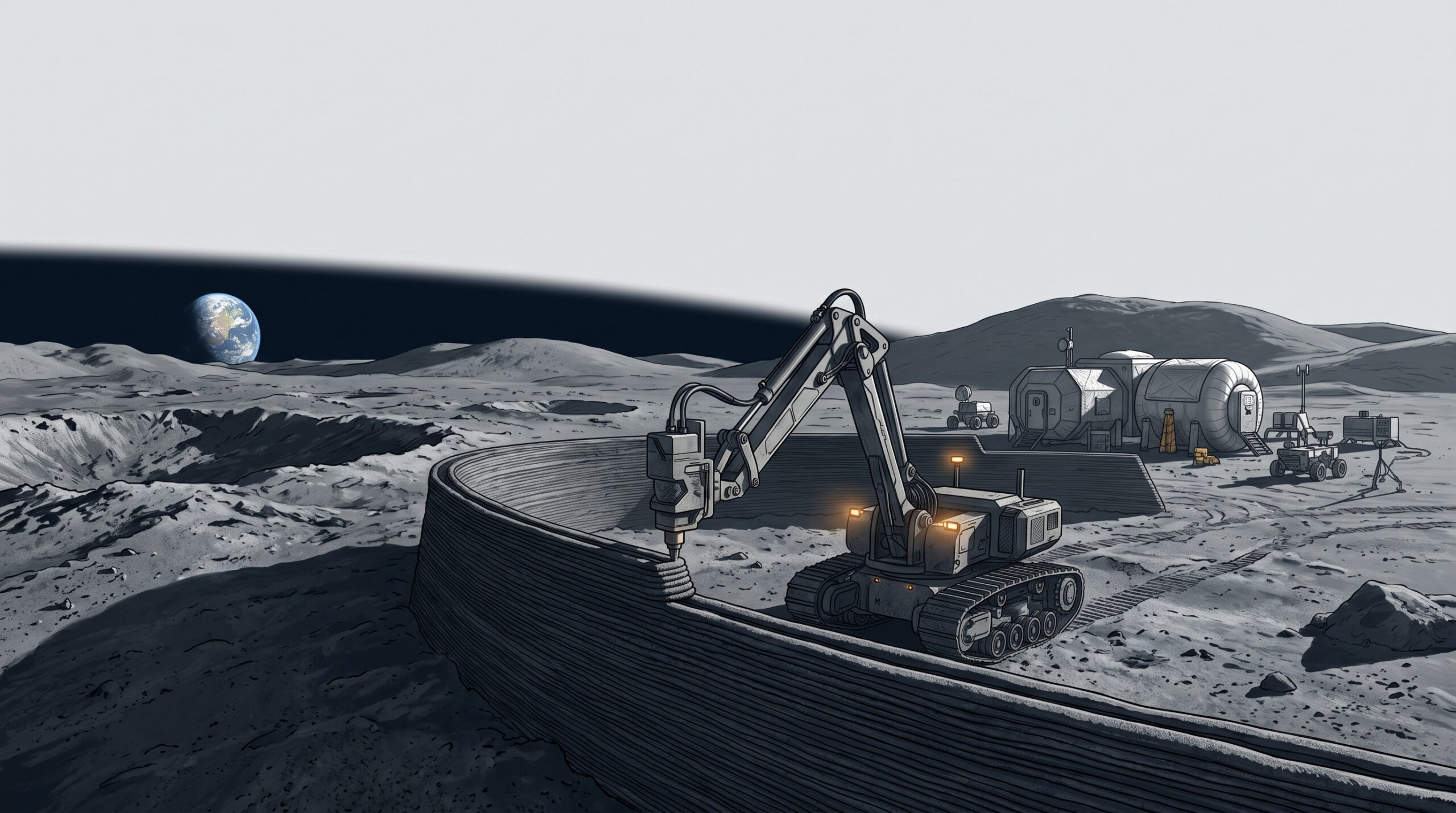
A future Moon base cannot depend on rockets delivering every wall, landing pad, road, and protective barrier from Earth. The mass would be expensive to launch, and replacement materials would always be a long trip away.
That is why lunar regolith—the loose rock, crushed minerals, and dust covering the Moon—has become a serious candidate for off-world construction. If robotic systems can collect and consolidate that material, astronauts may be able to build with what is already beneath their boots.
Quick Answer: Are 3D-Printed Lunar Bricks Really Stronger?
The UCF result is promising, but “stronger than concrete” is not an accurate summary. A University of Central Florida team produced lunar-regolith simulant samples that reached a compressive strength of 21.73 MPa after one hour of sintering at 1,200°C. That falls within the broad brick range cited by the researchers.
The study did not print a complete habitat or test an occupied structure on the Moon. Its specimens were molded to represent the green stage of binder jetting, then furnace-sintered and compression-tested on Earth.
What UCF’s Lunar-Brick Research Actually Tested
Associate Professor Ranajay Ghosh and colleagues at UCF studied how sintering temperature changes the structure, shrinkage, and compressive strength of specimens made from lunar and Martian regolith simulants. Their findings were published in Ceramics International under the title “Effect of sintering temperature on microstructure and mechanical properties of molded Martian and Lunar regolith.”
The distinction between a simulant and genuine lunar material is important. Apollo missions returned a limited quantity of lunar rocks and soil, so most Earth-based process development uses manufactured powders designed to reproduce relevant mineral and particle characteristics. UCF used LMS-1 lunar mare simulant and MGS-1 Martian global simulant supplied by its Exolith Lab.
UCF’s public summary described the work as combining 3D printing with binder jetting. The research paper provides a more precise account: the test cylinders were made in 3D-printed PLA molds. The loose regolith-and-binder mixture was gently packed rather than pressure-compacted so the resulting green parts would approximate the fragile state produced by a binder-jet process.
This is still relevant to additive manufacturing. Binder jetting deposits a liquid binder only where each powder layer should become solid. After printing, the fragile green part must normally be cured, depowdered, and sintered. UCF’s experiment concentrated on that last step: determining whether the regolith-based material could become strong enough to serve as masonry.
The Strength Result—and the Detail Headlines Missed
The specimens heated to 1,000°C and 1,100°C remained so brittle that useful compression data could not be collected. At 1,200°C, however, the lunar and Martian samples became solid enough for mechanical testing.
| Test material | Condition | Compressive strength | Dimensional change | What it means |
|---|---|---|---|---|
| LMS-1 lunar simulant | 1 hour at 1,200°C after presintering | 21.73 MPa (3.15 ksi) | 6.17% radial shrinkage; 18.13% height shrinkage | Brick-like strength, but substantial and direction-dependent shrinkage |
| MGS-1 Martian simulant | 1 hour at 1,200°C after presintering | 25.46 MPa (3.70 ksi) | 10.54% radial shrinkage; 16.03% height shrinkage | Slightly stronger than the lunar sample under the same test process |
| Lower-temperature samples | 1,000°C or 1,100°C for 1 hour | No reliable value reported | Roughly 1%–3% in the measured directions | Low shrinkage did not matter because the material remained too fragile |
The research paper cites a wide compressive-strength range of roughly 6–82 MPa for brick. That places the 21.73 MPa lunar-simulant result in the brick range—not automatically above concrete and certainly not three times stronger than every concrete mix.
Concrete, masonry, and sintered ceramic test pieces also cannot be compared honestly from a single headline number. Specimen geometry, density, porosity, loading direction, curing or firing process, and test standard all influence the result. A material that performs well in a small compression specimen may still crack under thermal cycling, impact, vibration, bending, or stress concentrations in a complete structure.
Why Sintering Made the Difference
A green binder-jetted part is not a finished part. The binder provides just enough cohesion for careful handling, but the powder particles have not formed the strong bonds required for structural use.
At high temperature, particles begin bonding and densifying without the entire object becoming a free-flowing liquid. In UCF’s lunar simulant, glass-rich basalt and pyroxene entered temperature ranges where significant consolidation could occur. The 1,200°C samples became stronger and glassier, but they also shrank dramatically.
That tradeoff is central to the research. If a future printer produces a wall segment at the correct digital dimensions but sintering reduces its height by nearly one-fifth, the part may no longer fit its neighbors. Engineers would need reliable compensation factors, controlled thermal gradients, consistent feedstock, and a way to prevent warping or cracking at a much larger scale.
The UCF samples also failed as brittle ceramics. During compression, a vertical crack formed and propagated rapidly. Compressive strength is valuable for blocks carrying loads, but brittle failure leaves little warning and limited ability to absorb movement. A lunar structure would require geometry, joints, redundancy, shielding, inspection methods, and possibly reinforcement—not merely stronger individual blocks.
Why Build With Regolith Instead of Shipping Materials From Earth?
The answer is in-situ resource utilization, usually shortened to ISRU. Instead of treating every mission as a closed supply chain from Earth, ISRU looks for useful local resources that can become oxygen, water, fuel, shielding, roads, landing surfaces, or construction feedstock.
NASA’s Moon to Mars Planetary Autonomous Construction Technology project is exploring large-scale robotic construction with simulated lunar and Martian material. The target is broader than crew cabins. Stable landing pads can reduce high-velocity dust kicked up by rocket exhaust. Roads and berms can control traffic and shield equipment. Thick regolith structures may also become part of a larger radiation- and micrometeoroid-protection strategy.
This is the industrial version of a principle that also matters in desktop printing: additive manufacturing is most valuable when it reduces logistics, consolidates functions, or creates geometry that another method cannot make efficiently. For a broader look at those applications, see 3D Printing: The Future Is Now—2026 Technology Guide.
The Moon Does Not Harden These Bricks for Free
One of the most important corrections to the earlier article is the energy requirement. UCF’s strong lunar-simulant specimens did not harden simply because they were exposed to a lunar-like environment. They were processed in a furnace, including a one-hour presinter at 200°C and a one-hour high-temperature cycle at 1,200°C.
Other researchers have demonstrated different approaches, including concentrated-solar sintering without an imported binder. That is a separate process with its own control, scale, and energy-storage challenges. Sunlight may be the energy source, but collection optics, positioning systems, thermal management, and robotic hardware are not free.
NASA has also described laser-based systems that melt regolith into ceramic-like material, as well as extrusion and contour-construction concepts that combine regolith with a binder. No single route has yet become the proven, end-to-end method for building an occupied lunar base.
| Construction route | How it consolidates regolith | Potential advantage | Major challenge |
|---|---|---|---|
| Binder jetting + sintering | Deposits binder into a powder bed, then fires the green part | Fine geometry and no high-power laser during printing | Fragile green parts, binder supply, depowdering, high-temperature shrinkage |
| Solar sintering | Concentrated light heats and fuses regolith | Can reduce or eliminate imported binder | Thermal control, illumination limits, speed, and consistency |
| Laser melting or vitrification | High-powered lasers melt selected material | Strong ceramic-like surfaces and localized processing | Power demand, optics contamination, cracking, and scale |
| Extrusion / contour construction | Places a regolith-based mixture through a nozzle | Well suited to large walls, berms, and pads | Rheology, binder sourcing, nozzle wear, layer bonding, and curing |
What a Real Lunar Structure Still Has to Survive
A laboratory compression test answers one narrow question. A useful Moon structure must survive a complete operating environment.
- Temperature swings: NASA reports that temperatures near the lunar equator can exceed 121°C in daylight and fall near −133°C after nightfall. Repeated expansion and contraction can damage materials, joints, and seals.
- Vacuum: Materials may release trapped gases, lubricants can behave differently, and a pressurized habitat places outward loads on the pressure vessel.
- Abrasive dust: Lunar particles are sharp, electrostatically charged, and damaging to seals, mechanisms, spacesuits, radiators, cameras, and lungs. NASA’s Electrodynamic Dust Shield demonstration on the Moon showed how seriously the agency treats dust control.
- Radiation and impacts: The Moon’s exosphere and weak magnetic field do not provide Earth-like protection from solar particles, cosmic rays, or small impacts.
- Feedstock variability: Regolith composition and particle distribution change by location. A process tuned for one simulant may not transfer directly to another site.
- Power and maintenance: Furnaces, lasers, excavators, printers, and robots must operate with limited energy and without a nearby repair depot.
The UCF study did not test vacuum exposure, lunar thermal cycling, radiation attenuation, micrometeoroid impact, long-term fatigue, or a pressurized enclosure. Regolith has been investigated as shielding mass, but that does not mean these specific samples were proven to block radiation.
Water ice has been detected in permanently shadowed regions near the lunar poles, which makes local water and binder production conceivable. Extracting, purifying, transporting, and allocating that water would still be a major system-level decision. A saltwater binder that works in a terrestrial laboratory is not automatically the best use of a scarce lunar resource.
What Desktop 3D-Printer Owners Can Learn From Lunar Bricks
The scale is extraordinary, but the engineering lessons are familiar to anyone who has made a functional print.
1. The machine does not determine final strength by itself
Feedstock, particle size, binder ratio, process temperature, geometry, porosity, and post-processing all influenced the UCF result. On an FDM printer, the comparable variables include material, moisture, layer adhesion, wall count, orientation, temperature, and cooling. “3D printed” describes a manufacturing route—not a guaranteed material property.
2. Post-processing can change dimensions
UCF’s lunar samples lost 18.13% of their height at the strongest tested condition. Binder-jetted metals and ceramics are commonly scaled to compensate for sintering, but compensation only works when shrinkage is repeatable. Desktop makers see a smaller version of the same problem when annealing, curing, sanding, coating, or heat-forming alters fit.
3. Compression strength is not the whole design
A brittle block can carry a strong compressive load and still fail suddenly from a crack, impact, or poorly designed interface. Useful parts must be evaluated for the actual load direction and failure consequence.
4. Test the finished process, not the promising intermediate
The unsintered green parts were easy to form but too fragile to serve as masonry. A visually successful print is also only an intermediate result until fit, load, temperature, weather exposure, or wear has been checked.
If you are learning how these choices connect in everyday projects, start with 3D Printing for Absolute Beginners. For a complete reusable planning system, P.R.I.N.T. It Practical: 3D Printing for Beginners covers materials, slicing, calibration, testing, and troubleshooting.
The P.R.I.N.T. Planner for Lunar Construction
Kevin’s P.R.I.N.T. Method™ is designed for practical desktop projects, but it also exposes why a “strong brick” is only the beginning of a construction system.
The framework forces a useful question: better for which job? A material suited to an unpressurized landing-pad tile may not be right for a habitat shell. A printed regolith wall may work best as external shielding around a separate airtight pressure vessel rather than as the vessel itself.
Where Lunar 3D Printing Stands in 2026
The field has moved beyond a single brick experiment. NASA, ESA, universities, and commercial teams have demonstrated regolith simulant processing through binder-based printing, solar sintering, lasers, and large-scale robotic deposition. NASA’s MMPACT work is explicitly investigating infrastructure such as habitats, radiation shielding, roads, and launch or landing pads.
Yet the technology remains in development. No occupied lunar building has been 3D printed from local regolith. Engineers still need reliable excavation, material preparation, power generation, construction robotics, dimensional control, joining methods, inspection, repair, dust mitigation, and environmental qualification.
UCF’s contribution matters because it puts real numbers behind one part of that chain. The study showed a path from loose simulant and a simple binder to a brittle but genuinely load-bearing ceramic material. It also exposed the cost of that strength: high heat and substantial shrinkage.
Frequently Asked Questions
What is lunar regolith?
Lunar regolith is the layer of loose rock fragments, mineral grains, and fine dust covering the Moon. With no weathering system like Earth’s, impact processes help create sharp, abrasive particles that can damage equipment and threaten human health.
Were UCF’s test pieces made from real Moon dust?
No. The team used LMS-1 lunar mare simulant from UCF’s Exolith Lab. Simulants reproduce selected characteristics of lunar material so researchers can develop and compare processes without consuming scarce Apollo samples.
Were the UCF lunar bricks completely 3D printed?
The public UCF story connects the work to binder jetting, but the published experiment used 3D-printed PLA molds. Researchers gently packed a regolith-and-saltwater mixture into those molds to replicate the green state expected from binder jetting, then sintered the samples.
Are lunar-regolith bricks three times stronger than concrete?
That claim is not supported by the UCF paper. The lunar-simulant specimens reached 21.73 MPa in compression at the strongest tested condition. The researchers described the result as within the range of brick. Concrete strength varies widely, and direct comparisons require matched specimens and test conditions.
Can the lunar environment harden the bricks without energy?
No. UCF’s strongest specimens required high-temperature furnace sintering at 1,200°C. Separate projects have tested concentrated sunlight as an energy source, but those systems still require collection, control, equipment, and careful processing.
Could regolith bricks form the airtight wall of a Moon habitat?
Possibly as one part of a future system, but the UCF result does not establish that use. Many concepts place regolith-based walls or shells around a separately manufactured pressure vessel so the local material provides mass, shape, and shielding while delivered components provide airtightness and life-support interfaces.
Knowledge Check: Can You Separate the Result From the Hype?
Could Today’s Research Become Tomorrow’s Moon Base?
Yes—but only if researchers solve the complete chain from excavation to inspection. UCF’s work shows that lunar simulant can become masonry-strength ceramic after the right thermal cycle. It also warns us that low-temperature parts may crumble, high-temperature parts may shrink, and strong parts can still fail in a brittle way.
That combination of promise and constraint is what good additive-manufacturing research looks like. The goal is not to make the most dramatic claim. It is to identify the next failure mode before astronauts depend on the result.
What Should Robots Build First?
If autonomous lunar construction became available, would you prioritize a landing pad, a dust-control berm, a road, an equipment shelter, or shielding around a crew habitat? Share your choice—and the engineering reason behind it—in the comments.
Research Sources
- University of Central Florida: UCF Researchers Create Lunar Regolith Bricks
- Warren et al.: Effect of Sintering Temperature on Molded Martian and Lunar Regolith
- NASA: Construction Technology for Moon and Mars Exploration
- NASA Science: Weather on the Moon
- NASA Science: Hazards Caused by Lunar Regolith
Editorial note: This research-focused article does not include a product affiliate link because no current 3D-printing product is directly relevant to the UCF experiment.
