
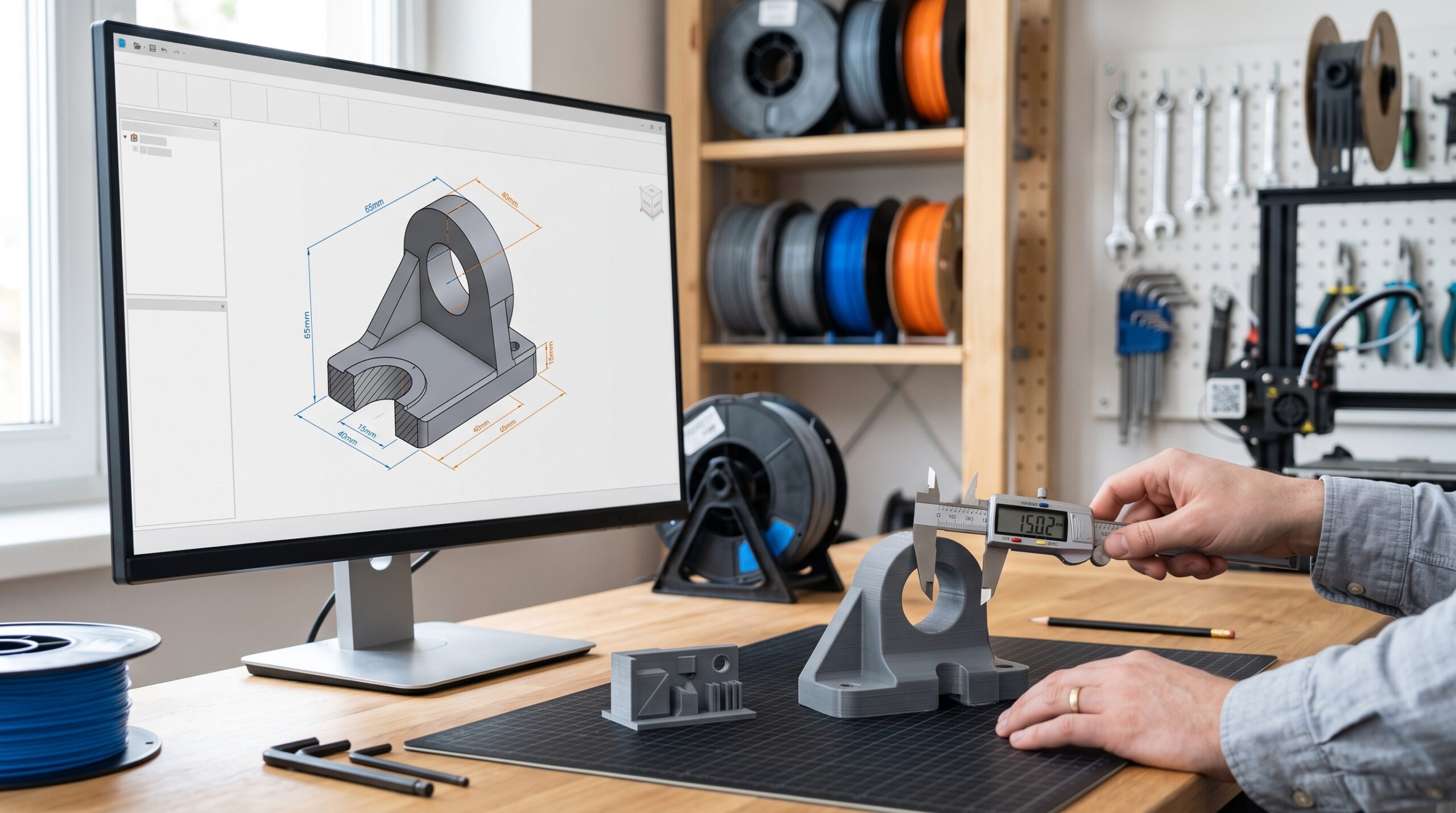
Most manufacturers do not need a 3D printer to replace every machine on the production floor. The real opportunity appears when a conventional process becomes slow, expensive or inflexible because of tooling, low quantities, design changes or hard-to-find replacement parts.
That is where additive manufacturing can change the decision. A digital model can become a physical prototype, fixture or selected production part without first machining a dedicated mold or die.
Quick answer: How is 3D printing changing industry?
3D printing is changing industry in five practical ways:
- Faster design iteration: Teams can test physical ideas before committing to production tooling.
- Custom tooling: Factories can produce jigs, fixtures, guides and inspection aids for a specific operation.
- Low-volume production: Short runs and customized parts can be made without spreading tooling costs across thousands of units.
- Complex and personalized designs: Additive processes can produce internal channels, lattice structures and patient-specific geometry.
- On-demand replacement parts: Controlled digital files can support legacy equipment without keeping every physical spare on a shelf.
The important limitation is that 3D printing does not automatically make a part cheaper, faster, stronger or more sustainable. Its value depends on the geometry, quantity, material, process, inspection requirements and consequences of failure.
What does 3D printing mean in manufacturing?
3D printing, or additive manufacturing, creates an object from digital geometry by joining or solidifying material—usually layer by layer. Depending on the process, the material may be thermoplastic filament, liquid photopolymer, metal powder, polymer powder, wire, concrete or another feedstock.
The U.S. Department of Energy explains the basic additive process as placing material only where the digital model requires it. Conventional subtractive manufacturing takes the opposite approach by cutting material away from a larger piece.
Neither approach is automatically better. Machining, molding, casting and forming remain essential. Additive manufacturing expands the set of practical options available to the designer and manufacturer.
1. Physical prototypes arrive earlier in the design cycle
The change: From waiting for tooling to testing the idea
Before a company invests in a mold, die or production fixture, it needs evidence that the product fits, works and can be assembled. A 3D-printed prototype can expose problems that are difficult to recognize on a screen.
Designers can evaluate enclosure size, hole placement, ergonomics, cable routing, clearances and assembly order. The model can then be revised and printed again without rebuilding dedicated tooling for every version.
Where this helps most: early design development, fit checks, customer demonstrations, ergonomic studies and low-risk functional testing.
Watch the limitation: A prototype printed in PLA does not prove that a final molded, machined or metal component will perform the same way. The test must match the question being asked.
This faster physical feedback can prevent an expensive mistake from reaching production. It can also help a smaller company communicate an idea to customers, suppliers or investors before committing to a large order.
2. Jigs, fixtures and manufacturing aids become easier to customize
The change: Tooling can be designed around the worker and the operation
Some of the most valuable industrial prints never become part of the product. They hold, guide, align, protect or inspect something else.
Common examples include:
- Assembly fixtures that position two components consistently.
- Drill guides and trimming templates.
- Soft jaws, protective covers and custom grippers.
- Go/no-go gauges for checking a critical feature.
- Tool holders and shadow-board inserts.
- Ergonomic handles for repetitive tasks.
NIST identifies customized jigs and fixtures as an established additive-manufacturing application. These tools are often a sensible starting point because they can deliver value without immediately placing a printed component inside a safety-critical product.
Where this helps most: operations with frequent changeovers, specialized workholding, short product cycles or repetitive tasks that would benefit from a better-fitting tool.
Watch the limitation: Printed tooling still needs the correct stiffness, temperature resistance, wear surface, dimensional accuracy and hardware. A poorly chosen material can soften, creep or wear before the job is finished.
3. Low-volume and bridge production become more practical
The change: Quantity no longer has to justify a dedicated mold
Injection molding can produce excellent plastic parts at a low unit cost once the tooling exists and production volume is high enough. The difficulty appears when a business needs 10, 50 or 200 parts instead of tens of thousands.
Additive manufacturing can remove the initial mold from that equation. This may make short runs, customized parts and bridge production economically possible while a final design is being validated or conventional tooling is being built.
Useful applications can include:
- Small batches of brackets, mounts, covers and adapters.
- Pilot products used to test market demand.
- Replacement components for equipment with a limited installed base.
- Production parts that vary by customer, location or machine.
- Temporary parts that keep a process operating while a permanent component is sourced.
Where this helps most: low quantities, frequent design changes, high product variation and situations where avoiding a large minimum order matters more than achieving the lowest possible unit price.
Watch the limitation: Printing every part separately can become slower and more expensive as quantity increases. Repeatability, machine capacity, finishing, inspection and failed-build risk must be included in the estimate.
For a practical example, see how discontinued plastic parts can be evaluated for custom replacement.
4. Designers can use geometry that conventional tools struggle to produce
The change: Manufacturing constraints become different—not nonexistent
Additive manufacturing can build curved internal passages, lattice structures, topology-optimized shapes and consolidated assemblies that may be difficult to machine or mold as one component.
In aerospace, NASA has demonstrated this potential through work on additively manufactured rocket-engine components and printable aluminum alloys. The value is not simply that a part was printed; it is that the material and process were developed, tested and qualified for a demanding use.
Healthcare provides another example. The FDA lists patient-specific devices, orthopedic and cranial implants, surgical instruments, dental restorations and external prosthetics among the medical applications of 3D printing.
Where this helps most: high-value components where weight, flow, customization or part consolidation creates enough benefit to justify the process.
Watch the limitation: Complexity is not automatically useful. Internal passages may be difficult to clean or inspect. Metal builds may require support removal, heat treatment, machining and nondestructive evaluation. Medical and aerospace applications also require formal regulatory and qualification pathways.
5. Replacement inventory can move from shelves to controlled digital files
The change: Some slow-moving spares can be produced when needed
Traditional spare-parts programs require a manufacturer to predict demand, purchase inventory and store components that may remain untouched for years. If the supplier disappears or the tooling is discarded, a small plastic part can become impossible to obtain.
With a suitable CAD model, material specification and documented production process, a company may be able to manufacture selected spares closer to the point of need. This approach is often described as digital inventory or on-demand manufacturing.
Legacy parts may begin with an original CAD file, a surviving sample, measurements, photographs or reverse engineering. However, capturing the outside shape is only the beginning. Critical interfaces, clearances, load direction and environmental exposure still need to be understood.
Where this helps most: slow-moving service parts, older equipment, remote operations and components for which downtime costs more than the printed replacement.
Watch the limitation: A folder full of STL files is not a controlled inventory system. Companies still need revision control, file security, intellectual-property permission, material records, approved process settings and inspection criteria.
Where different manufacturing methods still win
| Production need | Where 3D printing may win | Where a conventional process may win |
|---|---|---|
| Early prototype | Fast revision without dedicated tooling | Final-process prototype when exact production behavior must be tested |
| Jig or fixture | Custom geometry, low quantity and rapid replacement | Heavy loads, high heat, extreme wear or very long service life |
| Small customized batch | No mold and economical product variation | Simple geometry with a stable, repeatable high-volume order |
| Complex high-value part | Internal channels, lattices and part consolidation | Simple geometry that can be machined, cast or formed efficiently |
| Legacy spare part | Low demand and unavailable tooling or inventory | Standard replacement already available, tested and inexpensive |
| Mass production | Limited cases involving high customization | Injection molding, stamping, casting or another optimized high-volume process |
Important reality check: 3D printing is not automatically greener
Additive manufacturing can reduce raw-material waste when it replaces a process that cuts away a large amount of material. It can also support lighter parts, local production and repairs that extend product life.
However, it does not produce “zero waste.” Support structures, test pieces, failed prints, purge material, powder handling, energy use and post-processing all affect the final environmental result.
A responsible comparison examines the complete job: material sourcing, production energy, yield, transportation, service life, repairability and end-of-life handling.
Is 3D printing a good fit for your business?
Promising signs
- Tooling cost dominates a low-volume project.
- The design is likely to change.
- Every customer needs a variation.
- A custom fixture could reduce setup time or errors.
- A discontinued part is causing expensive downtime.
- Complex geometry creates a measurable performance benefit.
Reasons to slow down
- The part is simple and required in very high volume.
- An inexpensive approved replacement already exists.
- The material cannot tolerate the real environment.
- There is no practical inspection or qualification plan.
- The consequences of failure are not understood.
- The business case depends only on the printer’s purchase price.
Use the P.R.I.N.T. Method™ before choosing a process
A printer should not be the first decision. Kevin’s P.R.I.N.T. Method™ keeps the project centered on what the finished part must accomplish.
Problem: Identify the delay, failure, inventory burden, design question or production bottleneck you are trying to solve.
Requirements: Record quantity, load, temperature, chemicals, weather, appearance, service life, regulations and the consequences of failure.
Interfaces: Measure every hole, shaft, fastener, mating surface, clearance and assembly relationship the part must fit.
Next-Best Materials & Methods: Compare printing with machining, molding, fabrication, repair or purchasing an existing component.
Test & Tune: Begin with the smallest useful prototype, inspect it, test it under real conditions and document controlled revisions.
For the complete beginner-friendly system, explore P.R.I.N.T. It: Practical 3D Printing for Beginners.
A practical five-step industrial pilot
- Choose one contained problem. A fixture, prototype or noncritical replacement part is usually easier to evaluate than an entire production line.
- Measure the current cost. Include purchasing time, tooling, inventory, downtime, labor and rejected parts.
- Produce a controlled test. Record the file revision, material, orientation, machine, settings and finishing steps.
- Inspect the result. Check dimensions, fit, repeatability and performance in the real environment.
- Compare the total outcome. Decide using lead time, lifetime cost, quality and risk—not novelty.
Knowledge check: Where does additive manufacturing fit?
1. Why can 3D printing be attractive for a frequently revised prototype?
2. Which is often a practical first industrial application?
3. Which statement about sustainability is most accurate?
4. What does a dependable digital inventory require beyond a printable file?
Frequently asked questions
Are 3D printing and additive manufacturing the same?
The terms are often used interchangeably. Additive manufacturing is the broader industrial term covering processes that build objects from digital data by joining or solidifying material. “3D printing” is the more familiar public term.
Will 3D printing replace injection molding?
Not broadly. Injection molding remains highly efficient for large quantities of repeatable plastic parts. Printing is more competitive when quantities are low, designs change frequently or every part requires customization.
Are 3D-printed parts stronger than traditionally manufactured parts?
Sometimes, but not automatically. Strength depends on material, geometry, orientation, process control, porosity, heat treatment and load direction. A printed part should be evaluated against its actual requirements.
Which industries use additive manufacturing?
Applications exist in aerospace, automotive, healthcare, dental manufacturing, consumer products, architecture, tooling, energy and general manufacturing. The specific application matters more than the industry label.
Can a small manufacturer benefit from 3D printing?
Yes. Jigs, fixtures, prototypes, inspection aids, replacement parts and short production runs can offer a manageable entry point without requiring a complete factory transformation.
Does 3D printing eliminate material waste?
No. It may reduce waste compared with some subtractive processes, but supports, failed prints, test pieces, purge material and post-processing still matter.
What is digital inventory?
Digital inventory stores controlled manufacturing data so selected parts can be produced when needed. A reliable system includes approved files, revisions, material specifications, production instructions and inspection requirements.
What should a company 3D print first?
Begin with a contained, measurable problem such as a prototype, assembly fixture, tool holder or noncritical replacement part. Compare the result with the current cost, lead time and performance before expanding the program.
Have a practical part or prototype in mind?
3D Printing by Kevin evaluates replacement parts, brackets, mounts, prototypes, fixtures and suitable small-batch projects. You can begin with a file, drawing, measurements, photographs or a description of the problem.
Start a Project Review Explore the P.R.I.N.T. It EbookFinal takeaway
3D printing is not changing industry by making every established process obsolete. It is changing the questions manufacturers can ask.
Can we test this design before ordering tooling? Can we build a fixture around the worker? Can we produce 25 parts without ordering 2,500? Can we combine these components? Can we make a discontinued replacement when the original supplier has moved on?
When the answer creates measurable value—and the material, process and testing support the job—additive manufacturing earns its place.
Which of these five changes would make the biggest difference in your work: faster prototypes, custom tooling, short production runs, complex parts or on-demand replacements? Share your example in the comments.
Start small. Print useful. Keep learning.

Hey, I find your article very interesting, and I have a question about healthcare. What do you think will be possible to print in 20 years? Maybe already organs? I find this direction of 3D printing the most interesting because you can save people’s lives with it. I also wanted to know where you think 3D printing can be used in the future in the automotive industry?
Hello Lou, I think it will be like a Star Trek Show; 3D printing is and will be able to make just about anything a person wants. You only need your imagination and a 3D printer to bring it to life.
3D technology can be one of the biggest game-changers in manufacturing, from Custom jewelry, making kids’ doll house furniture to making houses! For a living has been demonstrated in Japan and may come to market soon. The medical industry has used this technology to make artificial limbs, prototypes, and more.
It is used to help make garden stuff like planters and furniture in various designs. I am unsure if I have seen many easily accessible, cost-effective 3D printing outfits to help out.
I can visualize a durable luggage carrier for traveling. Custom manufactured eco-friendly home organizers and garden equipment. I am not thorough about what is out there. I haven’t seen many advertisements for 3D printing.
Thank you for this article. It offers knowledge about what could be done using 3D printing.
Are there business shows where there are demonstrations of 3D printing products?
Hello Anusuya, Thanks for stopping by! Here is the link for the latest Additive Manufacturing Trade Shows.