
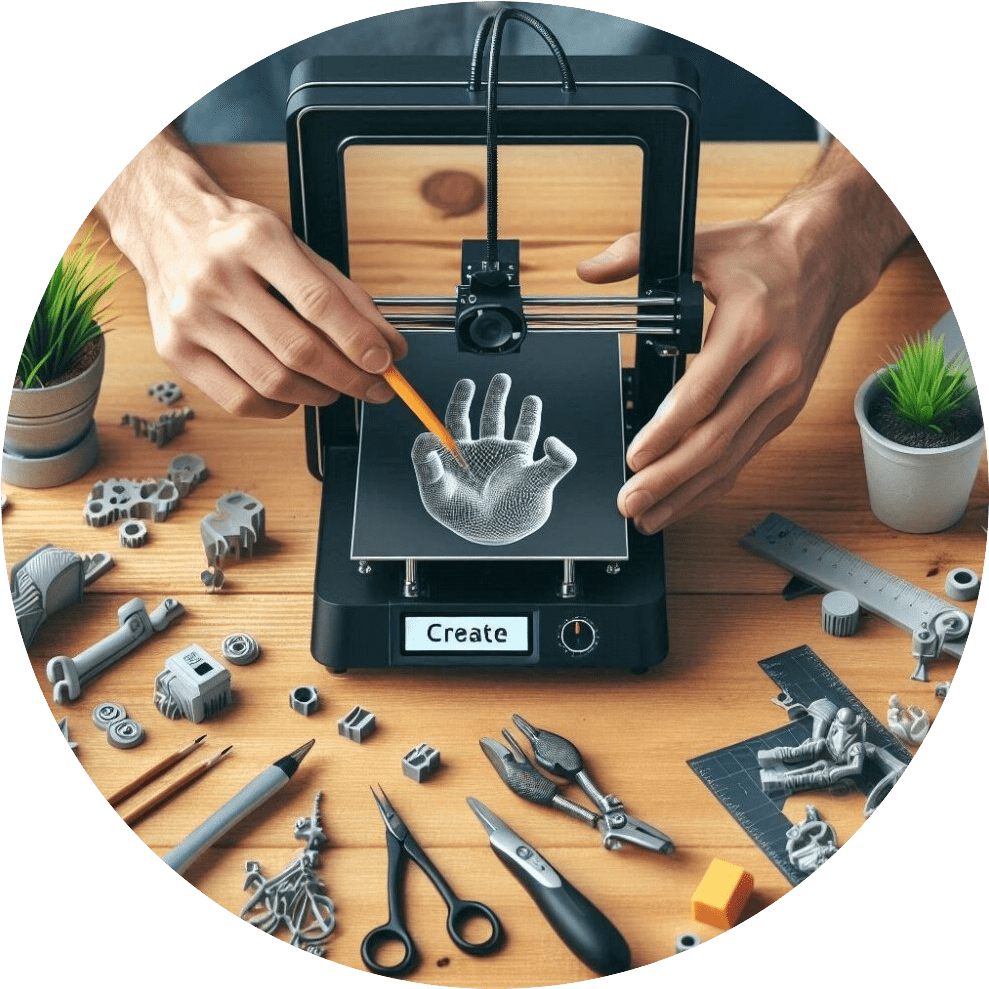
The most important thing about a 3D printer is not that it can make almost any shape. It is that the machine lets a person test an idea, hold the result, find the weak point, and improve the design without waiting for mass production.
That shorter path between problem and solution is changing workshops, classrooms, medical-device development, aerospace engineering, and small businesses. It is also giving home makers a practical way to build organizers, prototypes, replacement parts, fixtures, and one-off tools.
Quick answer: Why do 3D printers matter?
3D printers make low-volume, customized, and frequently revised objects easier to produce. They are especially valuable when the design may change, the geometry is difficult to machine, a discontinued part is unavailable, or only a few pieces are needed.
They do not replace every saw, mill, mold, or production line. Their future lies in becoming another dependable manufacturing tool—one that works best when the part, material, process, and test plan are chosen for the actual job.
What 3D printers changed about making
Traditional manufacturing often rewards volume. Tooling, molds, fixtures, and setup become easier to justify when a company expects to make hundreds or thousands of identical pieces.
3D printing changes that calculation. A digital model can become one physical part without first producing a dedicated mold, and the next part can contain a design revision without rebuilding an entire production system.
Ideas become testable
A screen image can hide scale, grip, clearance, and assembly problems. A printed prototype makes those problems easier to see and measure.
One-off parts become realistic
A clip, bracket, spacer, cover, or alignment guide may be valuable even when nobody needs a thousand of them.
Customization costs less to begin
Dimensions, labels, mounting features, and ergonomics can be adjusted in the digital design before the next build.
Small teams gain capability
A home shop, classroom, or small business can build useful test parts without owning a complete conventional machine shop.
The National Institute of Standards and Technology describes additive manufacturing as building an object layer by layer. That simple definition covers many processes, from familiar desktop filament printers to industrial systems that fuse metal powder.
How a 3D printer turns an idea into an object
A printer does not invent the part. It follows a toolpath generated from a digital model. The real workflow includes decisions before and after the machine moves.
For a typical FDM or FFF desktop printer, the machine heats thermoplastic filament and deposits it in thin paths. Other systems cure liquid photopolymer, fuse powder, jet binder, or add material with directed energy.
If you are new to the desktop workflow, start with the step-by-step 3D printing guide for absolute beginners. It explains the model-to-slicer-to-printer sequence, first-layer checks, basic safety, and a manageable first project.
Kevin’s shop note
After years of designing and printing functional parts, I have learned that the machine is only one part of the result. Fit, orientation, wall design, material behavior, and testing often matter more than the speed number printed on the box.
A successful print is not simply an object that finished. It solves the problem it was designed to solve.
Where 3D printers create practical value today
Rapid prototypes that answer physical questions
A prototype can reveal whether a handle feels comfortable, a housing closes, a cable clears an edge, or two parts align. Printing a small test section can answer one uncertain question before time and material are committed to the complete object.
This is where 3D printing often earns its place: not by producing the final product immediately, but by helping the designer make the next decision with evidence.
Discontinued and unavailable plastic parts
When a manufacturer stops supporting an older product, a small plastic component can sideline an otherwise useful machine, appliance, or tool. If the part can be measured, modeled, printed in an appropriate material, and tested safely, local production may offer a practical path forward.
Read the complete workflow for replacing discontinued plastic parts with 3D printing. Safety-critical, heavily loaded, high-temperature, pressure-containing, and regulated parts require extra caution and may not be suitable for desktop printing.
Jigs, fixtures, holders, and shop aids
Production tools do not need to be sold to a consumer to create value. A drill guide, assembly nest, inspection fixture, soft jaw, alignment block, or labeled tool holder can make repeated work faster and more consistent.
These applications are often less glamorous than a complex display model, but they are among the clearest examples of practical additive manufacturing.
Low-volume customization
A conventional process may be faster for a large run of identical parts. Printing becomes more competitive when dimensions vary, the quantity is small, or the design is still evolving.
That makes the technology useful for prototypes, ergonomic aids, custom mounts, enclosures, educational models, and short-run parts whose value comes from fit rather than volume.
Hands-on learning
Students can move from measurement and CAD to a physical result, then compare what they intended with what the machine produced. The best classroom projects teach iteration, material limits, documentation, and safe equipment habits—not merely how to download and print a decorative file.
Real industries already using additive manufacturing
The future of making is not a single dramatic breakthrough. It is the steady expansion of applications where digital design, complex geometry, customization, or shorter development cycles create a measurable advantage.
Healthcare and medical devices
The U.S. Food and Drug Administration lists 3D-printed medical applications that include orthopedic and cranial implants, surgical instruments, dental restorations, and external prosthetics. The same FDA overview of 3D-printed medical devices explains that patient-specific geometry and complex internal structures are important advantages.
That is very different from claiming hospitals can routinely print complete transplantable organs. Bioprinting and tissue-engineered constructs remain active research areas. Regulated devices also require design controls, validated processes, material documentation, and appropriate oversight.
Aerospace and propulsion
Additive manufacturing can consolidate assemblies, create internal passages, and produce geometries that are difficult to machine. NASA reported a successful hot-fire test of an aluminum 3D-printed rocket-engine nozzle and described how printable alloy development could reduce time, weight, and cost for future applications.
The NASA engine-nozzle project also shows why material science and qualification matter. Industrial metal printing is not simply a larger version of placing plastic filament on a desktop build plate.
Manufacturing and supply support
Manufacturers use additive processes for prototypes, production aids, replacement components, casting patterns, and qualified end-use parts. The attraction is strongest when geometry, lead time, part consolidation, or low volume outweigh raw printing speed.
NIST continues to work on the measurements and standards needed for broader industrial adoption. Process variability, surface finish, accuracy, material properties, and qualification remain real engineering concerns rather than minor setup details.
Construction, fashion, and food
Large-scale concrete systems, printed textiles or accessories, and deposited food products demonstrate the breadth of the idea. However, these specialized machines use very different materials, controls, codes, and post-processing steps.
A printed wall does not equal a finished house, and a printable ingredient does not automatically make a complete meal. The practical question is always the same: Which part of the workflow improves when material is placed digitally?
When is 3D printing the right manufacturing tool?
| Need | Often the better starting point | Why |
|---|---|---|
| One functional prototype or fit test | Desktop or service-based 3D printing | No dedicated mold; digital revisions can be tested quickly. |
| A few customized brackets, covers, or fixtures | 3D printing | Low quantity and changing dimensions favor a flexible process. |
| Hundreds or thousands of identical simple plastic parts | Injection molding after validation | Tooling costs more upfront, but cycle time and unit economics can win at scale. |
| Flat profiles cut from sheet | Laser, waterjet, router, or conventional fabrication | A layer-by-layer build may add time without adding useful geometry. |
| Precision metal part with demanding loads | Machining, casting, qualified metal AM, or a hybrid route | Material properties, tolerance, inspection, and certification drive the choice. |
| Highly detailed miniature or presentation model | Resin printing or a specialist service | Fine features and surface detail may matter more than toughness. |
The best process may be hybrid. A company can print a prototype, machine critical interfaces, use threaded inserts or standard hardware, and move to molding only after the design is stable. The printer does not need to make every feature to improve the project.
The limits that responsible makers should respect
A printable shape is not automatically a usable part
Layer direction, wall count, geometry, temperature, moisture, and process consistency all affect performance. A part that looks excellent may still fail at a thin corner, fastener hole, layer boundary, or heat-exposed surface.
For functional work, test the real interfaces and loads. Do not use a desktop print as an unreviewed substitute for a certified automotive, lifting, pressure, electrical, medical, food-contact, or structural component.
Speed depends on the entire workflow
A printer may produce one revision overnight, yet modeling, slicing, support removal, finishing, measurement, and reprinting still take time. Fast motion does not repair an unsuitable orientation or an incomplete design.
Sustainability is conditional
Additive processes can reduce scrap for some geometries and may support local or on-demand production. They also consume energy, create failed parts and support material, and use feedstocks with different environmental impacts.
The U.S. Department of Energy evaluates additive manufacturing across material, manufacturing, freight, use, and disposal phases with a lifecycle energy assessment approach. That broader view is more useful than assuming every printed object is automatically greener.
Safety belongs in the plan
Hot surfaces, moving machinery, sharp tools, electrical faults, fumes, and particles all deserve attention. The CDC/NIOSH guide to safer 3D printing in makerspaces, schools, and small businesses discusses ventilation, material choice, enclosures, filtration, and work-practice controls.
Follow the instructions for the exact printer and material. Keep unfamiliar or unproven setups supervised, and do not place a printer in a poorly ventilated sleeping or living area simply because the material is marketed as easy to use.
What the future of 3D printing is likely to bring
More automation—but not zero judgment
Bed probing, flow calibration, camera monitoring, profile sharing, failure detection, and multi-material handling are reducing repetitive setup. These systems can make printing easier to start and more consistent.
They cannot determine whether the wrong material was chosen for a hot car, whether a clip has enough flex, or whether a replacement part is safe for its intended use. Better automation raises the floor; sound project judgment still sets the ceiling.
Broader and better-qualified materials
Desktop printers continue to improve their handling of flexible, reinforced, and higher-temperature polymers. Industrial research is expanding printable alloys, ceramics, composites, and biomaterials.
The important shift is not the longest material list. It is better data connecting a material, machine, process window, geometry, and inspection method to a reliable result.
Digital inventories and local production
Some physical inventory may become qualified digital files produced near the point of need. This model is promising for service parts, remote operations, and low-volume items, but only when version control, permissions, equipment capability, and quality assurance are managed.
Smarter hybrid manufacturing
Printing will increasingly work beside machining, molding, casting, scanning, and conventional assembly. Designers will choose each process for the feature it handles best.
For a closer look at current machines, materials, monitoring, and industrial directions, see the 2026 3D printing technology guide.
The future is not “print everything”
It is make the right thing, in the right quantity, with a process you can verify. Sometimes that means printing the final part. Sometimes it means printing the prototype, fixture, mold pattern, or test coupon that improves everything that follows.
Use the P.R.I.N.T. Method™ before the printer starts
A future-facing machine still needs a practical project plan. Use this five-step framework to move from enthusiasm to a result you can evaluate.
P — Problem
Describe the failure, inconvenience, idea, or opportunity in plain language. What must change?
R — Requirements
List size, load, heat, weather, flexibility, appearance, quantity, budget, deadline, and safety needs.
I — Interfaces
Identify every surface, fastener, clearance, connector, slot, clip, or object the part must fit.
N — Next-Best Materials & Methods
Choose the simplest reliable material, orientation, printer, hardware, finishing step, or alternative process.
T — Test & Tune
Print the smallest useful test, inspect it, change one variable, and verify the result under realistic conditions.
- Can you explain what the part must do in one sentence?
- Have you separated must-have requirements from nice-to-have features?
- Are the critical measurements and mating surfaces identified?
- Does the chosen material match heat, load, weather, and flexibility needs?
- Can a small test prove fit or function before the complete print?
For the full planning system, materials guidance, calibration workflow, and troubleshooting references, explore P.R.I.N.T. It: Practical 3D Printing for Beginners.
Should you buy a printer or use a printing service?
| Choose this path | When it fits | What to expect |
|---|---|---|
| Buy a printer | You want the skill, expect repeated projects, and enjoy setup, maintenance, and testing. | More control and faster iteration after a learning period. |
| Use a service | You need a finished part, lack a printable model, or do not want to manage equipment. | Project review, material discussion, design help, and production without owning a machine. |
| Use both | You want to learn but need the first version or a difficult part produced reliably. | A reference part and professional feedback can shorten the learning curve. |
If you need a replacement part, prototype, mount, holder, or small production run, use the 3D Printing by Kevin project intake form. Photos, dimensions, a sketch, the broken original, or an STL, STEP, 3MF, or OBJ file can help begin the review.
Building your own printing setup?
Start with the project, workspace, and materials you expect to use—not the loudest speed claim. These partner resources can help when you are ready to compare equipment or stock dependable filament.
Browse the Creality Official Store Explore COEX 3D Filament
COEX offer: Use code 3DPRINTINGBYKEVIN for 15% off when the promotion is available.
Affiliate disclosure: Some links in this section are affiliate or partner links. If you purchase through them, I may earn a commission at no additional cost to you. Availability, pricing, and discount terms can change.
Four-question knowledge check
Frequently asked questions
Will 3D printers replace traditional manufacturing?
No. They will replace or improve selected steps and applications. Machining, molding, casting, forming, and assembly remain better choices for many materials, tolerances, quantities, and part shapes. Hybrid workflows are often the strongest answer.
What can a beginner make with a desktop 3D printer?
Start with simple organizers, labels, stands, gauges, spacers, low-risk replacement pieces, and basic two-part fits. Avoid safety-critical parts and choose projects that add one new challenge at a time.
Is 3D printing cheaper than buying a replacement?
Sometimes. Compare design time, material, machine time, failed attempts, finishing, and testing with the cost and availability of the original part. Printing is especially attractive when the item is unavailable, customized, or needed in a very small quantity.
Are 3D-printed parts strong?
They can be strong enough for a defined use, but strength depends on material, geometry, layer orientation, process settings, environment, and quality control. Printed polymers are not automatically equivalent to molded or machined materials.
Is 3D printing environmentally friendly?
It can reduce material waste or transport in some applications, but no universal answer applies. Energy, feedstock, supports, failed prints, product life, and end-of-life handling all belong in the comparison.
Do I need CAD skills to use a 3D printer?
You can begin with properly licensed printable files, but CAD becomes valuable when you need custom dimensions, replacement parts, or controlled revisions. Even a downloaded model must still be checked for scale, printability, licensing, and suitability.
Should I buy a printer if I only need one part?
Usually not. A printer makes more sense when you want to learn the process and expect ongoing projects. For one finished part, a service can be faster and may cost less than buying equipment, tools, and material.
What is the biggest mistake people make when imagining the future of 3D printing?
They focus on whether something can be printed instead of whether printing improves the complete job. The useful future is built around verified parts, thoughtful process choices, and faster learning—not novelty alone.
Make the next useful thing
3D printers are igniting the future of making because they give more people a practical way to test, repair, customize, and improve physical objects. The machine matters, but the real spark is the decision to turn a problem into a measured, testable design.
What would you make if one unavailable part, awkward fit, or slow prototype were no longer standing in your way? Share your project or biggest question in the comments. Your example may help another maker choose a smarter first step.
Sources and further reading
