
Custom design • Prototyping • FDM production
Turn the problem in front of you into a part you can test.
Start with a broken original, clear photographs, measurements, a sketch, or an existing digital model. Kevin will help define the requirements, develop a practical design path, produce an FDM prototype when appropriate, and refine the result around real fit and function.
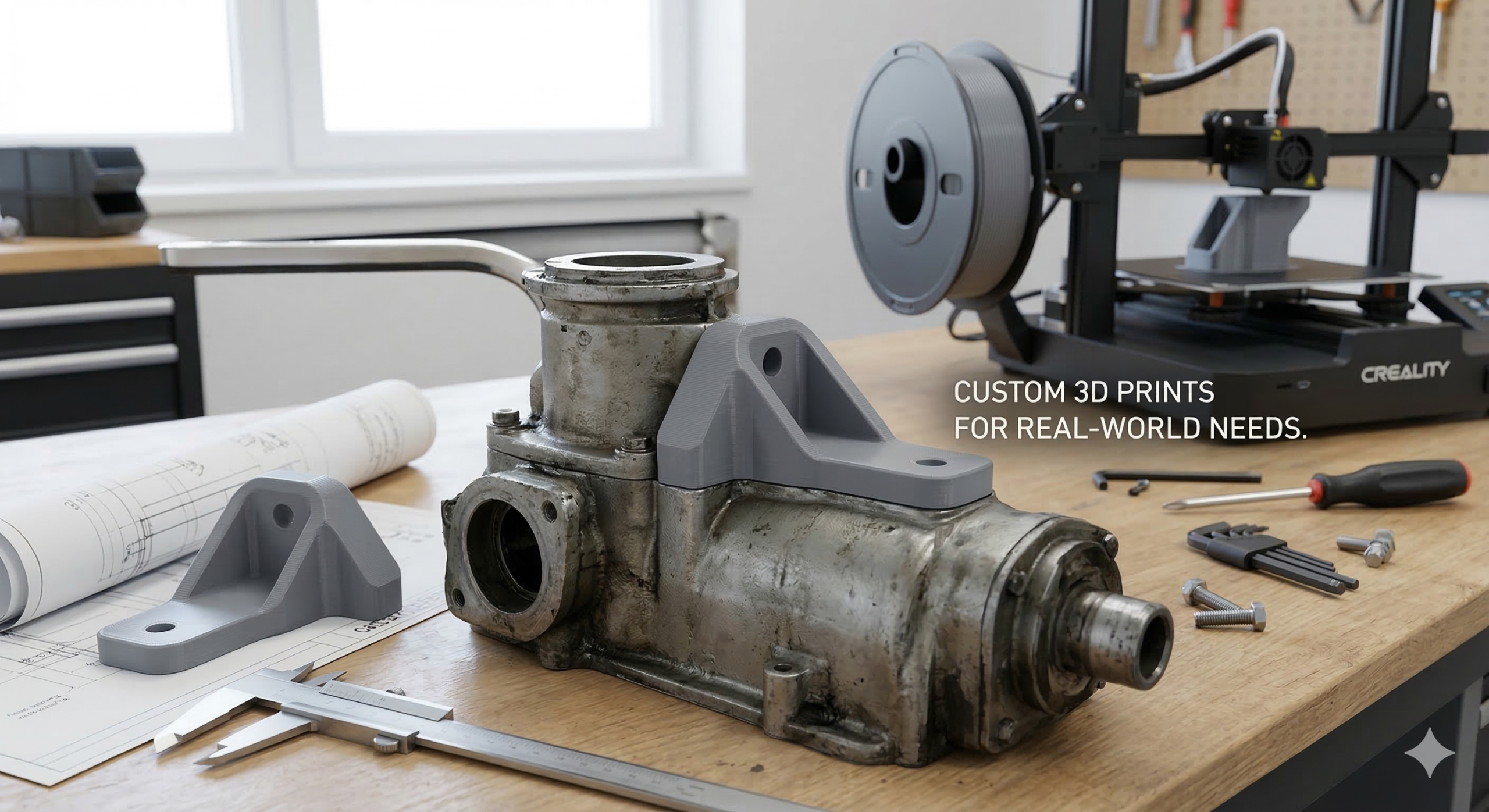
What does this service cover? Kevin can evaluate the problem, model or refine a custom part, prepare the geometry for production, print and inspect suitable FDM prototypes, revise uncertain features, and produce qualified small batches. When another process is a better fit, he may coordinate suitable work through a vetted outside manufacturing provider.
Your starting point
You do not need a finished 3D model to begin.
The first step depends on what you already have and what the finished part must accomplish.
A broken or missing part
Share the surviving original, photographs from several angles, key measurements, attachment points, and an explanation of how it failed.
Explore replacement-part work →A sketch, idea, or partial design
Provide the intended function, approximate size, interfaces, environment, quantity, and the features that matter most. Kevin can evaluate whether the design can be developed responsibly.
An STL, STEP, or OBJ file
Send the file with the material, quantity, appearance, deadline, tolerance, and use requirements. A printable file still needs a project-fit and production review.
Submit the file for review →Service scope
Design, prototyping, and production decisions belong in one workflow.
The job may require one service or several connected stages. Each stage is evaluated against the part—not added automatically.
Custom part modeling
Develop geometry around measurements, surviving features, attachment points, clearances, and the real task the part must perform.
File review and refinement
Evaluate scale, wall thickness, orientation, interfaces, unsupported features, assembly choices, and revision access before production.
Rapid functional prototypes
Produce a testable version to check fit, access, movement, alignment, handling, or another uncertain feature before committing to the final route.
In-house FDM printing
Produce suitable brackets, holders, fixtures, covers, adapters, prototypes, and replacement parts with a material and orientation chosen for the application.
Small-batch production
Make a limited quantity of repeatable parts when tooling or large production minimums do not make economic sense and FDM remains an appropriate route.
Managed specialized manufacturing
For qualified projects, coordinate outside processes such as SLA, SLS, MJF, metal additive manufacturing, CNC machining, or urethane casting when they offer a better fit.
Clear distinction: Kevin operates FDM equipment in his shop. Resin, powder-bed, metal, machining, and casting processes are not produced in-house; they are considered only when the project is suitable for managed outside manufacturing.
Choose the practical route
The same file can require very different levels of service.
| Route | Often fits when | Kevin’s role | Important limit |
|---|---|---|---|
| Print-ready FDM | You own a usable digital file and the part fits Kevin’s in-house equipment and material range. | Review, orient, slice, produce, clean, inspect, and communicate any visible production concerns. | A file being printable does not automatically make the finished part safe or suitable. |
| Design and prototype | The geometry must be created, reconstructed, repaired, resized, or tested around a real interface. | Define requirements, develop geometry, prototype uncertain features, measure, and revise. | Design time, test parts, and controlled revisions are separate from a simple print-only job. |
| Managed specialized process | Fine detail, complex nylon, metal, machining, casting, documentation, or another requirement makes FDM a poor fit. | Screen the job, prepare requirements, coordinate quotes and production, and inspect the received result. | Availability, documentation, lead time, price, and acceptance are confirmed per project. |
Why process choice matters: The National Institute of Standards and Technology provides additional background on additive manufacturing for prototypes, customized parts, replacement components, and low-volume production. The useful question is not merely whether a part can be printed, but which process fits its requirements.
A repeatable decision process
Kevin’s P.R.I.N.T. Method™ keeps the project focused on the finished job.
The printer comes after the problem, requirements, and interfaces are understood.
Problem
Define what is broken, missing, awkward, or worth improving.
Requirements
Identify load, heat, weather, movement, appearance, quantity, and risk.
Interfaces
Measure where the part fits, fastens, slides, clips, seals, or supports.
Next-Best Materials & Methods
Choose the geometry, material, orientation, and production process.
Test & Tune
Produce, inspect, fit, measure, revise, and document what the result teaches.
Four-question project planner
Answer these before requesting a quote.
Open each question and note the details you know. Honest uncertainty is useful; it shows Kevin where the first test may belong.
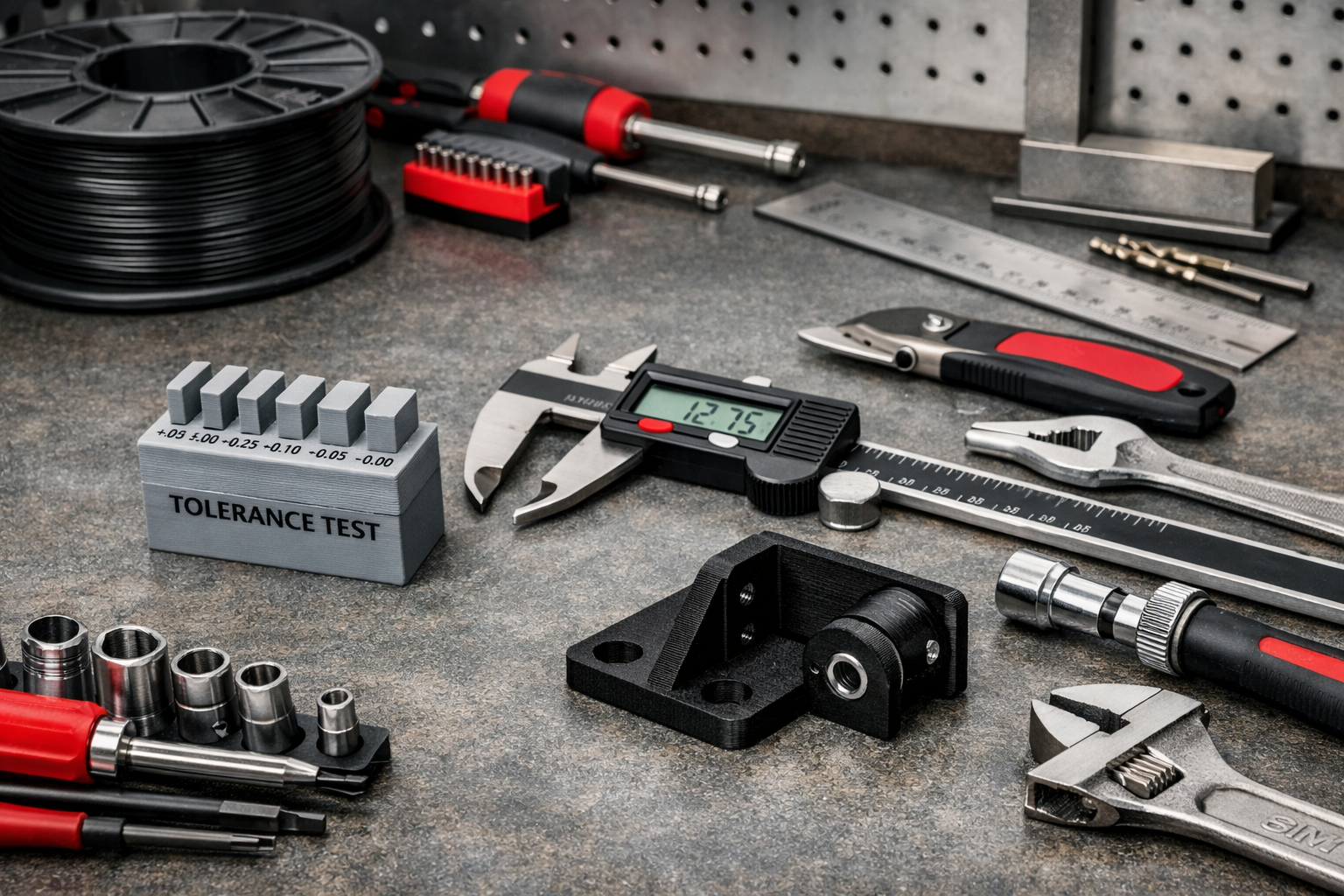
1. What must the part accomplish?
Describe the problem in plain language, what success looks like, what the original did, and which feature matters most.
2. Where must it fit or connect?
List the mating surfaces, hole locations, fasteners, clips, shafts, clearances, contact points, or objects the part must fit around.
3. What environment and forces will it face?
Include heat, sunlight, moisture, chemicals, vibration, repeated movement, impact, flexing, static load, and the consequence of failure.
4. What quantity, appearance, and deadline matter?
Share the number of parts, color or finish expectations, whether a prototype is acceptable, documentation needs, budget context, and any real deadline.
Would you rather build the skill yourself? Start with Kevin’s free beginner guide, then use the P.R.I.N.T. It practical 3D printing ebook when you want a structured reference beside your printer.
Project-fit check
A good project is defined by function, environment, risk, and economics.
Often a strong fit
- Discontinued plastic covers, clips, spacers, knobs, feet, and brackets
- Custom holders, guides, trays, jigs, fixtures, and adapters
- Prototype housings, fit checks, and usability models
- Low-volume functional parts without a practical retail match
- Parts that can be tested without creating unacceptable risk
Needs additional review
- Fine details or smooth surfaces beyond a practical FDM result
- Outdoor, vehicle, high-heat, chemical, or repeated-load use
- Complex nylon, engineering resin, metal, machining, or casting
- Tight mating fits, controlled repeat production, or documentation
- Large quantities where another manufacturing method may cost less
May be declined
- Parts that support a person or protect someone from injury
- Fuel, flame, pressure, or critical electrical applications
- Medical, regulated, certified, or legally controlled components
- Projects without clear rights or permission to reproduce the design
- Jobs where a failure could create unacceptable consequences
Important: A successful print is not automatically a safe final product. Kevin may recommend a smaller test, design change, different material or process, qualified engineering review, or a decision not to proceed.
Material and process decisions
The material name is only one part of performance.
Geometry, wall design, layer orientation, printer setup, interfaces, and testing can matter as much as the polymer.
| Material | Often considered for | Planning caution |
|---|---|---|
| PLA | Indoor prototypes, organizers, models, fixtures, and moderate-use parts | Limited heat resistance can rule it out for vehicles, hot shops, or sun-exposed use. |
| PETG | Tough everyday covers, brackets, holders, and some moisture-exposed parts | Flexibility, creep, surface finish, and fit still depend on geometry and print setup. |
| ASA | Outdoor parts where weather and ultraviolet exposure matter | Weather resistance does not make every ASA design appropriate for every load or temperature. |
| TPU | Flexible feet, bumpers, grips, guards, and compliant features | Hardness, wall thickness, infill, and geometry strongly change the finished behavior. |
Practical experience
Repair judgment, modeling, production, and inspection stay connected.
Kevin’s background includes industrial machine repair, more than 14 years at Xavier University, 8+ years of practical FDM printing, 8+ years working with 3D models, and 4+ years using Shapr3D.
In-house equipment includes the Bambu Lab X1 Carbon, Raise3D Pro2, Creality CR-M4, and MakerGear M3. Suitable local projects can be reviewed in Northern Kentucky, while qualified digital-file projects may be handled remotely and shipped.
Frequently asked questions
Start with the answer that matches your project.
Do I need a 3D model before contacting Kevin?
No. A broken sample, clear photographs, measurements, a sketch, or a detailed description may be enough for an initial review. The first step is determining whether the geometry and requirements can be defined accurately enough.
Which digital files can I submit?
The project intake accepts common starting formats such as STL, STEP, and OBJ. Include the units, intended use, quantity, material preferences, and any editable source file you own when available.
Can Kevin recreate a part from a broken original?
Possibly. The surviving geometry, interfaces, intended function, operating environment, consequences of failure, and available measurements determine whether reconstruction is practical.
Does Kevin provide resin, SLS, MJF, CNC, or metal production?
Those processes are not produced in Kevin’s shop. For qualified projects, Kevin may coordinate an appropriate outside manufacturing provider, prepare requirements, review quotations, and inspect the completed result.
How much does custom design and prototyping cost?
Cost depends on design time, available measurements, geometry, material, process, size, production time, cleanup, quantity, inspection, risk, and the number of useful test revisions. A print-ready file is different from recreating or developing a custom part.
Will the first prototype be the final part?
Not necessarily. A prototype may be intended to test fit, alignment, access, movement, appearance, or one risky feature. What it reveals determines whether a controlled revision is worth making.
Do you serve customers outside Northern Kentucky?
Yes, when the project is suitable for remote review. Local handoff is useful when a physical sample or fit check matters, while digital-file projects and suitable shipped parts can be handled beyond the local area.
Does Kevin accept every project?
No. Feasibility, safety, file and design permissions, scheduling, budget, production method, and the consequences of failure all affect project acceptance.
The next useful step
Start with what the part must accomplish.
Send the file, photographs, measurements, quantity, intended use, environment, and deadline you know. Kevin will evaluate whether the job belongs in his FDM shop, needs design and prototyping work, fits a managed manufacturing route, or should take a different path.
Submitting a request does not guarantee acceptance or a particular production method. Each project is reviewed for feasibility, safety, permissions, scheduling, budget, and fit with the available workflow.