
Small businesses are out-scaling large manufacturers by using modular 3D print farms instead of centralized factories. By stacking reliable desktop printers, standardizing profiles, and producing on demand, they reduce capital risk, scale incrementally, and often hit ROI faster than traditional tooling-based production.
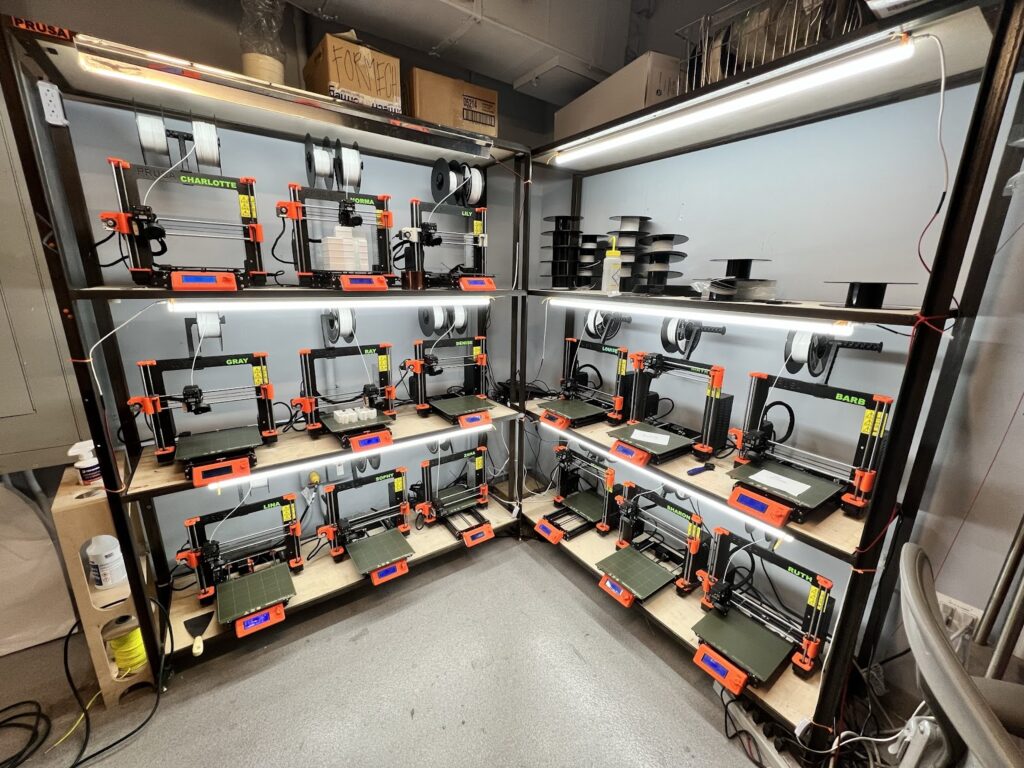
For decades, manufacturing scale belonged to giants: massive factories, long tooling cycles, and huge upfront bets. Then the rules changed. Small teams started winning—quietly—by building desktop factories: rows of printers run like a production system, not a hobby station.
The Underdog Advantage: Why Print Farms Flip the Old Manufacturing Model
Traditional manufacturing rewards scale only after expensive commitments: tooling, minimum orders, long lead times, and inventory risk. Print farms flip that equation: no tooling, fast iteration, and demand-driven production. Instead of “go big or go home,” you grow one printer at a time.
What Is a 3D Print Farm (Really)?
A 3D print farm is a coordinated group of printers running as a single production system. The goal is repeatable output at scale, not one-off experimentation.
- Multiple similar printers (for consistency)
- Standardized materials and nozzle sizes
- Locked slicer profiles
- Central job queue and simple QC checks
Why Print Farms Scale Better Than Factories
1) Linear, Predictable Scaling
Factories scale in giant leaps. Print farms scale linearly: add one printer, gain more capacity. Add five, increase throughput by five—without retooling the entire operation.
2) Fault Tolerance
If one printer fails, the farm keeps running. That resilience is a real competitive edge that small shops can leverage immediately.
3) Local, Distributed Manufacturing
Print farms can operate near customers, reduce shipping cost, and cut delivery time. This makes small-batch and customized production far more practical.
Hobby Printing vs Desktop Factory Printing
| Area | Hobby Printing | Desktop Factory |
|---|---|---|
| Printer Setup | Constantly changing | Locked and standardized |
| Materials | Many brands/types | One or two validated materials |
| Slicer Profiles | Experimental | Version-controlled |
| Downtime | Random | Scheduled |
| Quality Control | Visual only | Measured and repeatable |
| Scaling | Chaotic | Linear and predictable |
The ROI Math: Print Farm vs Traditional Manufacturing
Most people think ROI is “printer cost vs profit.” In real print farms, ROI is usually driven by two levers: repeatability (fewer failures) and labor efficiency (less handling time per part).
Upfront Investment Comparison
| Factor | Traditional Manufacturing | Desktop Print Farm |
|---|---|---|
| Initial Cost | Very high | Low to moderate |
| Tooling Required | Yes | No |
| Minimum Order | High | None |
| Time to Market | Weeks to months | Days |
| Risk Exposure | High | Controlled and incremental |
Print Farm ROI Calculator Table
How to use: Fill in the “Your Number” column. The “Formula” column shows how to calculate the result. If you want an exact calculator, copy this table into Google Sheets and use the formulas as written.
| Metric | Your Number | Example | Formula / Notes |
|---|---|---|---|
| Printers in farm | [enter] | 10 | Total active machines |
| Avg sell price per part ($) | [enter] | 18 | Revenue per unit shipped |
| Avg material cost per part ($) | [enter] | 3.25 | Filament/resin + waste factor |
| Avg labor minutes per part | [enter] | 6 | Setup + removal + QC + packing |
| Labor rate ($/hour) | [enter] | 22 | Your fully loaded labor cost |
| Failure rate (%) | [enter] | 8% | Rejects / reprints as a % of attempts |
| Avg print hours per part | [enter] | 2.2 | Used for capacity planning |
| Utilization (%) | [enter] | 70% | Realistic uptime for production |
| Hours available per printer per month | [enter] | 720 | 24*30 = 720 (or your schedule) |
| Monthly capacity (parts) | [calc] | [calc] | = (Printers * HoursAvailable * Utilization) / PrintHoursPerPart |
| Good parts after failures | [calc] | [calc] | = MonthlyCapacity * (1 – FailureRate) |
| Labor cost per part ($) | [calc] | 2.20 | = (LaborMinutesPerPart / 60) * LaborRate |
| Gross profit per part ($) | [calc] | 12.55 | = SellPrice – MaterialCost – LaborCostPerPart |
| Monthly gross profit ($) | [calc] | [calc] | = GoodParts * GrossProfitPerPart |
| Monthly overhead ($) | [enter] | 450 | Power, rent share, supplies, etc. |
| Monthly net profit ($) | [calc] | [calc] | = MonthlyGrossProfit – Overhead |
| Farm hardware investment ($) | [enter] | 6,500 | Printers + shelving + spares (your total) |
| ROI payback (months) | [calc] | [calc] | = Investment / MonthlyNetProfit |
The Operational Blueprint: How Successful Print Farms Actually Run
The difference between a profitable desktop factory and a room full of idle printers is process discipline. Winning farms treat printers like production assets. The goal is consistent throughput, not constant tweaking.
Daily Workflow That Scales
- Jobs queued centrally (not printer-by-printer)
- Slicer profiles locked and versioned
- Printers loaded in batches
- Output inspected against simple pass/fail criteria
- Failures logged and resolved (not ignored)
Labor Efficiency: The Hidden ROI Multiplier
Most ROI calculators ignore labor. Real print farms don’t. When you shave two or three minutes of handling time per part, it compounds fast at scale. That’s the underdog advantage: small teams can be ruthlessly efficient.
Smart Scaling: When to Add Printers (and When Not To)
Add capacity when your farm is consistently booked and lead times are creeping up. Do not add capacity when your failure rate is still high or your profiles are unstable. More printers amplify both good systems and bad ones.
Maintenance Is Not Overhead—It’s Throughput Insurance
High-performing farms schedule maintenance like production. A printer that fails mid-job costs more than one paused for ten minutes of upkeep.
- Scheduled nozzle swaps
- Predictive replacement of wear parts
- Maintenance logs per machine
Why Giants Struggle to Copy This Model
Large manufacturers can build print farms, but they often struggle to run them efficiently. Procurement friction, slow approvals, and risk aversion add drag. Small businesses can pivot in days—materials, profiles, pricing, and product design—without waiting for a quarterly meeting.
Fact-Safe Reality Check: What Print Farms Can’t Do (Yet)
Print farms are powerful, but not magical. They’re not ideal for ultra-high-volume commodity parts, extremely tight tolerances without post-processing, or materials that require industrial-only equipment. The winners design products around strengths, not wishful thinking.
FAQ
Can small businesses really compete with large manufacturers using 3D print farms?
Yes. By avoiding tooling costs, producing on demand, and scaling incrementally, small businesses often reach ROI faster and stay more flexible than traditional manufacturers for the right product types.
Are 3D print farms only for plastic parts?
No. While FDM plastics dominate, many farms use engineering materials and hybrid workflows (printing plus inserts, machining, or finishing) to expand what they can sell reliably.
How many printers does a print farm need?
You can start with three to five printers. A “farm” is less about a magic number and more about standardized profiles, repeatable QC, and a predictable workflow.
First-Page Takeaway
3D print farms don’t win by being bigger. They win by being faster, leaner, and more adaptable. The desktop factory model works because it fits modern business: low risk, rapid iteration, and demand-driven production. If you treat printing like manufacturing—not a hobby—the advantage is still wide open.
US Store-New Product Launch: SPARKX i7
