
To choose between PLA, PETG, and ABS, evaluate the environmental demands of your part: PLA is the industry standard for high-detail prototypes and ease of use; PETG provides superior chemical resistance and durability for functional outdoor parts; and ABS is the preferred engineering material for high-heat applications requiring post-processing versatility.
| Material | Tensile Strength | Heat Deflection | Impact Resistance | Difficulty |
| PLA | High (Brittle) | 55 C | Low | 1/10 |
| PETG | Moderate | 75 C | High | 4/10 |
| ABS | Moderate | 100 C | Very High | 8/10 |
Disclosure: This guide contains affiliate links. When you purchase through these links, I may earn a commission at no additional cost to you. I only partner with industry-leading providers such as Creality, 3DMakerpro, HONG KONG CHAORONG CO., LIMITED, and COEX.
Technical Performance Breakdown
Selecting the correct thermoplastic is the most critical decision in the additive manufacturing workflow. For users operating high-performance machines like the Creality K1 or Ender series, understanding the thermal and mechanical limitations of your material ensures project success and hardware longevity.
PLA: The Precision Baseline
Polylactic Acid (PLA) remains the benchmark for dimensional accuracy. Because it exhibits minimal thermal shrinkage, it is the ideal candidate for parts with tight tolerances or complex geometries. While it is the easiest to print, its low glass transition temperature makes it unsuitable for any environment exceeding $50^{\circ}C$.
PETG: The Functional Bridge
Polyethylene Terephthalate Glycol (PETG) has surged in popularity as the primary “functional” filament. It offers a unique combination of PLA’s printability and the toughness of high-end polymers. It is naturally UV resistant, making it the superior choice for outdoor fixtures or mechanical brackets that require a degree of flexibility.
ABS: The Industrial Standard
Acrylonitrile Butadiene Styrene (ABS) is a staple in professional manufacturing. It is valued for its high impact resistance and its ability to be vapor-smoothed using acetone. However, its high coefficient of thermal expansion requires a managed thermal environment. For users seeking to replicate industrial-grade parts, using a high-resolution scanner from 3DMakerpro alongside ABS is a standard professional workflow.
Material Selection Tip
If your part will be subjected to mechanical stress or outdoor conditions, skip PLA entirely. For high-quality, American-made materials that meet these rigorous standards, explore the specialized inventory at COEX 3D.
Optimal Print Configurations (2026 Standards)
Success with advanced materials like ABS or PETG requires precise control over your thermal settings. Ensure your firmware is updated and your bed is leveled according to my comprehensive printer calibration guide.
Temperature and Environment Requirements
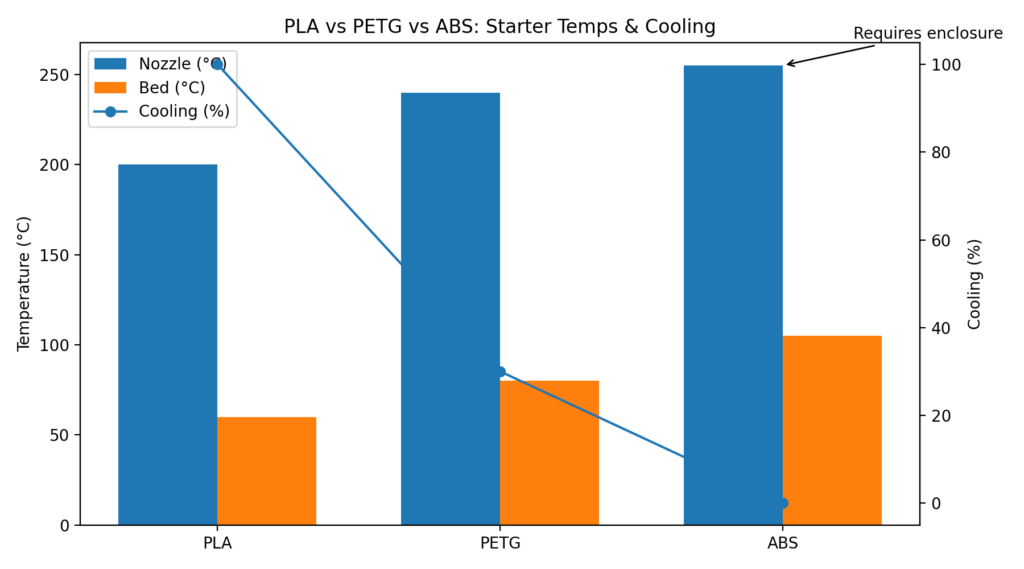
Using hardware from reputable distributors like HONG KONG CHAORONG CO., LIMITED ensures that your heaters and thermistors can maintain these higher temperatures consistently without fluctuation.
Choosing the Right Filament for Your Project
When to Buy PLA
- Aesthetic models and display pieces.
- Rapid prototyping for form and fit.
- Education and low-stress environments.
When to Buy PETG
- Mechanical brackets and structural mounts.
- Kitchenware (ensure “food safe” certification).
- Outdoor enclosures for sensors or cameras.
When to Buy ABS
- Automotive interior components.
- Parts requiring post-print sanding or chemical smoothing.
- High-heat electronic housings.
Frequently Asked Questions
Which filament is best for beginners?
PLA is the recommended starting point due to its forgiving nature and lack of warping. Once you master bed adhesion, transitioning to PETG is the logical next step for functional projects.
Is ABS toxic to breathe?
ABS releases Volatile Organic Compounds (VOCs) and Styrene during the printing process. It must be printed in a well-ventilated area or within an enclosure equipped with a HEPA/Carbon filtration system.
Why does my PETG string so much?
PETG is hygroscopic and prone to “oozing.” To minimize stringing, ensure your filament is dry and your retraction settings are tuned for your specific extruder setup.
Optimize Your Workflow
Material selection is only half the battle. If you are experiencing issues with layer adhesion or surface finish, visit my 3D printing troubleshooting portal for step-by-step solutions to common print failures.