
High-speed 3D printing sounds simple. Print faster, get more parts.
In reality, it forces a decision most buyers don’t expect.
Do you optimize for faster machines, or do you optimize for cheaper, more reliable output?
This comparison explains how throughput really works, where Klipper and CoreXY help, and how to choose the right path based on how you actually print.
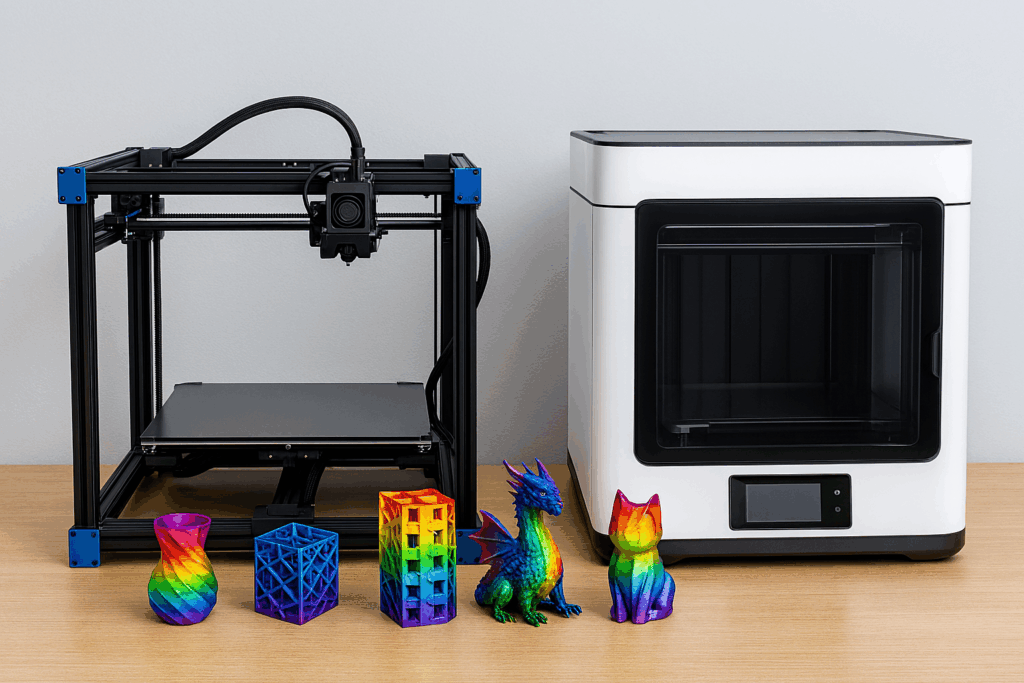
What Is High-Speed 3D Printing
High-speed 3D printing refers to printers designed to increase usable output per hour by combining higher acceleration, efficient motion systems, and advanced firmware such as Klipper.
True high-speed printing prioritizes throughput, not just higher speed settings.
The Real Choice: Faster Printers vs Cheaper Parts
Most buyers focus on print speed.
Professionals focus on usable parts per day.
That difference creates two distinct strategies.
Strategy 1: Speed-First High-Speed 3D Printing
Speed-first setups aim to finish prints as quickly as possible.
What Defines a Speed-First Printer
- CoreXY motion system
- Rigid frame design
- Klipper firmware with input shaping
- High-flow hotend and extruder
- Aggressive acceleration tuning
This approach works best when iteration speed directly affects productivity or revenue.
Speed-First Pros and Cons
| Advantage | Tradeoff |
|---|---|
| Faster print completion | Higher upfront cost |
| Rapid prototyping | More tuning required |
| Shorter lead times | Higher failure sensitivity |
| Time efficiency | More maintenance |
Who Should Choose Speed
Speed-first printing makes sense if you:
- Prototype frequently
- Need fast turnaround times
- Run short production batches
- Are comfortable tuning firmware and slicer profiles
This is where Klipper and CoreXY setups provide real gains.
Strategy 2: Cost-First High-Speed Printing
Cost-first setups accept longer print times to reduce cost per finished part.
They often achieve higher real-world throughput because they fail less.
What Defines a Cost-First Setup
- Proven, stable motion systems
- Conservative acceleration
- Long unattended print runs
- Low material waste
- Minimal operator intervention
This approach favors consistency over headline speed.
Cost-First Pros and Cons
| Advantage | Tradeoff |
|---|---|
| Lower cost per part | Longer print times |
| Fewer failed prints | Slower iteration |
| Predictable output | Less marketing appeal |
| Easier scaling | Lower peak speed |
Who Should Choose Cost
Cost-first printing is ideal if you:
- Run long production jobs
- Sell parts with tight margins
- Value uptime over speed
- Want predictable results
Many print farms quietly outperform “fast” machines this way.
What Matters More, Speed or Throughput?
Throughput matters more than print speed.
The printer that produces the most usable parts per day delivers the best return on investment.
Real-World Throughput Comparison
| Metric | Speed-Focused Printer | Cost-Focused Printer |
|---|---|---|
| Average print time | 1.2 hours | 2.6 hours |
| Failure rate | 12–18% | 2–4% |
| Parts per 24 hours | 18–20 | 21–23 |
| Operator attention | High | Low |
Faster prints do not automatically mean more output.
Where Klipper Actually Fits
Klipper does not magically make printers fast.
It enables higher acceleration, better vibration control, and more consistent extrusion, but only when the hardware supports it.
If you’re new to firmware-based tuning, start with Klipper setup for beginners, then move on to input shaping calibration explained and pressure advance tuning for high-speed printing before increasing acceleration.
Where CoreXY Helps (and Where It Doesn’t)
CoreXY motion systems reduce moving mass, which allows higher acceleration with less ringing.
They help when:
- Frames are rigid
- Belts are properly tensioned
- Slicer limits are realistic
They do not compensate for poor extrusion or weak frames.
For a deeper comparison, see CoreXY vs Cartesian printers explained and how frame rigidity affects print quality.
Throughput Comes Before Speed
Throughput is not print speed.
It is usable parts per day.
A printer that finishes faster but fails more often usually loses in real output. This is why print farm throughput optimization and reducing failed 3D prints at scale matter more than chasing speed settings.
Buyer Guidance: Matching Hardware to Your Goal
Buying for Speed and Iteration
Newer machines from Creality focus on CoreXY motion and Klipper-style workflows aimed at faster iteration.
You can explore current options here:
https://tidd.ly/3KUghXJ
Best suited for experienced users who value time savings over simplicity.
When Scanning Accuracy Affects Throughput
If your workflow includes reverse engineering or inspection, scan accuracy can matter more than print speed.
3DMakerpro focuses on capture precision rather than print velocity.
https://tidd.ly/49ziphJ
This supports digitization-first workflows.
Scaling or Building Cost-Controlled Machines
For users sourcing components at scale, HONG KONG CHAORONG CO., LIMITED supplies motion and electronic parts designed for cost stability.
Supplier link:
https://tidd.ly/4oBR0PW
This approach favors long-term margin protection.
Speed vs Cost: Quick Buyer Guide
- Choose speed if iteration time affects revenue
- Choose cost if uptime and margins matter more
- Throughput beats headline speed every time
- Klipper helps only when hardware can keep up
Best results come from matching the printer to how you actually print.
Buyer Questions
Is high-speed 3D printing worth it?
Yes, if faster turnaround improves productivity or revenue.
Does a faster printer always improve throughput?
No. Higher failure rates often reduce usable output.
Is Klipper required for high-speed printing?
Not required, but strongly recommended for safe acceleration control.
Should beginners buy high-speed printers?
Only if they’re willing to learn tuning. Reliability-first machines are often better starting points.
Final Takeaway,
High-speed 3D printing is not about chasing spec-sheet numbers.
It’s about choosing between:
- Faster completion
- Cheaper, more reliable output
The right choice depends on how you print, not what looks impressive online.
Throughput wins. Every time.
