
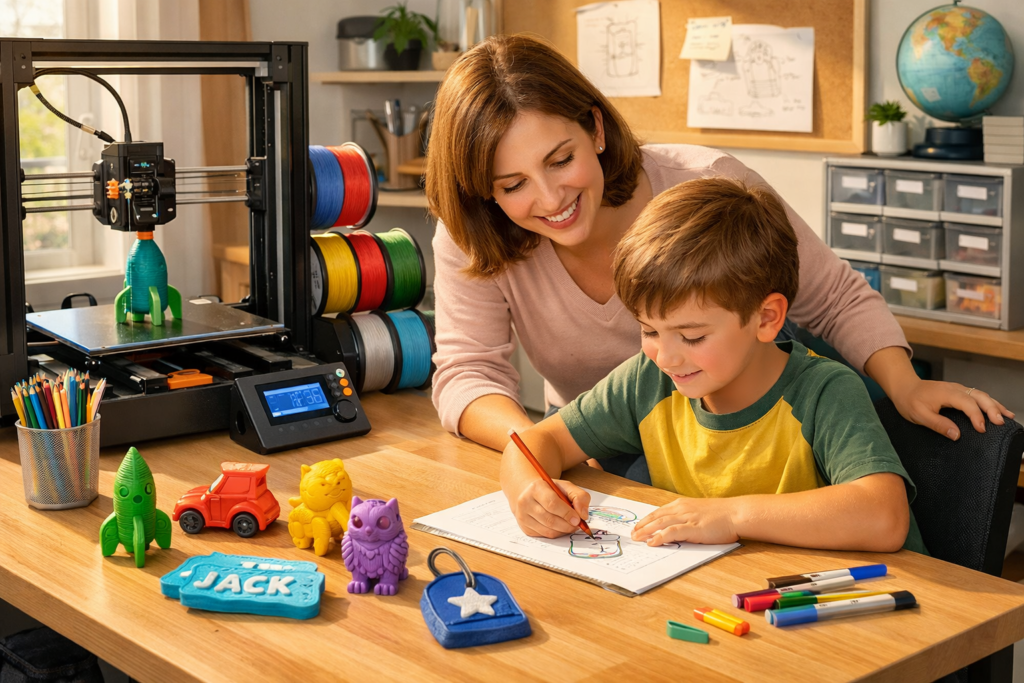
The best 3D printing projects for kids are not the flashiest ones. They are the projects that finish cleanly, survive little hands, and give kids that unforgettable moment where they say, “Wait, we made this?”
That is where 3D printing becomes more than a machine on a desk. It becomes a tiny workshop for problem-solving, creativity, patience, and confidence. Kids get to imagine something, help shape it, watch it appear layer by layer, and then actually use it.
The trick is choosing the right projects first. A complicated dragon with thin wings might look exciting online, but it can turn into a pile of strings, supports, and disappointment. A simple backpack tag, bookmark, garden marker, or puzzle token can feel like magic because it prints well and has a real purpose.
The Best Kid Projects Have One Thing in Common
They are simple on purpose.
That does not mean boring. It means the design has a flat bottom, strong walls, clear details, and little or no support material. Those are the prints that make beginners feel successful instead of frustrated.
For kids, success matters. A clean print teaches them that design choices have consequences. A failed print can still teach something, but too many failures early on can make the printer feel like a problem instead of a tool.
So, this list focuses on projects that are fun, useful, and realistic for a typical FDM printer using PLA filament. These are the kinds of prints that work well in a home, classroom, library makerspace, or small family workshop when adults handle the safety side.
Quick Reality Check: Is Your Setup Kid-Ready?
Before choosing a project, run through these five quick questions. The goal is not to make 3D printing feel scary. The goal is to make it feel smarter.
- Can the printer run in a ventilated space away from where kids sit for long periods?
- Will an adult handle the hot nozzle, heated bed, scraper, glue, cutters, and failed print removal?
- Are you using PLA for the first kid projects instead of ABS, resin, or more advanced materials?
- Does the model have a flat base and little or no support material?
- Is the finished part too large to be a choking hazard for younger children?
If you can answer yes to those questions, you are already aiming in the right direction.
Safety First: The Adult Handles the Printer, the Kid Handles the Imagination
3D printing with kids should feel exciting, but it should not be treated like a toy. A desktop 3D printer has hot parts, moving parts, and material-related emissions that deserve adult attention. For family use, the safest rhythm is simple: kids help imagine, sketch, choose colors, and test the finished object, while adults run the printer.
For a beginner family setup, PLA is usually the easiest starting filament. Print in a ventilated area, keep children away from the printer while it is running, and let an adult remove the part only after the bed has cooled.
Also, avoid resin printing for kid projects unless a trained adult is fully managing the workflow. Resin printing adds liquid chemicals, gloves, washing, curing, odor control, and disposal concerns. For simple family projects, FDM printing with PLA is usually the better starting point.
Best Starter Settings for Kid-Friendly Prints
You do not need advanced slicer tricks for these projects. In fact, the best approach is usually boring and reliable.
Use PLA
PLA is the easiest beginner filament for most families. It prints at lower temperatures than many advanced materials and is widely available in fun colors.
Choose No-Support Models
Supports add cleanup, sharp edges, broken details, and frustration. Flat-backed designs are better for young makers.
Print Big Enough
Avoid tiny parts for younger kids. Larger prints are easier to paint, easier to remove, and less likely to break.
| Setting | Good Starting Point | Why It Helps |
|---|---|---|
| Layer height | 0.20 mm | A good balance of speed and detail for simple projects. |
| Infill | 12% to 20% | Strong enough for most kid projects without wasting filament. |
| Walls | 2 to 3 perimeters | Improves strength on tags, clips, tokens, and toys. |
| Supports | Off when possible | Cleaner results and easier post-processing. |
| Brim | Use for tall or narrow prints | Helps prevent corners from lifting during the print. |
| Material | PLA | The easiest starting material for most beginner FDM projects. |
If your first print fails, do not turn it into a big dramatic moment. Let the child inspect it with you. Ask what changed. Was the part too thin? Did a corner lift? Was there too much overhang? That turns a failed print into a design lesson.
Helpful Gear and Materials for Family 3D Printing
You do not need a complicated setup to enjoy 3D printing with kids. A reliable beginner-friendly printer, clean filament, and simple project choices matter more than chasing every upgrade.
The best purchases are the ones that support easy wins: a dependable FDM printer, quality PLA, basic cleanup tools, safe storage, and simple designs that do not require a weekend of troubleshooting.
Beginner-Friendly Printers
If you are still choosing a printer, Creality offers many popular FDM printer options that can fit family, classroom, hobby, and beginner maker workflows when used with adult supervision.
For kid-focused projects, look for reliability, simple leveling, good community support, and a build size that fits practical prints like tags, bookmarks, organizers, and small desk tools.
3D Scanning for Creative Projects
A scanner is not required for the projects in this guide, but 3DMakerpro Global can be worth exploring if your family wants to scan small objects, art pieces, models, or real-world shapes as inspiration for future prints.
This is especially interesting for older kids who are ready to connect real objects with digital design.
PLA Filament That Prints Cleanly
For these beginner projects, I would keep the material simple and start with PLA. COEX is a strong filament source for makers who want dependable material and clean color choices.
Use coupon code: 3DPRINTINGBYKEVIN for 15% off
10 Easy 3D Printing Projects for Kids That Actually Work
These projects are arranged from easiest to slightly more involved. Most can be made from free models, simple CAD designs, or custom text-based templates. The adult should handle slicing, printer setup, print removal, and any sanding or cleanup.
1. Personalized Backpack Name Tag
A backpack tag is one of the best first projects because it is flat, useful, and easy to customize. Kids can choose the shape, color, icon, and initials. The print usually finishes cleanly because the bottom sits flat on the build plate.
First print
No
Pick name, shape, color
Slice, print, remove
For younger kids, use initials instead of a full name if the tag will be visible in public. A lightning bolt, fish, dinosaur, soccer ball, or star shape makes the tag feel personal without needing a complicated design.
EasyUsefulGreat first win
2. Custom Bookmark With Raised Letters
A bookmark is simple, thin, and perfect for kids who like books, drawing, or school supplies. Add raised letters, a small icon, or a favorite shape at the top. Keep the design slightly thicker than a paper bookmark so it does not snap.
Readers
No
Choose theme
Check thickness
The secret is avoiding tiny text. Big, bold letters print better and are easier to paint. A bookmark also teaches kids that 3D printing does not always need to be a toy. Sometimes the best prints solve small everyday problems.
3. Pencil Name Clip
A pencil clip is a small snap-on label that helps kids identify their pencils, markers, or art tools. It can include initials, a tiny symbol, or a simple color-coded shape. This is a great classroom-style project because every child can make a slightly different version.
School supplies
No
Choose icon
Test fit
Print one test clip first before making a full batch. Pencils and markers vary in size, and a tiny adjustment can make the difference between a clip that slides off and one that feels just right.
4. Paint-Your-Own Animal Silhouettes
Flat animal silhouettes are excellent because they print quickly and invite creativity after the printer is done. A child can paint a turtle, cat, dinosaur, fish, dog, butterfly, or dragon shape without needing a highly detailed 3D model.
Art time
No
Paint and decorate
Remove safely
This is also a smart project when you want the child involved beyond the printer. The print becomes the canvas. Acrylic paint markers work well, but make sure the print is clean, dry, and handled on a protected surface.
5. Board Game Tokens
Board game tokens are small, simple, and surprisingly fun. Kids can design new player pieces, score markers, treasure coins, shields, hearts, stars, or custom game pieces for homemade games.
Game night
No
Invent rules
Keep size safe
For younger children, make tokens large enough that they are not a choking concern. For older kids, this project can become a full design challenge: create a game, design the pieces, print them, test them, and revise them.
6. Garden Markers or Seedling Stakes
Garden markers are perfect because they connect 3D printing with the outside world. Kids can help label basil, tomatoes, peppers, flowers, or classroom seedlings. Use chunky raised letters so the words stay readable.
Nature projects
No
Pick plant names
Choose durable size
PLA can soften or degrade over time outdoors, especially in heat and sun, so treat this as a seasonal project rather than a permanent garden label. That is actually part of the lesson: material choice matters.
7. Simple Desk Nameplate
A desk nameplate feels special because it gives kids ownership of their space. It can sit on a homework desk, bookshelf, bedroom shelf, or classroom table. Keep the base wide and the letters thick.
Personal space
Usually no
Choose style
Check stability
This project is a great introduction to design constraints. Tall, skinny letters can break. Thick letters print better. A wider base stands better. Kids can understand those rules quickly once they see the finished object.
8. Cable Clips for a Homework Desk
Cable clips are useful, simple, and practical. They keep charger cords, headphones, and USB cables from sliding behind a desk. Kids get to solve a real problem with a real object.
Organization
No
Find the problem
Measure cables
Measure the cable before printing. Make the opening slightly larger than the cord. If the first clip is too tight, that is not a failure. It is a perfect lesson in tolerances.
9. Simple Puzzle Maze
A flat maze is a great project for older kids because it combines design, problem-solving, and play. The print can be a shallow tray with raised walls. A bead or small ball moves through the path after printing.
Older kids
No
Draw maze path
Check small parts
This project is not ideal for toddlers or children who still put objects in their mouths. For older kids, though, it is a strong design challenge. If the maze is too easy, redesign it. If the walls are too thin, thicken them. That is real iteration.
10. Mini Tool Holder or Crayon Cup Insert
A small organizer is one of the most satisfying kid-friendly projects because it immediately cleans up a messy desk. Print a simple holder for pencils, paint brushes, glue sticks, markers, or crayons.
Useful printing
No if designed simply
Choose what it holds
Check wall thickness
Keep the shape simple. A square cup, round cup, or tray with dividers will usually work better than a fancy thin-walled sculpture. This is the project that helps kids see 3D printing as a way to make their daily life easier.
Have a Kid’s Drawing You Want Turned Into a Real 3D Print?
A hand-drawn idea can become a nameplate, charm, token, simple toy, desk sign, or gift. If you want help turning a child’s idea into a clean printable design, I can help you shape it into something realistic for 3D printing.
Start a Custom 3D Printing ProjectWhat Makes a Kid Project Print Well?
When choosing a 3D model for children, do not start with the coolest-looking file. Start with the most printable design. That usually means fewer overhangs, fewer tiny details, thicker parts, and a flat base.
A good kid project should have a purpose. It can decorate something, organize something, identify something, hold something, or help the child play. When the project has a job, the print feels more meaningful.
| Good Choice | Risky Choice | Why It Matters |
|---|---|---|
| Flat tag | Thin floating character | Flat designs stick better and need less cleanup. |
| Large raised letters | Tiny engraved text | Big letters are easier to print, paint, and read. |
| No supports | Lots of supports | Support removal can break delicate parts. |
| PLA | ABS or resin for first projects | PLA is easier for beginner FDM workflows. |
| Useful object | Random trinket | Useful prints teach design thinking faster. |
How Kids Can Help Without Touching the Printer
Kids do not need to operate the machine to learn from 3D printing. In many cases, they learn more when they are involved in the thinking stages.
Let them sketch the idea. Let them choose the color. Let them pick between two shapes. Let them measure the pencil, cable, plant pot, or shelf where the print will be used. Let them predict what might go wrong before the print starts.
After the print finishes and cools, let them inspect it. Is it strong enough? Does it fit? Would they change the size? Did the letters come out clearly? This is where 3D printing quietly teaches engineering without making it feel like homework.
For more beginner guidance, you can also point readers toward common 3D printing problems and quick fixes or learning how to design 3D objects with software.
Projects to Avoid When Printing With Kids
Some projects look fun but are not great first choices. That does not mean they are impossible. It just means they are more likely to frustrate beginners or require more adult cleanup.
Avoid thin swords, tiny articulated toys, complex print-in-place mechanisms, high-detail miniatures, food-contact items, whistles or mouth-contact objects, and anything that needs lots of support material. Also avoid printing anything that imitates a weapon or could be misused at school.
Food-contact prints deserve extra caution. A 3D printed cookie cutter or cup might look harmless, but food safety depends on material, layer lines, cleaning, coatings, and use conditions. For family beginner projects, it is better to print craft cutters for clay or play dough rather than items meant for food.
FAQs About 3D Printing With Kids
What is the best 3D printing project for kids?
A personalized backpack tag is one of the best first projects because it is simple, useful, and easy to customize. It usually prints flat with no supports, which makes it more reliable for beginners.
Is 3D printing safe for kids?
3D printing can be used around kids with adult supervision, smart material choices, and good ventilation. Children should not touch the hot nozzle, heated bed, scraper, cutters, or printer while it is running. Adults should handle setup, removal, and cleanup.
What filament should I use for kid-friendly projects?
PLA is the best starting filament for most kid-friendly FDM projects. It is widely available, easier to print than many advanced materials, and works well for simple tags, bookmarks, tokens, organizers, and decorative pieces.
Should kids use resin printers?
Resin printing is not the best starting point for children. It involves liquid resin, gloves, washing, curing, odor control, and chemical handling. For family projects, a supervised FDM printer using PLA is usually the better beginner path.
Do I need an expensive printer for kid-friendly projects?
No. Most kid-friendly projects are simple enough for a basic, reliable FDM printer. Good setup, clean filament, adult supervision, and smart model choices matter more than buying the most expensive machine.
How can I make 3D printing educational?
Ask kids to sketch the idea, measure the object it needs to fit, choose the color, predict problems, and test the finished print. That turns a simple project into a lesson about design, problem-solving, measurement, and iteration.
Final Takeaway: Keep It Simple, Make It Useful, Let Kids Feel the Win
3D printing with kids works best when the first projects are simple enough to succeed and useful enough to matter. A name tag, bookmark, garden marker, cable clip, or desk nameplate may not look as dramatic as a giant fantasy model, but these are the prints that build confidence.
They teach kids that ideas can become objects. They show that measurements matter. They reveal why strong shapes beat fragile ones. Most importantly, they make creativity feel real.
Start small. Use PLA. Keep the printer supervised. Choose projects with flat bases and clear purpose. Then let the child experience the best part of 3D printing: holding an idea they helped bring to life.
Want a Print That Turns Out Right the First Time?
If you have a family project, classroom idea, kid drawing, prototype, replacement part, or custom 3D print in mind, I can help turn it into something practical and printable.
Request a Custom 3D Printing Quote