
Production planning without the guesswork
Ten parts can feel like a perfect 3D-printing job. One hundred can still make sense. At 1,000, the answer may change completely—or it may not.
The quantity printed on a purchase order does not choose the manufacturing process by itself. A stable, simple part with predictable demand may justify tooling. A customized part, replacement component, or design that is still changing may remain a strong additive-manufacturing candidate at a much higher quantity.
The expensive mistake is deciding too early. Tool before the design is stable, and every revision can become painful. Keep 3D printing after the part and demand have stabilized, and you may continue paying a higher unit cost than necessary.
Disclosure: This article includes a material-partner link. Kevin may receive a benefit if you purchase through that link, at no added cost to you. Recommendations remain based on project fit.
Quick answer: When should you stop 3D printing production parts?
Do not stop at an arbitrary number. Compare total delivered cost, design stability, material requirements, inspection needs, lead time, cash tied up in inventory, and the consequences of failure.
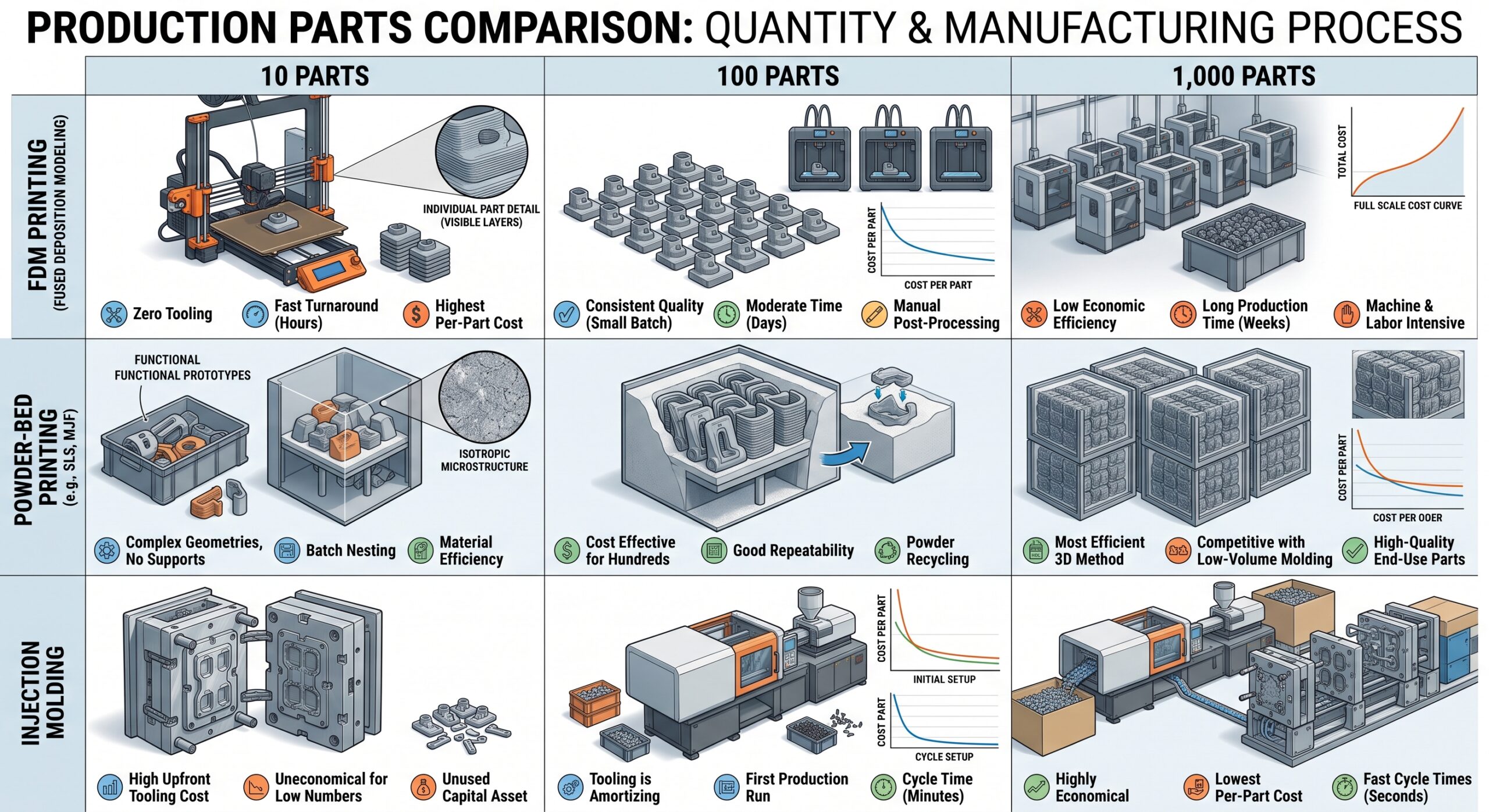
For many projects, 10 parts favor flexibility, 100 parts trigger a serious process comparison, and 1,000 parts make tooling worth investigating. Those are planning checkpoints—not universal break-even points.
The quantity ladder: what changes at 10, 100, and 1,000 parts?
Think of quantity as a signal to ask better questions. Each step increases the importance of production rate, repeatability, inspection time, finishing labor, packaging, and the cost of a failed batch.
Protect flexibility. Confirm fit, function, finish, assembly, and the inspection method before optimizing unit price.
Price in-house FDM against managed FDM, SLS, MJF, casting, machining, or early tooling using the same requirements.
Investigate tooling and faster production methods—but keep additive in the comparison when demand, geometry, or variants still favor it.
These quantities are review gates, not automatic process switches.
At 10 parts, learning is usually more valuable than squeezing pennies
A ten-part run often exposes what a single prototype cannot. You see whether supports remove consistently, holes remain usable, assemblies line up, colors match, labels stay readable, and packaging protects the finished pieces.
This is where desktop FDM can be especially useful. There is no mold to revise, a damaged or uncertain feature can be isolated for testing, and the next version can move quickly. If the part is suitable for Kevin’s equipment and risk level, it may be produced in-house.
Before approving the run, use the site’s first-article and 3D-printing quality-control guidance. A clean-looking sample is not enough if it has never been checked against written requirements.
At 100 parts, hidden labor starts to become visible
One hundred parts can still be a strong 3D-printing job, especially when tooling would be expensive, the design may change, or parts are ordered in smaller monthly releases. However, the quote now depends on much more than print time and filament weight.
- How many parts fit safely on each build?
- What happens if one part lifts or fails during a shared build?
- How much labor is required for support removal, sanding, inserts, bonding, labeling, or assembly?
- Which dimensions or visual features must be inspected?
- Can the same material, color, profile, and orientation be maintained?
- How will accepted parts be separated from rejects and rework?
At this checkpoint, it is sensible to compare in-house FDM with managed FDM, SLS, MJF, urethane casting, CNC machining, or early injection-molding options. The right route can change with geometry, surface requirements, material behavior, and delivery schedule.
At 1,000 parts, tooling deserves a real quote—but not an automatic victory
When a design is stable and demand is credible, the low cycle time and falling unit cost of a molded process can outweigh its tooling expense. That is why 1,000 units should trigger a formal production review.
Yet additive manufacturing can still win when the order contains many variants, internal complexity, frequent revisions, uncertain demand, discontinued spares, or quantities released over time. The National Institute of Standards and Technology highlights low-volume, customized, end-of-life, and repair parts as areas where avoiding tooling and inventory can materially change the economics.
Important distinction: A 1,000-piece annual requirement is not the same as a 1,000-piece immediate order. Ten monthly releases of 100 parts affect storage, cash flow, revision risk, and inspection planning differently from one large delivery.
3D printing versus the alternatives: a practical comparison
No process is simply “better.” Each moves cost and risk to a different place. This comparison is a screening tool; final suitability requires the actual file, material, dimensions, use, quantity, finish, documentation, and failure consequences.
| Process | Often strongest when | Watch closely | Best planning question |
|---|---|---|---|
| Desktop or managed FDM | Low to moderate volume, larger parts, fast revisions, fixtures, prototypes, and practical polymer components | Layer direction, visible layer lines, supports, machine time, warping, and per-part finishing | Can orientation and geometry produce the required function repeatedly? |
| SLS or MJF | Complex nylon parts, nested batches, no support structures, and short production runs | Powder-process tolerances, surface texture, color options, post-processing, and provider specifications | Does the geometry and batch density justify a powder-bed process? |
| SLA, DLS, or PolyJet | Fine detail, smoother surfaces, visual models, specialized resins, or multi-property presentation work | Material aging, support marks, post-curing, brittleness, cost, and application-specific performance | Is appearance or fine detail more important than FDM simplicity? |
| Urethane casting | Short runs that need molded-like appearance or properties without committing to production tooling | Master-pattern quality, mold life, per-batch variation, lead time, and material choices | Is the design stable enough to create and use a master and mold? |
| CNC machining | Machinable geometry, engineering stock materials, critical surfaces, and tighter controlled dimensions | Tool access, workholding, material waste, setup, and geometry-driven cost | Would stock material and machining provide a more credible functional result? |
| Injection molding | Stable designs, repeat demand, high production rates, and quantities that can absorb tooling | Tooling cost, moldability changes, revision expense, minimum commitments, inventory, and lead time | Is the design and demand stable enough to pay for the tool? |
NIST’s additive-manufacturing economics overview makes the central point: cost-effectiveness depends on understanding when additive creates value and why. It is not a universal promise that one process always costs less.
The seven factors that move the break-even point
1. Design stability
A design that may change next month has not earned expensive tooling. Additive manufacturing keeps revision cost comparatively low because the digital file drives the next build. Once the interfaces and function are frozen, other methods become easier to justify.
2. Total delivered cost
Compare more than piece price. Include design work, setup, tooling, material, machine time, failed builds, post-processing, assembly, inspection, packaging, freight, inventory, rework, and the cost of a future revision.
3. Order pattern
A single 500-piece release creates a different production plan from 50 parts per month for ten months. Smaller releases may reduce inventory exposure and allow controlled changes, even when the nominal annual quantity is identical.
4. Geometry and part consolidation
Complex channels, internal features, many variants, or an assembly consolidated into fewer pieces can favor additive manufacturing. A simple shape designed for rapid molding may move the decision in the other direction.
5. Material and environment
“Plastic” is not a complete specification. Temperature, ultraviolet exposure, chemicals, moisture, creep, impact, flexing, flame requirements, and long-term loading can disqualify an otherwise attractive route.
6. Finish, tolerance, and documentation
A rough shop fixture and a presentation model do not need the same surface. Neither requires the same inspection plan as a controlled production component. Define critical features before comparing quotes so every supplier prices the same result.
7. Consequence of failure
Parts involving personal safety, pressure, fuel, flame, high voltage, regulated use, or certification need more than a low price and a successful sample. They may require qualified engineering, test data, traceability, a specialized provider, or a decision not to manufacture the part through this workflow.
Use the P.R.I.N.T. Production Route Planner
Before requesting competing quotes, put the same facts in front of every process. Kevin’s P.R.I.N.T. Method™ prevents a quantity target from becoming the only specification.
Copy these seven answers into your project request
- Problem: What must the finished part solve?
- Requirements: What load, environment, lifespan, finish, color, documentation, and deadline matter?
- Interfaces: Which dimensions, holes, mating faces, fasteners, clearances, or assembly points are critical?
- Quantity pattern: How many now, per month, and over the expected life of the project?
- Design status: Is this a concept, tested prototype, approved first article, or frozen production design?
- Next-best methods: Which routes should be quoted—FDM, SLS, MJF, resin, casting, CNC, molding, or a hybrid plan?
- Test and tune: What must be measured, assembled, loaded, inspected, and approved before the next quantity?
If you print your own FDM batches, material consistency and documentation belong in the same plan. Kevin’s COEX material-partner page is one source to consider when the material fits the job; confirm the current product specification, color, lot availability, and printer compatibility before production.
A safer way to scale: prototype, approve, compare, release
- Prototype the riskiest feature. Test the interface, snap fit, hole, surface, assembly, or load path that can invalidate the project.
- Build a paid first article. Use the intended material, orientation, finish, assembly steps, and inspection criteria whenever practical.
- Record approval. Freeze the file version and write down what was accepted, what remains cosmetic, and which measurements are critical.
- Quote more than one route. Use identical quantities, delivery schedules, finish requirements, quality checks, packaging, and shipping assumptions.
- Release a controlled batch. Inspect the beginning, middle, and end of the run according to risk—not merely the first attractive piece.
- Revisit the process. A route that wins at 25 parts may lose at 250. A process that wins at 1,000 may become wasteful if demand falls or the design changes.
The practical goal is not to keep every job on a 3D printer. It is to use 3D printing where flexibility, speed, geometry, or low commitment creates value—and move to another process when the evidence supports it.
What Kevin can evaluate—and what may be managed elsewhere
3D Printing by Kevin produces suitable FDM prototypes, replacement parts, fixtures, holders, and small batches in Northern Kentucky. Kevin does not operate resin, powder-bed, metal, molding, or CNC equipment in his shop.
When another process is a better fit, a qualified project may be coordinated through a vetted outside manufacturing provider. That can include defining requirements, preparing files, comparing the route, managing the order, and inspecting the completed parts before delivery.
Access to more processes does not make every job acceptable. Geometry, budget, schedule, ownership of the design, material suitability, documentation, and failure risk still determine whether a project can proceed responsibly.
Not sure whether your next quantity should still be 3D printed?
Send the file, quantity now, expected monthly demand, intended use, material or environment, finish requirements, and deadline. Kevin can evaluate whether the next practical step is in-house FDM, a paid sample, a controlled batch, or a managed manufacturing comparison.
Start a Project Review Explore the P.R.I.N.T. It EbookQuick knowledge check
1. Does an order of 100 parts automatically belong in injection molding?
No. One hundred parts should trigger a process comparison, but design stability, tooling cost, geometry, material, finish, release schedule, and revision risk may still favor FDM, SLS, MJF, casting, machining, or another route.
2. Why can 100 parts per month differ from one order of 1,200?
Monthly releases can reduce inventory and cash exposure, create opportunities for revision, and spread inspection and delivery. One large order may improve production efficiency but commits the design and quantity earlier.
3. What should be approved before a larger production batch?
Approve the correct file version, material, orientation, color, finish, critical dimensions, assembly method, labeling, packaging, inspection plan, and the functional test that represents real use.
4. When might additive manufacturing still make sense at 1,000 parts?
It may remain competitive when the order includes variants or customization, tooling would be difficult, geometry is complex, demand is uncertain, the part is an on-demand spare, or quantities arrive in smaller releases.
Frequently asked questions
Is there one break-even quantity for 3D printing versus injection molding?
No. Break-even depends on tooling, geometry, material, finish, tolerance, machine utilization, labor, inspection, order timing, inventory, and revision risk. Use quantity as a review trigger, then compare complete quotes.
Is FDM suitable for production parts?
It can be suitable for qualified parts when the material, geometry, layer orientation, environment, finish, repeatability, and test results meet the requirements. “Production” does not make a part safe or appropriate by itself.
When should I compare SLS or MJF with FDM?
Compare them when complex nylon geometry, batch nesting, support-free production, surface consistency, or efficient short runs may outweigh the accessibility and material options of FDM.
Should I finish the design before requesting a production quote?
You can request a planning estimate earlier, but label it non-binding. A dependable production quote needs a controlled file version, quantity, material, finish, inspection requirements, packaging, and delivery schedule.
Can the same prototype file go directly into injection molding?
Not always. A printable design may need draft, uniform wall decisions, gate and ejector considerations, corner changes, sink-risk review, and other moldability work. Plan for design-for-manufacturing review before tooling.
What details help Kevin compare manufacturing routes?
Provide an STL or STEP file when available, photos or drawings, overall dimensions, critical interfaces, quantity now and later, intended use, environment, material goals, finish, color, documentation, packaging, deadline, and what happens if the part fails.
Can Kevin handle a project that is not right for his FDM printers?
Possibly. Qualified projects may be evaluated for managed production through a vetted outside provider. Kevin will identify whether the requirements, budget, risk, and available process make that route practical.
What quantity are you planning?
Are you trying to move from one sample to ten parts, from ten to one hundred, or from a pilot run to regular monthly production? Share the quantity and the feature you are least certain about in the comments. Your question may help shape the next practical guide.
Start with the problem. Approve the part. Then let the evidence choose the process.
