
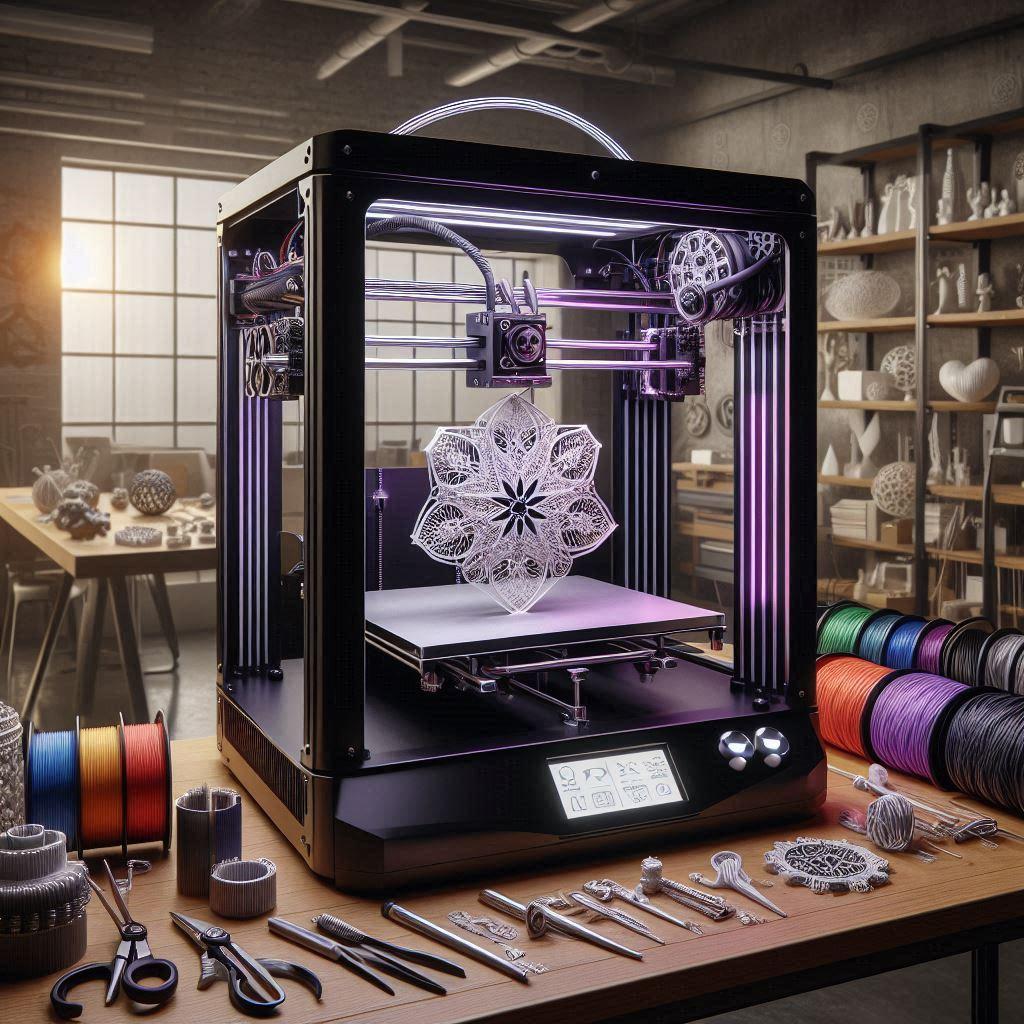
2025 is the year 3D printing finally explodes because high-speed, reliable desktop machines are now affordable, materials are easier and safer to use, and the average hobbyist can turn one printer into real products, services, and income. The tech has quietly matured—now the rest of the world is catching up.
For more than a decade, 3D printing has been “the next big thing” that always seemed just around the corner. Early adopters loved it. Mainstream users, on the other hand, often bumped into clogged nozzles, warped beds, confusing slicer settings, and printers that felt more like a science project than a tool.
That era is ending. In 2025, 3D printing is shifting from experimental hobby to everyday tool. Printers are faster, smarter, and more user-friendly. Materials are stronger and more predictable. And most importantly, more people finally understand how to use 3D printing to solve real problems, not just make benchies.
In this guide, we will break down the forces coming together right now—from better hardware and software to new business models—that make 2025 the year 3D printing finally explodes into the mainstream.
If you are completely new to this space, you may want to start with my foundational guide, What Is 3D Printing Technology? and then come back here for the bigger-picture trends shaping 2025.
Affiliate disclosure: Some of the links on this page are affiliate links. If you decide to purchase through them, I may earn a small commission at no extra cost to you. I only recommend tools and printers I would be comfortable using in my own workshop.
From Tinkering to Tools: 3D Printing Has Quietly Grown Up
The biggest shift heading into 2025 is that 3D printers are no longer fragile, experimental toys. They are evolving into fast, reliable tools. Out of the box, modern machines are far easier to live with than the early DIY kits many of us started on.
Entry-level and midrange printers now ship with features that used to require upgrades:
- Automatic bed leveling that actually works day after day
- Strong frames and enclosed or semi-enclosed designs for better temperature control
- High-speed motion systems that cut print times dramatically
- Pre-tuned slicer profiles that produce quality results with minimal tinkering
If you want a deeper breakdown of motion systems and form factors, I walk through the main categories (bed-slinger, CoreXY, resin, and more) in What Are the Different Types of 3D Printers?
Ready to Step Up to a Modern 3D Printer?
If you are still fighting with an older machine, it may be time to upgrade to a faster, more reliable printer. Modern high-speed CoreXY and well-tuned bed-slinger printers can save you hours on every project and dramatically increase your success rate.
Creality’s latest generation of printers focuses on speed, ease of use, and reliability—exactly what you want if you are serious about 3D printing in 2025.
2025’s Big Shift: Speed, Reliability, and Real-World Results
For years, print time was the quiet bottleneck. A simple functional part could take most of the day, and failed prints felt painfully expensive in lost time. In 2025, high-speed motion systems and smarter slicers are turning that equation on its head.
Combined with better auto-compensation (pressure advance, input shaping, flow calibration), 3D printers can now hit speeds that would have seemed unrealistic a few years ago while still delivering clean corners, sharp details, and strong layers.
That change has a ripple effect:
- Iterating a design in one day is now realistic instead of a week-long process.
- Running small production batches for paying clients becomes more profitable.
- Schools and makerspaces can push more students through the same number of machines.
I explore the practical side of this in 3D Desktop Printers Are Closing the Gap with Industrial Systems, where you can see how modern desktop machines compare to far more expensive industrial systems in real-world usage.
Smarter Materials and Easier Workflows
The explosion is not just about hardware. Materials are becoming more capable and more forgiving. In 2025, many hobbyists will be able to print parts that stand up to heat, UV exposure, and mechanical stress—without needing a lab or a specialized shop.
- PLA+ and modified PLAs that are tougher and more temperature-resistant than standard PLA
- PETG and PET-based blends with improved bed adhesion and reduced stringing
- ASA and ABS alternatives that print better in enclosed consumer machines
- Flexible and composite filaments that open the door to grippy, impact-resistant parts
Meanwhile, slicer workflows have become more intelligent. Instead of manually tuning every parameter, you can lean on well-tested profiles, then fine-tune a few key settings as you gain experience. Beginners can get good results quickly, and advanced users still have room to push boundaries.
The Rise of Scanning: From Real Objects to Printable Files
One of the quiet multipliers behind 3D printing’s growth is 3D scanning. Instead of designing every part from scratch, you can now capture real-world objects and turn them into editable digital models. This combination is powerful for repair work, custom accessories, and even art.
Professional-grade scanners used to cost more than a full printer farm. Today, consumer and prosumer scanners are bringing that capability into home workshops and small studios.
Turn Real Objects into Printable 3D Models
3D scanning lets you copy broken parts, capture organic shapes, and create highly customized designs that would be difficult to model by hand. It is a powerful way to expand what your printer can do in 2025.
Pairing a capable scanner with a reliable printer turns your workshop into a small reverse-engineering and customization studio.
Why 3D Printing Adoption Has Been Slow (Until Now)
If 3D printing is so powerful, why has it taken this long to reach a tipping point? Three major friction points have held it back:
- Complex setup: Manual bed leveling, firmware updates, and hardware tweaks scared off beginners.
- Unclear use cases: Many people saw cool prints online but did not know how 3D printing would fit into their own life or work.
- Unreliable results: Failed prints, inconsistent adhesion, and mechanical issues made owners feel like unpaid technicians.
The good news is that each of these barriers is being lowered. In Why 90% of 3D Printing Hobbyists Quit Within 6 Months (And How to Avoid It), I break down these challenges in detail and show how to stay on the right side of the statistics.
2025: When Use Cases Finally Click for Everyday Users
The real reason 3D printing will explode in 2025 is not just the hardware. It is the growing understanding of what to do with it. People are finally seeing concrete ways 3D printing can save time, save money, or create new income.
- Home and hobby: Custom mounts, brackets, organizers, gaming accessories, and repair parts
- Education: Hands-on models for science, engineering, and art classes
- Small business: Jigs, fixtures, housings, marketing props, and custom packaging
- Content creators: Custom props, product prototypes, and physical merch
If you are still exploring what is possible, my Guide to Choosing the Right 3D Printer walks through how to match your use cases to the right machine so you can grow into more advanced applications over time.
From Hobby to Business: 3D Printers as Micro-Factories
In 2025, more people will stop seeing their printer as a toy and start seeing it as a micro-factory. That mental shift changes everything. Instead of asking, “What can I print for fun?” you begin asking, “What problems can I solve for other people?”
There are three main paths I see hobbyists taking when they want to turn 3D printing into income:
- Selling physical prints: Offering parts on marketplaces or directly to local customers.
- Selling digital files (STLs): Creating designs and selling the files for others to print.
- Service and consulting: Helping others design, prototype, and troubleshoot their own parts.
If you are deciding between selling physical objects or digital designs, you will want to read Why Selling STL Files Is Better Than Selling Physical Prints, where I compare both models step by step.
What This Means for You in 2025
Put simply, 2025 is the year 3D printing stops being an interesting niche and starts becoming a normal tool—like a drill, a camera, or a laptop. You do not need to be an engineer to get value from it. You just need a clear use case and a reliable machine.
- If you are a beginner, this is the best time to start. The learning curve has never been smoother.
- If you are an intermediate user, you can upgrade to high-speed machines and expand into materials and scanning.
- If you are an entrepreneur, you can use 3D printing to prototype products, serve local businesses, or sell specialized designs online.
And if you do not want to invest in your own printer yet, you can still tap into the power of 3D printing by working with a reliable service provider.
Need Custom Parts Without Owning a Printer?
If you have an idea for a part, a prototype, or a small production run but no printer of your own, I can help. I offer design, troubleshooting, and print-on-demand services through my workshop.
Send your idea, a sketch, or a file, and we will explore the best way to turn it into a physical object.
Frequently Asked Questions About 3D Printing in 2025
Why is 2025 such an important year for 3D printing?
2025 is a turning point because hardware, software, and market awareness have all matured at the same time. High-speed, reliable printers are affordable, materials are easier to use, and thousands of real-world examples show how 3D printing can solve practical problems in homes, classrooms, and small businesses.
Is 3D printing finally ready for beginners in 2025?
Yes. You will still need some patience and curiosity, but modern printers offer auto-leveling, guided wizards, pre-tuned profiles, and better documentation than ever before. If you follow a structured starter guide like my Beginner’s Guide to Desktop 3D Printing, you can go from unboxing to successful prints without feeling overwhelmed.
Can you really make money with 3D printing in 2025?
You can, but it requires more than just buying a printer. You need a plan. That might mean specializing in one type of part, focusing on a local industry, or building a catalogue of digital designs. My article on selling STL files versus physical prints is a good starting point if you are thinking about the business side.
What kind of 3D printer should I buy in 2025?
For most people, a modern FDM printer with reliable auto-leveling, a sturdy frame, and good community support is the best first step. Resin printers are fantastic for small, highly detailed parts but require more attention to safety and post-processing. My Guide to Choosing the Right 3D Printer walks through this decision in more detail.
Is it better to buy a printer or use a 3D printing service?
If you see yourself printing regularly, experimenting with designs, or building a side business, owning a printer makes sense. If you only need occasional parts or prototypes, working with a 3D printing service can be more cost-effective and less time-intensive. My Custom 3D Printing Service page explains when it makes sense to outsource your prints.