
The Part Looked Perfect—Until It Spent One Afternoon in the Car
A phone mount, sunglasses clip, console organizer, or replacement knob may look strong on the print bed. Summer heat can reveal whether you printed a functional part—or a temporary one.
You designed the part carefully. The first layer went down cleanly. The walls looked solid, the dimensions fit, and the finished print felt stronger than expected.
Then you left it in the car.
By the end of a sunny afternoon, the mount leaned to one side. The clip no longer gripped. A screw hole that had fit perfectly was now slightly oval. Nothing technically “melted,” but the part had softened enough to lose the shape that made it useful.
This is one of the most frustrating lessons in functional 3D printing: a material can feel rigid at room temperature and still be the wrong material for the environment where the part will live.
How Hot Does a Parked Car Really Get?
A parked vehicle is not simply “a little warmer” than the outdoor air. Sunlight passes through the windows and heats the dashboard, seats, trim, and other interior surfaces. Those surfaces then transfer heat into the cabin.
That puts the cabin into a temperature range where ordinary PLA can begin losing rigidity. It also explains why a part may survive in a shaded door pocket but fail when mounted against a sunlit windshield.
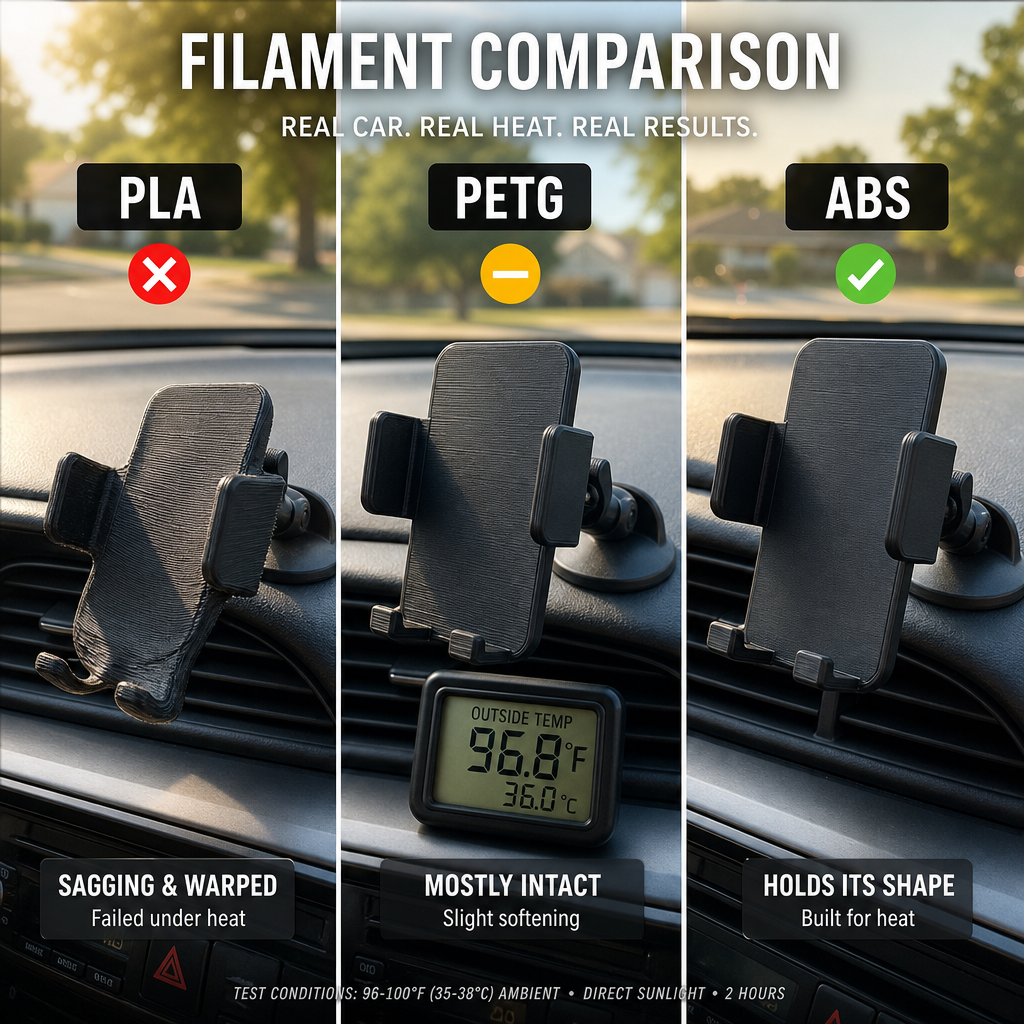
PLA vs. PETG vs. ABS: The Fast Verdict
PLA
Easy to print and excellent for prototypes, decorations, and room-temperature parts. In a hot vehicle, however, standard PLA may soften, sag, creep, or permanently change shape.
PETG
A useful middle ground with better heat resistance, impact tolerance, and layer adhesion than ordinary PLA. It can work for many interior parts, but high heat plus constant stress can still cause movement.
ABS
A stronger candidate for hot vehicle interiors because it retains its shape at higher temperatures. The tradeoff is more difficult printing, greater warping risk, odor, and the need for ventilation.
| Material | Typical heat behavior | Hot-car outlook | Printing difficulty | Best fit |
|---|---|---|---|---|
| PLA | Can begin softening or deforming around 60°C / 140°F, depending on formulation and load | Poor for parts left in summer cabin heat | Easy | Prototypes, models, indoor organizers, fit checks |
| PETG | Many formulations have heat-deflection values in roughly the 70–80°C / 158–176°F range | Better, but not guaranteed on dashboards or under sustained load | Moderate | Console parts, clips, trays, brackets, general functional prints |
| ABS | Many formulations retain useful stiffness at substantially higher temperatures than PLA or PETG | Strongest of these three for cabin heat | More demanding | Hot interior parts, housings, fixtures, mechanically stressed components |
Softening Is Usually the Problem—not Melting
People often ask whether PLA will “melt” in a car. That wording can be misleading.
Your print does not need to become a puddle to fail. It only needs to become soft enough for gravity, clamping force, a screw, a spring, or the weight of a phone to move it out of shape.
Three temperature terms are useful when comparing filament:
- Glass-transition temperature: the region where an amorphous polymer begins changing from hard and glassy to softer and more flexible.
- Heat-deflection temperature: the temperature at which a test sample bends a defined amount under a specified load.
- Vicat softening temperature: another standardized measurement of how a material responds to heat under pressure.
None of these numbers guarantees that your finished part will perform exactly the same way. A thin phone holder under constant leverage can fail before a thick, unloaded test block made from the same filament.
That is why I start with the job the part must perform—not just the material name printed on the spool.
PLA in a Hot Car: Easy to Print, Easy to Overestimate
PLA remains one of the best materials for learning 3D printing. It is affordable, dimensionally stable, available in nearly every color, and capable of producing detailed parts without a heated enclosure.
Those advantages make PLA excellent for:
- Checking whether a design fits
- Testing the position of holes and mounting points
- Creating visual prototypes
- Printing templates and measuring aids
- Producing indoor parts that will remain near room temperature
Its weakness is sustained heat. Prusa’s material guidance notes that ordinary PLA can soften and deform above approximately 60°C. A sun-soaked vehicle can enter that range, especially around the dashboard and windshield.
How PLA commonly fails in a vehicle
- A phone mount slowly droops toward the dashboard.
- A spring clip opens and no longer grips.
- A flat organizer develops a bow.
- A bracket creeps around a tightened screw.
- A fitted lid becomes loose because its dimensions shift.
- A suction-cup attachment deforms where the load is concentrated.
The part may still look like a print. It simply stops doing the job for which it was designed.
Can annealed PLA survive?
Some specialty PLA formulations can gain substantial heat resistance through controlled annealing. The catch is that annealing can also cause shrinkage, expansion, warping, and dimensional changes. The results depend heavily on the filament and the process.
Annealed PLA can be useful when you have tested a specific combination of material, geometry, and heat treatment. I would not treat ordinary PLA as a dependable hot-car material merely because annealing is theoretically possible.
PETG in a Hot Car: The Practical Middle Ground
PETG is often the first material I consider when PLA is not tough or heat-resistant enough but ABS would add unnecessary printing complications.
It generally offers:
- Better temperature resistance than standard PLA
- Good layer adhesion
- Better impact tolerance
- Low warping compared with ABS
- Useful chemical and moisture resistance
- Compatibility with many open-frame printers
Prusa describes PETG as suitable for many interior and exterior uses below 80°C. Current Polymaker data sheets show heat-deflection temperatures in the 70s Celsius for several PETG formulations. That gives PETG far more breathing room than ordinary PLA.
But “more heat-resistant” does not mean “immune to a hot car.”
The problem of heat plus load
PETG can creep when it remains warm while supporting a continuous load. A thick console tray that simply rests in place may perform well. A thin hook supporting a heavy bag, or a phone mount held under constant leverage, faces a much more difficult job.
PETG is a reasonable candidate for:
- Console dividers and removable organizers
- Protective covers away from direct windshield sun
- Low-load cable guides
- Replacement knobs and caps
- Thicker brackets with generous support
- Trunk organizers that are not carrying safety-critical loads
I would test it carefully before trusting it for a windshield-mounted accessory, a thin loaded clip, or any part where gradual movement could create a hazard.
For a broader material comparison, see my 2026 PLA vs. PETG vs. ABS performance guide.
ABS in a Hot Car: Better Heat Resistance With More Printing Demands
ABS has long been used for functional parts, housings, tools, and automotive-related applications because it combines toughness with better heat resistance than standard PLA and PETG.
For example, Polymaker lists a heat-deflection temperature near 98°C for its PolyLite ABS under one standardized load condition. That does not guarantee every ABS print will survive every vehicle environment, but it demonstrates why ABS gives you more thermal margin.
ABS may be the better choice when the part:
- Will remain in the cabin throughout summer
- Must hold its shape under a steady mechanical load
- Will be mounted near a hot dashboard or window
- Needs better impact resistance than brittle PLA
- Must tolerate repeated heating and cooling cycles
The tradeoffs are real
ABS shrinks as it cools and can lift, split, or warp when the print environment is unstable. Larger parts benefit from a warm enclosure, controlled airflow, good bed adhesion, and a tuned material profile.
Printing ABS can also release fumes and ultrafine particles. Use suitable ventilation and follow the filament and printer manufacturers’ safety guidance. An enclosure controls drafts, but an enclosure alone should not automatically be treated as complete air handling.
My guide to stopping PLA, PETG, and ABS warping can help when a higher-temperature material introduces new bed-adhesion challenges.
What About ASA?
Although this comparison focuses on PLA, PETG, and ABS, ASA deserves a serious look for vehicle accessories exposed to sunlight.
ASA offers heat resistance in the same general class as ABS while providing better resistance to ultraviolet exposure and outdoor weathering. That makes it particularly attractive for parts near windows or for accessories that may spend time outside the vehicle.
Like ABS, ASA prints best with controlled temperatures and appropriate ventilation. It is not as effortless as PLA, but the material may be worth the additional setup when sunlight and heat are both part of the design requirements.
Use the P.R.I.N.T. Method™ Before Choosing the Filament
A spool label cannot make the decision for you. Start with the actual job, environment, interfaces, and consequences of failure.
Problem
Define what the part must accomplish. Is it organizing loose change, holding a phone, supporting weight, replacing a broken clip, or protecting an electronic device?
Requirements
List the heat, sunlight, load, impact, chemical exposure, flexibility, appearance, lifespan, and safety requirements. A cabin part faces a very different environment from a display model in an office.
Interfaces
Measure every place where the part clips, screws, rests, slides, supports, or touches another component. Heat-driven movement matters most at tight fits and loaded connection points.
Next-Best Materials & Methods
Choose the easiest material and manufacturing method that honestly meets the requirements. That could mean PETG instead of PLA, ASA instead of ABS, thicker walls, a metal insert, or a completely different design.
Test & Tune
Test the part under realistic heat and load before trusting it. Watch for creep, loosened fasteners, dimensional change, layer separation, and loss of grip.
Where the Part Sits Changes the Decision
There is no single temperature inside a vehicle. The location, sunlight, airflow, material color, and surrounding surfaces all influence how hot a part becomes.
Material Choice Is Only Half the Answer
A better filament cannot rescue a weak design. The way you model, orient, slice, and fasten the part can be just as important as the polymer itself.
Reduce long, unsupported arms
A long phone-mount arm creates leverage. As the material warms, even a small loss of stiffness can allow the weight at the end of the arm to pull the print downward. Shorter load paths and triangular support ribs can make a dramatic difference.
Add walls where the load actually travels
More infill does not automatically create a stronger functional part. Perimeters, ribs, fillets, and local reinforcement often matter more. Concentrate material around screw holes, clips, hinges, and transitions.
Respect layer direction
FDM parts are anisotropic: they do not have equal strength in every direction. Orient the model so the main load does not simply pull neighboring layers apart.
Design around creep
A snap fit held open continuously may lose force over time. A metal spring, mechanical fastener, heat-set insert, or replaceable tension element can reduce the amount of work assigned to the plastic.
Use generous radii
Sharp inside corners concentrate stress. Fillets spread the load and can reduce cracking where a bracket changes direction.
Consider color and sun exposure
Dark surfaces can absorb more solar energy than lighter ones. Color alone will not turn PLA into a safe dashboard material, but it can influence how hot an exposed part becomes.
A Simple Hot-Car Test for Noncritical Parts
Do not wait for a finished part to fail after you begin depending on it. Create a test plan before full deployment.
- Print a representative prototype using the final orientation, wall count, and material.
- Measure critical dimensions before heat exposure.
- Install the intended fasteners or apply the expected load.
- Place the test piece in the actual vehicle location without creating a driving hazard.
- Use a thermometer or temperature logger near the part.
- Inspect it after repeated hot afternoons rather than one brief exposure.
- Check for sagging, creep, loose fits, whitening, cracking, and layer separation.
- Repeat the measurements and compare them with the original dimensions.
- Add a safety margin instead of designing to the edge of a data-sheet number.
A sample that survives unloaded may still fail while supporting a phone. Test the real load, attachment method, and orientation whenever the consequences are low enough to test safely.
Which Material Would I Choose?
Here is the practical way I would approach common vehicle projects:
| Project | Starting material | Why |
|---|---|---|
| Quick fit-check prototype | PLA | Fast, inexpensive, and dimensionally predictable for checking the design |
| Shaded console divider | PETG | Good balance of printability, toughness, and heat resistance |
| Removable trunk organizer | PETG or ABS | Depends on load, vehicle temperature, and risk of impact |
| Dashboard phone mount | ABS, ASA, or a higher-temperature material | Direct sun and constant leverage demand more temperature margin |
| Exterior sensor cover | ASA | Better suited to heat, weather, and UV exposure |
| Under-hood bracket | Engineering review required | Heat, vibration, chemicals, and safety exceed ordinary hobby assumptions |
The key is not to ask, “What is the strongest filament?” The better question is:
What material gives this specific part enough strength, heat resistance, dimensional stability, and safety margin for the place where it will actually be used?
Use Better Filament—Then Prove the Design
PLA, PETG, and ABS are not simply “beginner, medium, and advanced” materials. Each one represents a different set of compromises.
PLA is easy and precise but vulnerable to vehicle heat. PETG is a versatile middle ground, especially for shaded and lightly loaded interior accessories. ABS provides more heat resistance but asks more from the printer, the workspace, and the person running the job.
The filament is only the starting point. A reliable hot-car part also needs thoughtful geometry, useful wall placement, correct orientation, realistic testing, and enough margin for the worst afternoon—not merely the average one.
That is functional 3D printing: not producing an object that looks finished, but building a part that continues doing its job after real life gets involved.
Ready to Make Your Prints More Practical?
P.R.I.N.T. It: Practical 3D Printing for Beginners walks through the decisions that turn a promising model into a useful finished part—from defining the problem and measuring interfaces to choosing materials and testing the result.
Filament I Use for Practical Prints
I keep coming back to COEX 3D filament because dependable diameter, consistent material behavior, and reliable extrusion matter when a part has a real job to perform. Readers can use code 3DPRINTINGBYKEVIN for 15% off eligible purchases.
Whichever brand you choose, read its technical data sheet instead of assuming every spool carrying the same material name will perform identically.
Frequently Asked Questions
Will PLA actually melt inside a hot car?
PLA usually does not need to reach its melting temperature to fail. Standard PLA may begin softening and deforming around 60°C, especially when the part is thin or supporting a constant load. A parked vehicle can approach or exceed that range in summer.
Is PETG safe for a dashboard phone mount?
PETG is more heat-resistant than standard PLA, but a dashboard phone mount combines direct sun, high cabin temperatures, and continuous leverage. Some PETG designs may work, while thinner or heavily loaded versions may creep. Test the exact material and design, or consider ABS, ASA, or another higher-temperature filament.
Is ABS always the best filament for car parts?
No. ABS offers useful heat resistance, but it is harder to print and has weaker long-term UV performance than ASA. The best choice depends on the part’s location, load, sunlight exposure, chemical exposure, lifespan, and consequences of failure.
Is ASA better than ABS for a vehicle accessory?
ASA is often a better choice for parts exposed to sunlight or outdoor weather because it combines good temperature resistance with stronger UV resistance. It still benefits from an enclosure and appropriate ventilation.
Can more infill prevent a PLA part from warping in a hot car?
Additional infill may make a part stiffer, but it does not change PLA’s fundamental softening behavior. Geometry, walls, orientation, and load distribution can delay failure, but a more suitable material is normally the better solution for sustained vehicle heat.
Can I use a 3D-printed part under the hood?
Under-hood applications can involve temperatures, chemicals, vibration, fire behavior, and safety consequences beyond the capabilities of standard PLA, PETG, and many ABS filaments. Use qualified engineering materials, verified environmental data, and professional testing for those applications.
Sources and Further Reading
- National Weather Service: Look Before You Lock
- Prusa Material Guide: PLA
- Prusa Material Guide: PETG
- Prusa Material Guide: ABS
- Polymaker Technical Data: PolyLite PETG
- Polymaker Technical Data: PolyLite ABS
Material specifications differ by manufacturer and formulation. Review the current technical data sheet for your filament and test the completed part under realistic conditions before relying on it.
