
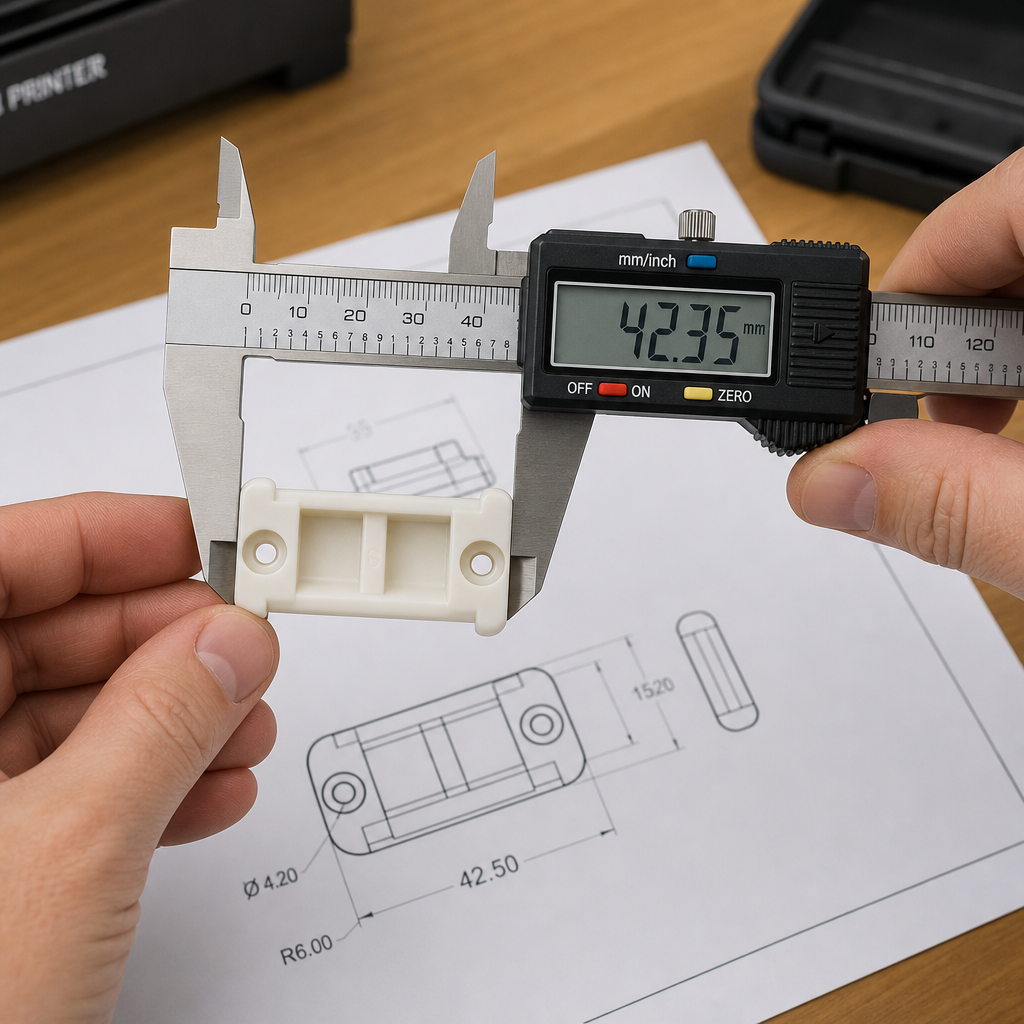
A 3D printer can reproduce a digital model with impressive consistency. It cannot determine whether the model contains the correct dimensions. This practical guide shows you what to measure, what to photograph, and what information matters most when recreating a broken, missing, or discontinued part.
How do you measure a part for 3D printing?
Start by recording the part’s overall length, width, height, and thickness. Then measure every important interface: screw holes, tabs, clips, slots, curves, mounting surfaces, clearances, and the spacing between features. Photograph the part from several angles, document how it connects to the larger assembly, and keep all broken pieces. The dimensions that control fit and function matter more than decorative details.
A printer can print the wrong dimensions perfectly
One of the easiest mistakes in custom 3D printing is focusing on the printer before understanding the part. Better hardware may improve consistency, speed, or surface quality, but it cannot correct a hole that was modeled in the wrong location.
A replacement can look nearly identical to the original and still be unusable. A mounting hole may be one millimeter too far from the edge. A clip may be too thick to flex. A slot may be too narrow after printing. A curved surface may look right but contact the surrounding assembly in the wrong places.
When replacement parts disappear, we make the next one. 3D Printing by Kevin
Making the next one begins by understanding how the original part performed its job—not merely by copying its visible outline.
Small errors can stop assembly
Incorrect hole spacing, tab placement, wall thickness, or clearance can keep an otherwise attractive print from fitting.
Movement requires clearance
Hinges, sliders, rotating features, removable lids, and snap connections need room to operate after printing.
The environment changes the design
Heat, sunlight, moisture, repeated flexing, load, and chemicals may affect both the geometry and material choice.
Start with the P.R.I.N.T. Method™
Measuring is not a separate chore added before the “real” work. It is part of defining the real problem and developing a replacement that has a reasonable chance of working.
Problem
Define what failed, what is missing, and what the replacement must accomplish.
Requirements
Account for load, heat, weather, flexibility, appearance, lifespan, quantity, and safety.
Interfaces
Measure every place the part fits, clips, slides, screws, supports, locates, or rests.
Next-Best Materials & Methods
Choose the simplest reliable design, material, orientation, printer, and workflow.
Test & Tune
Print a controlled version, inspect it, adjust one variable, and verify the fit.
What should you measure first?
Begin with the dimensions that define the part’s basic envelope. Then work inward toward the features that control assembly and function.
| Feature | Measurements to record | Why it matters |
|---|---|---|
| Overall size | Length, width, height, thickness, and maximum outside dimensions | Establishes the part’s basic size and whether it can occupy the available space. |
| Screw holes | Diameter, center-to-center spacing, depth, edge distance, and countersink or counterbore size | Incorrect hole geometry can prevent installation or weaken the surrounding material. |
| Tabs and clips | Length, width, thickness, angle, hook depth, flex direction, and engagement distance | Snap features must engage securely while bending without immediately breaking. |
| Slots and channels | Opening width, depth, taper, internal radius, and distance from reference edges | A slot that is too tight can bind; one that is too loose may not guide or retain the mating part. |
| Curves and contours | Radius where practical, chord dimensions, contact points, and neighboring gaps | A visually similar curve may still rock, wobble, or leave an unwanted gap. |
| Moving features | Pivot location, travel distance, rotation range, contact surfaces, and operating clearance | The replacement must move without binding or striking nearby components. |
| Reference spacing | Distance between holes, tabs, edges, centers, shoulders, and mounting faces | Relative position is often more important than the isolated size of one feature. |
| Wall sections | Wall thickness, ribs, reinforced areas, transitions, and thin failure points | These dimensions influence durability, printability, and how the load travels through the part. |
Choose a repeatable reference point
Measurements become confusing when each dimension begins from a different location. Select one or more stable reference surfaces and measure important features from them.
Measure from a flat mounting face
A flat edge, centerline, mounting surface, or undamaged shoulder creates a dependable starting point for related dimensions.
Avoid stacking uncertain dimensions
Measuring one feature from another poorly defined feature can allow several small errors to accumulate across the part.
Practical tip: Write dimensions directly on printed photographs or a simple hand sketch. Label the same feature consistently in every view so the numbers do not become disconnected from the geometry.
A practical seven-step measurement process
What tools can you use?
You can begin a project with basic household tools. More precise instruments become useful when a feature must fit closely or when the original geometry is small.
Do not report more precision than you actually measured. A ruler reading should not be presented as though it came from a calibrated precision instrument. Honest uncertainty is more useful than a falsely exact number.
How to photograph a replacement part for 3D printing
Measurements provide numbers. Photographs provide context. A useful photo set shows the part itself, the location where it belongs, and how it interacts with nearby components.
- Photograph the front, back, top, bottom, and both sides.
- Add angled views that reveal depth and hidden transitions.
- Place a ruler in the same plane as the feature being photographed.
- Use bright, even lighting that does not hide edges in shadow.
- Include a wide photo showing where the part belongs.
- Photograph the matching or mating component separately.
- Show every surviving fragment of a broken part.
- Mark the area where the original failed or no longer fits.
Avoid relying on one dramatic close-up. Without a wider reference view, it can be difficult to understand the part’s orientation or relationship to the larger product.
Keep every broken piece
A cracked tab, chipped corner, or separated fragment may contain information that is difficult to recover from photographs alone. Broken surfaces can reveal wall thickness, rib placement, original reinforcement, and the direction in which the part failed.
The failure can also reveal an opportunity to improve the replacement. Reproducing the original geometry exactly may recreate the original weakness. A better solution might use a thicker transition, a rounded corner, a different print orientation, added hardware, or a material better suited to the environment.
The objective is not always to create an identical copy. It is to create the next-best practical part that fits the assembly and performs the required job.
Should you measure the part, scan it, or rebuild it in CAD?
These methods are not direct replacements for one another. They often work best together.
Manual measurement
Best for straight features, holes, thicknesses, spacing, mounting geometry, and dimensions that control fit.
3D scanning
Helpful for capturing visible organic shapes, broad contours, and complex surfaces that are difficult to describe with a few dimensions.
CAD reconstruction
Useful for creating editable geometry, restoring missing features, defining precise interfaces, and preparing a controlled printable model.
A scanner captures visible surfaces, but it does not automatically know the intended hole diameter, hidden wall thickness, original symmetry, required clearance, or how the part should have looked before it broke.
For a deeper explanation, read Can a 3D Scanner Replace CAD?
Why exact-size modeling can still create a poor fit
A measurement describes the real object. The digital model converts that measurement into geometry. The printer, material, orientation, cooling, and machine setup then influence the dimensions of the physical print.
That is why a post measuring exactly 10 millimeters may not slide into a printed hole modeled at exactly 10 millimeters. Mating parts commonly need some clearance, but there is no single adjustment that works equally well for every printer, material, orientation, and type of fit.
A small fit test is often more useful than guessing. Print several controlled variations using the intended machine, material, and orientation. Record the result that produces the movement, retention, or assembly behavior the project requires.
Measure function before cosmetic detail
Prove the working geometry
Confirm mounting faces, hole locations, clearances, overall size, connection points, and load paths.
Add visual refinement
Logos, texture, color, decorative grooves, surface styling, and cosmetic matching can follow after the fit is proven.
This order keeps the first prototype focused. There is little benefit in polishing a model that cannot yet attach to the assembly.
What should you send when requesting a custom-part quote?
You do not need a finished STL or engineering drawing to begin a conversation. A clear project packet can start with photographs, basic dimensions, and a plain-language description.
- A short explanation of what the part must accomplish
- Photos of the part from several directions
- A photo showing where it fits in the larger assembly
- Overall length, width, height, and thickness
- Critical hole, slot, tab, clip, and spacing dimensions
- Details about load, heat, weather, movement, and exposure
- The number of parts you may need
- Any available STL, STEP, OBJ, sketch, drawing, or PDF
Photographs and measurements do not guarantee that every part can be reproduced safely or economically. They provide the information needed for an honest first review.
When is a part a strong candidate for 3D printing?
Customization adds real value
- The plastic part is broken, missing, or discontinued.
- You need one part, a few parts, or a controlled prototype.
- The geometry can be measured, modeled, photographed, or scanned.
- The replacement is a bracket, clip, cover, spacer, holder, guide, adapter, or similar functional component.
Failure consequences matter
- The part carries a critical structural load.
- Failure could injure someone or damage expensive equipment.
- The application involves pressure, medical use, certified food contact, or regulated requirements.
- The component experiences extreme heat or requires machining-level tolerances.
Learn more about functional project expectations on the Precision 3D Printed Parts page.
Continue learning with Maker’s Muse
For additional 3D-printing tutorials, design discussions, projects, and educational resources, visit Maker’s Muse .
External resources can broaden your understanding, but always test measurements, clearances, settings, and material choices on the actual machine and project in front of you.
Quick knowledge check
Open each question to test the most important ideas from the guide.
1. Which measurements should receive the highest priority?
Prioritize interfaces: every location where the part mounts, fits, clips, slides, screws, supports, locates, or rests against another component.
2. Why can an exact-size hole still be too tight?
Printed dimensions are influenced by the printer, material, orientation, extrusion, cooling, and calibration. Mating parts commonly require tested clearance.
3. Why should you save broken fragments?
Fragments may preserve wall thickness, curves, ribs, tab geometry, and other details that are difficult to reconstruct from memory or photographs.
4. Is the best replacement always an identical copy?
No. If the original failed because of a weak transition, unsuitable material, poor reinforcement, or harsh operating conditions, the replacement may benefit from a practical improvement.
Frequently asked questions
Can a broken part still be measured for 3D printing?
Often, yes. Surviving pieces, matching components, photographs, symmetry, mounting locations, and known reference dimensions may provide enough information to reconstruct the missing geometry. The feasibility depends on how much information remains and how precisely the replacement must fit.
Do I need digital calipers to request a quote?
No. A ruler, tape measure, clear photographs, and an explanation of the problem can be enough for an initial review. Digital calipers become helpful when small holes, thin walls, depths, and close-fitting features must be documented more accurately.
Can I measure a part from a photograph?
A photograph can provide approximate dimensions when it includes a reliable scale reference in the same plane as the feature. Perspective distortion, camera angle, and distance can reduce accuracy, so direct measurements are preferable for critical interfaces.
Can a 3D scanner capture all the measurements automatically?
A scanner can capture visible surface geometry, but it may not recover hidden features, original dimensions, internal walls, intended symmetry, necessary clearance, or missing broken geometry. Scan data often needs cleanup, alignment, dimensional verification, and CAD reconstruction.
Should the first test print use the final material?
That depends on what the test needs to prove. A fast, inexpensive material may be useful for checking basic size and hole position. The intended material becomes more important when evaluating flex, heat behavior, snap features, load, durability, or final tolerances.
Can a replacement be made stronger than the original?
Sometimes. Improvements may come from material choice, wall thickness, rounded transitions, reinforcement, print orientation, fasteners, inserts, or a change in geometry. The modified design must still fit and must remain appropriate for the intended application.
What if I do not have the original part?
The surrounding assembly may provide enough information to design a new component. Useful references include mounting holes, available space, matching parts, product photographs, manuals, sketches, and a clear description of the missing part’s job.
Have a discontinued, damaged, or hard-to-find part?
Send photographs, measurements, available files, and a description of what the part must do. The project will be reviewed for fit, function, material demands, printability, and practical next steps.
Measure the problem before printing the solution
Better measurements do more than improve dimensional accuracy. They clarify the problem, expose the important interfaces, reveal material requirements, and create a more efficient test-and-tune process.
The goal is not simply to produce another plastic object. The goal is to create a practical part that fits its surroundings and performs the required job.
Printer owners who want a complete beginner-friendly planning system can explore P.R.I.N.T. It: Practical 3D Printing for Beginners . Readers who are completely new to the process can also begin with 3D Printing for Absolute Beginners .
Custom-part feasibility depends on the available reference information, required tolerances, material demands, operating environment, expected load, quantity, budget, and consequences of failure. Not every damaged or discontinued component is an appropriate candidate for FDM 3D printing.

The section about choosing a stable reference surface suggests a useful extra handoff check: put the reference face, intended units and file revision on the same measurement sheet. When a revised model arrives, recheck hole position from that face, rather than checking only the overall length. A bracket can keep the same outer dimensions while its mounting pattern changes.
I represent CADProps. Our browser-based CAD viewer and measurement tools can help compare the digital dimensions of supported files with that sheet; the website is listed in my author link. Keeping the model check separate from the fit-test result also makes it clearer whether an adjustment was made in CAD or in the printing process.
Thanks for adding this practical handoff check. Recording the reference face, units, and file revision on the same measurement sheet helps prevent confusion when a revised model arrives. A bracket can retain its overall size while the mounting-hole positions change, so those locations deserve a fresh check.
I also agree with keeping the digital dimension check and physical fit-test results separate. That makes it easier to trace whether an adjustment came from the CAD model or the printing process. Thanks for clearly disclosing your connection to CADProps.