
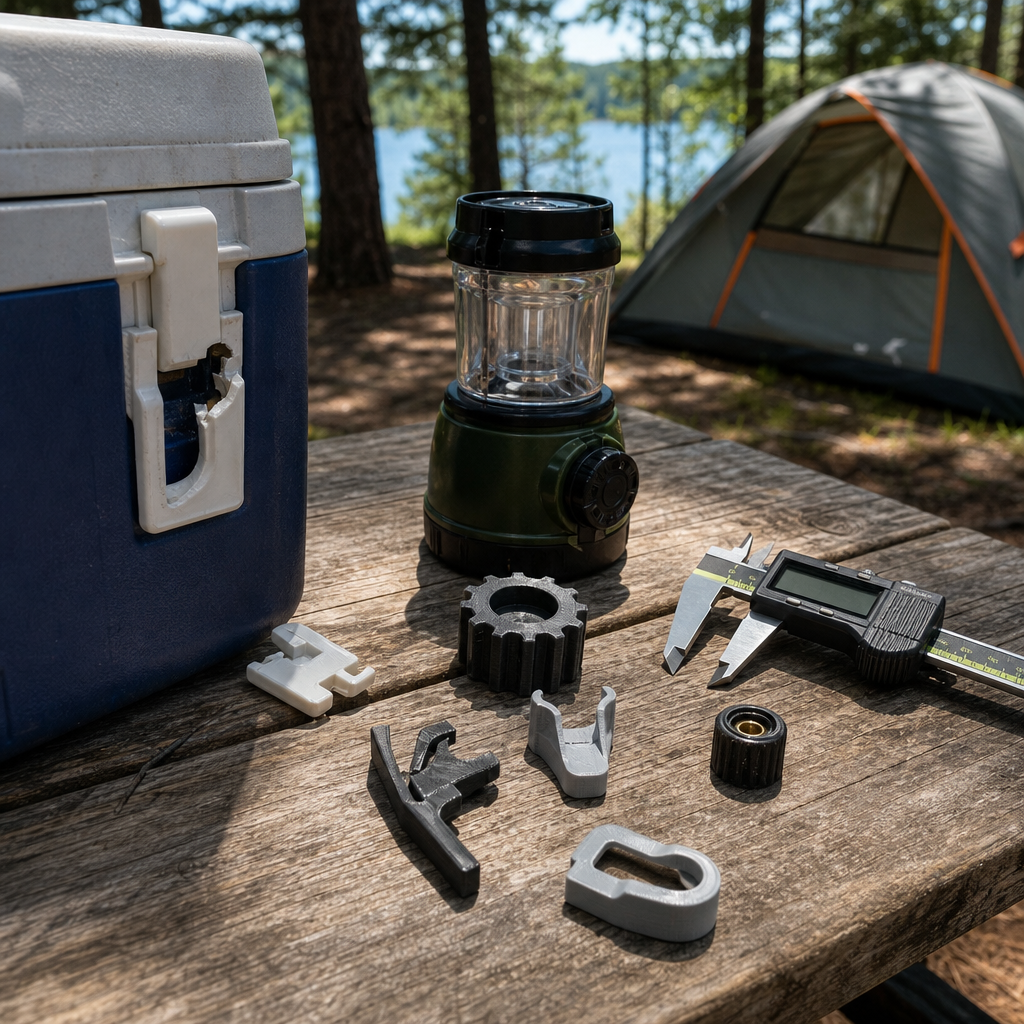
A cracked tent clip, missing lantern knob, broken cooler latch, or loose storage bracket can interrupt an otherwise good trip. Some of these components may be practical candidates for custom 3D printing. Others carry loads, heat, fuel, pressure, or safety consequences that make an original replacement the better choice.
Can broken camping-gear parts be 3D printed?
Some can. Non-critical items such as tent-pole clips, lantern knobs, cooler feet, storage hooks, cord guides, equipment caps, organizer brackets, and certain lightweight latches may be worth evaluating. Avoid casual printing for climbing equipment, stove and fuel-system parts, structural chair components, load-bearing hammock hardware, pressurized containers, electrical safety parts, or anything whose failure could cause injury, fire, or equipment collapse.
The broken piece may be small, but its job still matters
Two plastic parts can look equally simple while carrying very different responsibilities. A lantern knob may only turn a control shaft. A tent clip may position lightweight fabric. A stove fitting, chair joint, or hammock connector may face heat, fuel, repeated impact, or a person’s full weight.
That is why a useful review begins with function and failure—not merely whether the shape can be modeled.
3D Printing by Kevin principle: The question is not simply “Can this be printed?” The better question is “What must this part survive, and what happens if it fails?”
Use the P.R.I.N.T. Method™ before rebuilding camping gear
Outdoor equipment faces movement, dirt, sunlight, moisture, vehicle heat, and repeated packing. The P.R.I.N.T. Method keeps the project focused on the real job.
Problem
Identify what broke and which function was lost.
Requirements
Consider load, sunlight, heat, moisture, flex, impact, and safety.
Interfaces
Measure every pole, hole, slot, hook, shaft, screw, and mating surface.
Next-Best
Compare an original part, repair, redesign, custom print, or equipment replacement.
Test & Tune
Verify fit and function at home before depending on it outdoors.
9 camping-gear parts worth evaluating
Tent-pole clips
A measured clip may restore fabric positioning when the pole diameter, clip opening, flex direction, and expected tension are understood.
Lantern knobs
A replacement knob may work when it remains safely separated from flame, high heat, fuel, and critical electrical components.
Cooler feet and handles
Low-risk feet, grips, and trim components may be practical when the load and attachment method are documented.
Storage-bin latches
A latch can be redesigned around the actual hinge, catch, flex point, and amount of force needed to close the bin.
Cord and hose guides
Custom guides can match a particular cable, water hose, table edge, equipment case, or storage position.
Protective caps
Caps can cover exposed tube ends, protect threads, reduce dirt entry, or keep small equipment components together.
Table and campsite hooks
A custom hook may hold lightweight utensils, towels, cords, or bags when the mounting surface and load are appropriate.
Organizer brackets
Purpose-built holders can organize flashlights, cooking tools, tent stakes, small electronics, or repair supplies.
Discontinued covers and spacers
A small unavailable component may be recreated when the surrounding equipment remains useful and the interfaces can be measured.
Comparison: replace the gear or recreate the broken part?
| Option | Best when | Primary advantage | Important limitation |
|---|---|---|---|
| Original replacement | The manufacturer still sells the correct part affordably | Known fit and intended material | May be unavailable or bundled with a larger assembly |
| Simple repair | The original component can be restored reliably | Fast and potentially inexpensive | Cracked flex points and stressed joints may fail again |
| Downloaded model | A verified design matches the exact equipment | Less modeling work | Online files may not match the dimensions, load, or intended environment |
| Custom 3D-printed part | The component is unavailable or needs a specific fit | Purpose-built geometry and redesign potential | Requires measurements, material judgment, prototyping, and testing |
| Replace the equipment | The failure affects safety or several parts are deteriorating | Restores the complete system | Usually carries the highest cost |
What should not become a casual camping print?
Human-support components
Climbing hardware, hammock suspension, chair frames, cot joints, child carriers, and other load-bearing parts require proven equipment.
Fuel, flame, and pressure parts
Stove fittings, fuel caps, valves, pressurized vessels, and flame-adjacent components should not be treated as simple plastic replacements.
Critical electrical protection
Battery enclosures, high-current connections, charging safety parts, and heat-exposed electrical components require proper materials and engineering.
Safety boundary: A successful print is not automatically a safe camping part. Do not depend on an improvised component where failure could cause a fall, fire, fuel leak, electrical hazard, or shelter collapse.
Material choice begins with the environment
PLA
Useful for early fit checks and many low-load indoor items, but summer vehicle heat and prolonged outdoor exposure can make it a poor choice for trip-critical gear.
PETG
A practical candidate for many low-risk clips, guides, caps, knobs, and holders that need better moisture and heat tolerance than PLA.
ASA
Often worth considering for parts exposed to sunlight and weather, provided the geometry, printer setup, load, and failure consequences are appropriate.
Material alone cannot rescue a weak design. Wall thickness, print orientation, stress concentration, fasteners, trapped water, flex direction, and the conditions inside a parked vehicle also matter.
Measure the attachment—not just the broken outline
A tent clip can look correct but release from the pole. A cooler latch can close but fail to engage the catch. A knob can fit the shaft but turn past the intended stop. Functional success depends on the interfaces.
- Measure pole, tube, shaft, cable, and hose diameters.
- Record hole size, spacing, depth, and edge distance.
- Document clip openings, hooks, tabs, slots, and catches.
- Measure screw size, thread features, and insertion depth.
- Photograph the component installed on the full product.
- Include every broken fragment when possible.
- Explain the direction and amount of expected force.
- Note sun, rain, dirt, heat, and vehicle-storage conditions.
Review How to Measure a Part for 3D Printing before submitting the project.
Try the pre-trip thirty-second test
Pick up the questionable part and decide which description fits it best.
This may be a promising custom-part candidate.
Slow down and choose proven equipment or specialist review.
Do not depend on it during a trip until the risk is understood.
Helpful resources for the next step
Original part unavailable?
Read Discontinued Plastic Parts Replaced with 3D Printing to understand the replacement-part process.
Need a purpose-built holder?
Explore Custom Plastic Mounts and Holders for equipment organization and mounting projects.
Want a repeatable project system?
Continue with P.R.I.N.T. It: Practical 3D Printing for Beginners for structured planning, materials, troubleshooting, and functional-print decisions.
Readers new to the process can also begin with 3D Printing for Absolute Beginners .
Quick knowledge check
Open each question to test the key decisions before relying on a printed camping part.
1. Why is a tent clip different from a hammock connector?
A tent clip usually positions lightweight fabric. A hammock connector supports a person, making its failure consequences much more serious.
2. Why is matching the outside shape not enough?
The part must also engage its pole, shaft, screw, hook, catch, or mating surface with the correct clearance and operating movement.
3. Why should a camping part be tested before the trip?
Home testing reveals poor fit, weak orientation, interference, unexpected flex, and installation problems before the part becomes necessary outdoors.
4. When should the original replacement come first?
Prefer it when it is available and affordable, or when the component involves human support, heat, fuel, pressure, electricity, or another serious failure consequence.
Frequently asked questions
Can a broken tent-pole clip be 3D printed?
Often, it is worth evaluating. The pole diameter, fabric attachment, clip opening, flex direction, tension, sunlight, and expected temperature should all be considered.
Can a cooler latch be recreated?
Some low-risk cooler latches and handles may be practical. The hinge, catch, closing force, flex cycle, impact, food-contact boundaries, and vehicle-storage temperature must be reviewed.
Is PETG suitable for camping accessories?
PETG can be useful for many low-risk camping accessories, but suitability depends on load, sunlight, heat, moisture, geometry, print orientation, and expected lifespan.
Is ASA better for parts left outdoors?
ASA may be preferable for sustained sunlight and weather exposure. It does not make a safety-critical or poorly designed part appropriate.
Can a camping part be designed from photographs?
Photographs help explain the problem, but accurate interfaces usually require direct measurements, scale references, broken fragments, or access to the mating equipment.
Can several matching clips or organizers be produced?
Yes, but one prototype should be fitted and tested first. A small dimensional mistake becomes more expensive when repeated across a batch.
Have a broken camping part that is no longer available?
Send clear photographs, dimensions, broken fragments, equipment information, and an explanation of what the part must do. The review will focus on fit, outdoor exposure, load, safety, material, and whether FDM 3D printing is the right solution.
Project suitability depends on geometry, material, load, heat, sunlight, moisture, impact, movement, tolerances, expected lifespan, and the consequences of failure. Do not use improvised printed parts for climbing, human support, fuel systems, pressurized equipment, flame control, critical electrical protection, or other safety-dependent camping applications.
