
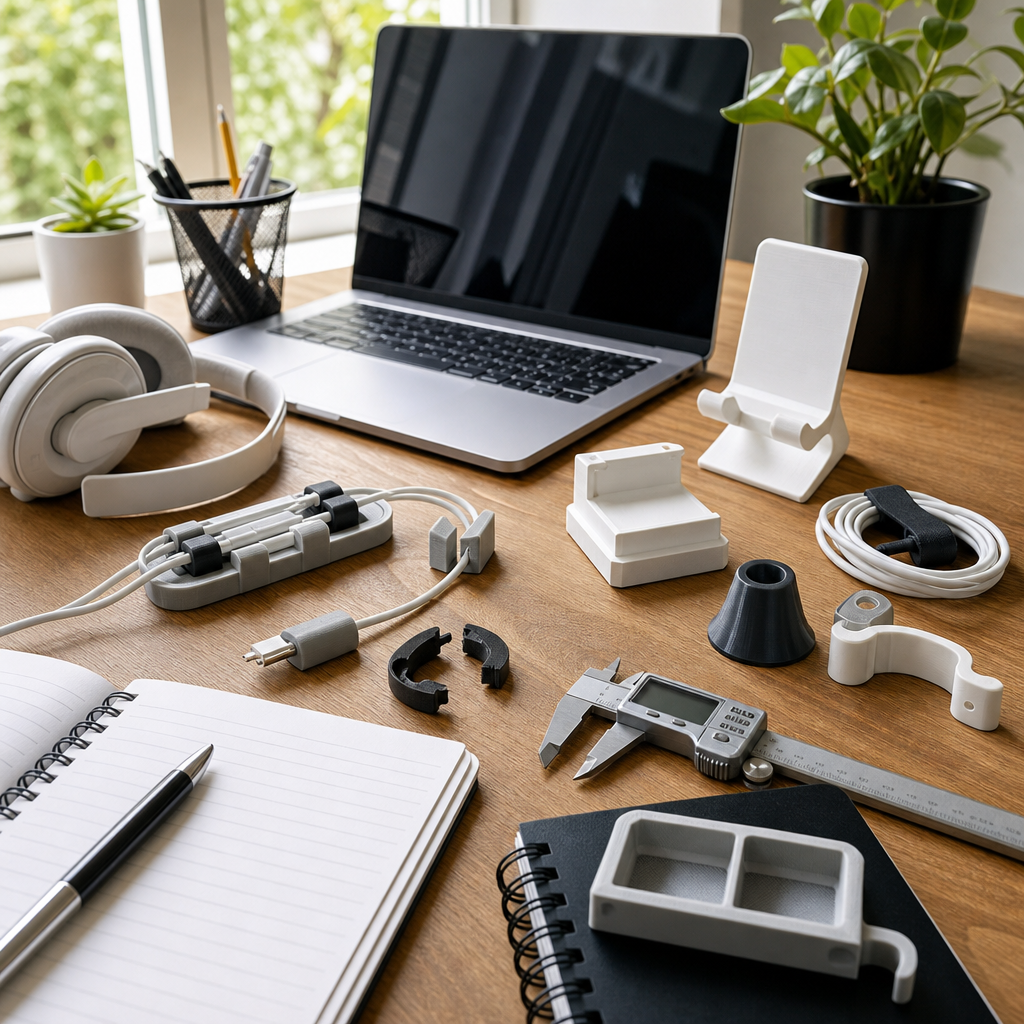
Back-to-school shopping usually focuses on notebooks, electronics, storage, and supplies. Yet the problems that create daily frustration are often smaller: a broken chair cap, loose charging cable, missing shelf clip, awkward headphone storage, or desk accessory that almost fits. Practical 3D printing can sometimes solve those problems without adding more clutter.
What are the most useful back-to-school 3D printing ideas?
The most useful ideas solve a specific fit or organization problem: cable clips, headphone hooks, device stands, replacement furniture caps, drawer dividers, label holders, backpack hooks, small equipment knobs, and custom holders for classroom or dorm supplies. Start with the problem and measurements—not a random list of decorative prints.
Useful beats impressive when school gets busy
A large decorative print may look exciting on move-in day. A small cable guide that keeps a charging cord from falling behind the desk may improve the workspace every day.
That difference matters. A useful print has a clear job, fits the available space, works with the surrounding objects, and can survive repeated use. It should reduce friction rather than become one more item competing for desk space.
More 3D printing inspiration: For a broader look at 3D printing projects and ideas, you can also explore All3DP .
3D Printing by Kevin principle: Start with the problem—not the newest printer, trending model, or most complicated design.
Plan school and dorm projects with the P.R.I.N.T. Method™
The P.R.I.N.T. Method keeps a simple organizer or replacement part focused on real dimensions, use conditions, and a purposeful test.
Problem
What keeps falling, breaking, tangling, sliding, or wasting space?
Requirements
Consider size, load, safety, appearance, movement, and daily use.
Interfaces
Measure desks, cables, shelves, tubes, devices, holes, and mounting surfaces.
Next-Best
Compare a purchased product, simple repair, custom holder, or printed replacement.
Test & Tune
Try a small version, check the fit, and adjust before making more.
9 practical back-to-school problems 3D printing may solve
1. Charging cables that fall
A custom cable guide can match the exact desk edge, cable diameter, and number of cords.
2. Headphones with no home
A hook can fit a shelf, desk, bed frame, or workstation without occupying writing space.
3. Awkward device viewing
A stand can match the device, charging-port location, case thickness, and preferred angle.
4. Broken chair or desk caps
A measured replacement may protect floors and restore furniture that is otherwise usable.
5. Drawers that waste space
Custom dividers can follow the actual drawer instead of forcing supplies into generic bins.
6. Missing shelf clips
Some low-risk clips and supports may be recreated when their fit, load, and failure risk are understood.
7. Backpacks on the floor
A properly designed hook or holder may help when the mounting surface and expected load are suitable.
8. Shared supplies without labels
Reusable label holders can help organize bins, drawers, shelves, and classroom stations.
9. A discontinued knob or cover
A custom replacement may preserve useful classroom, office, or dorm equipment when the original is unavailable.
Comparison: buy a generic organizer or make a custom-fit solution?
| Option | Best when | Advantages | Limitations |
|---|---|---|---|
| Generic store-bought product | A standard size fits and the item is affordable | Fast, widely available, no development work | May waste space, block ports, fit loosely, or solve only part of the problem |
| Downloaded 3D model | An existing design matches the object and use | Low design effort and quick access | Dimensions, strength, mounting, and printability may not match the real situation |
| Custom 3D-printed part | The problem requires a particular size, interface, angle, or attachment | Purpose-built fit, low-volume production, and redesign potential | Requires measurements, modeling, material selection, and testing |
| Repair or reuse | The original item remains repairable | May be the least expensive and least wasteful option | Weak clips, cracked hinges, and stressed joints may fail again |
What should not become a casual school print?
Furniture carrying people
Chair frames, load-bearing seat parts, structural desk supports, and similar components require more than a quick desktop print.
Electrical safety parts
Outlet components, electrical enclosures, battery safety parts, and heat-exposed charging components deserve proper certified solutions.
Protective or accessibility equipment
Safety guards, mobility aids, medical devices, restraints, and other critical equipment require specialist review.
Practical boundary: A classroom or dorm part should not be trusted merely because it printed successfully. The consequences of failure still determine whether FDM printing is appropriate.
Measure the space around the problem
Custom parts rarely succeed from one overall dimension. A cable holder must match the cable and desk. A device stand must allow room for the case, buttons, camera, and charging plug. A shelf clip must fit both the hole and the shelf position.
- Measure the object and the space surrounding it.
- Record cable, tube, hole, slot, and shelf dimensions.
- Photograph the problem from several angles.
- Include a ruler or known-size object for scale.
- Identify surfaces that cannot be drilled or altered.
- Note the expected weight and direction of load.
- Check ports, buttons, hinges, vents, and moving parts.
- Explain what happens when the current setup fails.
Use How to Measure a Part for 3D Printing before requesting a custom-fit solution.
Which problem is costing you the most time?
Look around the study area for thirty seconds. The best project is often not the most exciting object—it is the small problem handled several times every day.
Helpful resources for the next step
Need a custom holder?
Visit Custom Plastic Mounts and Holders for purpose-built mounting and organization projects.
New to 3D printing?
Read 3D Printing for Absolute Beginners for a practical introduction to printers, files, materials, and project decisions.
Want the complete system?
Explore The Practical Guide to 3D Printing , a 40-page ebook built around useful parts, troubleshooting, materials, and the P.R.I.N.T. Method™.
Printer owners working on their own parts may also benefit from My Go-To 3D Printer Settings for Reliable Prints on Any Machine .
Quick knowledge check
Open each question to test the main project decisions.
1. What makes a strong back-to-school 3D printing project?
It solves a defined problem, fits a particular space or object, uses an appropriate material, and can be tested without creating unnecessary risk.
2. Why are measurements around the object important?
A part may fit the main object but block a charging port, hit a hinge, interfere with a drawer, or lack enough room for installation.
3. When should a generic product come first?
Choose a generic product when it already fits the available space, meets the requirements, and costs less than developing a custom solution.
4. Why is a completed print not automatically a successful part?
The finished item still needs to fit, carry the expected load, survive repeated use, avoid interfering with other objects, and remain suitable for its environment.
Frequently asked questions
Can a custom laptop or tablet stand be 3D printed?
Often, yes. The device dimensions, case thickness, viewing angle, charging-port location, ventilation, stability, and expected use should be considered.
Can broken desk or chair caps be recreated?
Some non-structural caps and floor-protection pieces are good candidates. Parts that support a person or maintain the structural integrity of furniture require greater caution.
Is PLA suitable for desk organizers?
PLA can work well for many low-load indoor organizers. Material choice should still consider heat, direct sunlight, flex, impact, wall thickness, and how the item will be handled.
Can a part be designed from a photograph?
Photographs help explain the problem, but custom-fit interfaces normally require direct dimensions, scale references, or access to the object the part must fit.
Are downloaded school organizers ready to print?
Not always. Check scale, wall thickness, print orientation, supports, device compatibility, mounting method, and whether the model matches the actual workspace.
Can several matching organizers be produced?
Yes, when the design has been tested first. A verified prototype should come before producing a classroom set, dorm collection, or small batch.
Have a small school, dorm, or desk problem that generic products do not solve?
Send photographs, measurements, broken pieces, sketches, or available files. The review will focus on fit, function, material, daily use, safety, and whether custom FDM printing is the right solution.
Project suitability depends on geometry, required tolerances, material, load, heat, movement, mounting method, expected lifespan, environment, and the consequences of failure. Structural furniture parts, electrical-safety components, protective equipment, accessibility devices, and other critical items require additional scrutiny and may not be appropriate for FDM 3D printing.
