
It usually starts with one stupid little plastic part.
A clip snaps. A bracket cracks. A knob disappears. A mounting tab breaks off an otherwise perfectly good piece of equipment.
Then you start searching.
Amazon. eBay. Manufacturer websites. Parts diagrams. Hardware stores. Forums.
Nothing.
Or worse—you finally find something that looks almost right, order it, wait three days, and discover the holes are 4 mm off and the thing will not fit.
That is the kind of problem where custom 3D printing starts making a lot of sense.
Not because 3D printing is magical. Not because everything should be printed. But because sometimes the part you actually need was never mass-produced in the first place.
And when replacement parts disappear, sometimes the smartest move is to make the next one.
Quick Answer
Custom 3D printing is most useful when the part you need cannot simply be bought.
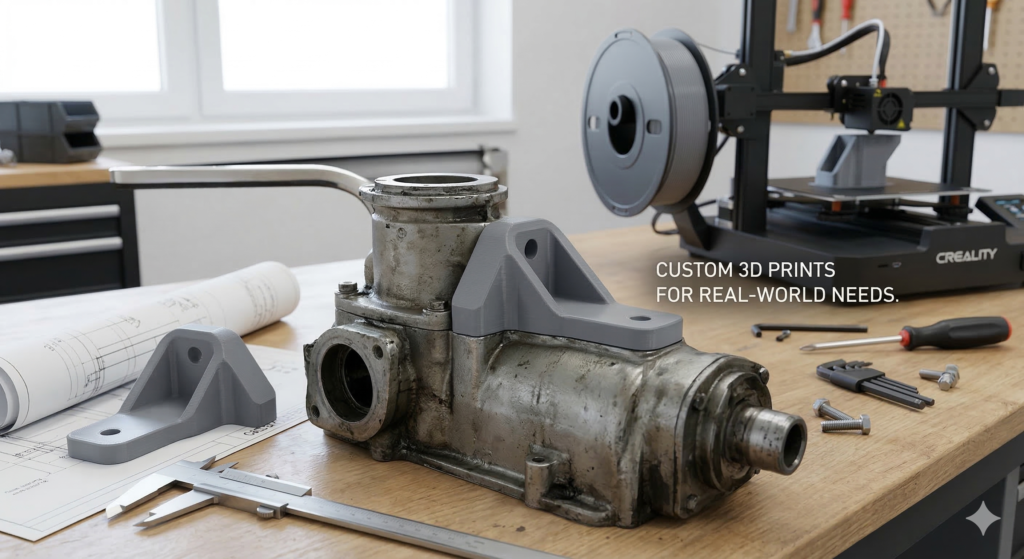
That might mean a discontinued replacement part, an odd-size bracket, a one-off adapter, a custom holder, a prototype, or something that needs to fit one very particular machine, cabinet, vehicle accessory, tool, or workspace.
If a $7 store-bought part solves the problem correctly, buy it. But when “close enough” is not actually close enough, a custom part can change the equation.
The $5 Part That Can Sideline a $500 Machine
This is one of the strangest things about modern products.
The motor may still work. The electronics may be fine. The frame may be nearly indestructible.
But one small molded plastic piece breaks—and suddenly the entire thing becomes difficult or impossible to use.
I see that kind of problem very differently from, “Can you print me something cool?”
Now we have a real job to solve.
What did the broken part actually do? What surfaces did it locate against? Did it flex? Did it hold a screw? Did it keep something aligned? Was the original design weak in the same place where it finally failed?
Those questions matter because sometimes recreating the old part exactly is not the best answer.
Sometimes we can make the replacement smarter.
This Is Where “Almost Fits” Gets Expensive
Off-the-shelf products are designed to fit lots of people.
Custom parts only have to fit your problem.
That difference is bigger than it sounds.
| The Problem | Off-the-Shelf | Custom 3D Print |
|---|---|---|
| Standard bracket | Usually the easy winner | Probably unnecessary |
| Holes do not line up | Drill, modify, or improvise | Design around the actual hole pattern |
| Discontinued plastic clip | May be impossible to source | Recreate the function |
| Odd holder for one specific object | Generic fit and wasted space | Fit the exact object and location |
| Two products need to connect | Hope someone makes an adapter | Build the missing interface |
| Prototype idea | Nothing to buy yet | Print, test, change, repeat |
And this is an important point: I am not trying to 3D print your problem just because I own 3D printers.
If the correct commercial part already exists, that may be the better choice.
The interesting projects are the ones where the shelves run out of answers.
The Projects That Make Me Say, “Yep, 3D Printing Might Work Here”
A Discontinued Part Nobody Sells Anymore
Vintage equipment is a perfect example.
The manufacturer may have stopped making the product years ago. Spare inventory dries up. Used parts become harder to find. Eventually, a tiny plastic component becomes the reason someone is considering throwing away something that still works.
If we have an original part, a broken sample, useful measurements, or the assembly it fits into, we may have enough information to recreate the important geometry.
I go deeper into that process in Discontinued Plastic Parts Replaced With 3D Printing.
A Bracket That Needs to Fit One Weird Space
These projects are deceptively satisfying.
You have 68 mm between two surfaces. A screw hole here. A cable passing there. A curved housing on one side. And nothing online is even remotely the right shape.
Perfect.
Instead of modifying five different things to accommodate a generic bracket, we can design the bracket around what is already there.
Two Things That Were Never Supposed to Connect
This comes up constantly in workshops, cars, hobby equipment, electronics, home organization, photography, tools, and machinery.
You have Thing A.
You have Thing B.
They would work beautifully together if somebody had bothered to make the missing adapter.
Sometimes that somebody can be us.
An Idea That Needs to Become Something You Can Hold
CAD is incredibly useful, but staring at a model on a screen can fool you.
Print the thing and suddenly you notice the handle feels too narrow. The clip is too stiff. The mounting hole needs another millimeter. The cable rubs the edge. The part looked compact on-screen but feels gigantic in your hand.
That is not wasted effort.
That is the prototype doing its job.
My guide to 3D-printed replacement-part test fitting explains why I like proving the uncertain features before committing to the final version.
I Don’t Start by Asking, “PLA or PETG?”
I start by asking what the part has to survive.
Will it live indoors?
Sit in a hot car?
Flex every time somebody opens a cabinet?
Hold a few ounces—or several pounds?
See vibration? Sunlight? Moisture? Repeated screw tightening?
Those answers tell me far more than the color you want.
PETG is often a useful option for functional parts because it offers a practical balance of toughness, durability, and printability. ASA becomes interesting when outdoor exposure and elevated temperatures enter the conversation.
But filament is only part of the design.
A poorly oriented “strong” material can still fail. A better-designed part in a more appropriate orientation can perform very differently.
Walls, ribs, fillets, print orientation, layer direction, clearances, fasteners, and where the load enters the part all matter.
That is why I would rather understand the job first and choose the material second.
My P.R.I.N.T. Method™ Starts Before the Printer Turns On
I use the P.R.I.N.T. Method™ to keep custom projects from becoming expensive guessing games.
- P — Problem: What are we actually trying to fix?
- R — Requirements: What does the new part need to survive and accomplish?
- I — Interfaces: Where does it bolt, clip, slide, rest, locate, or mate?
- N — Next-Best Materials & Methods: What material, geometry, print orientation, or manufacturing method makes sense?
- T — Test & Tune: Print what we need to learn, inspect it, and refine the design if necessary.
That last step is where a lot of good parts become better parts.
I would rather discover a clearance problem on one test print than after making twenty finished pieces.
No CAD File? That Does Not Automatically Stop the Project.
I think this surprises people.
You do not necessarily need to show up with a beautiful STEP file and a complete engineering drawing.
Sometimes the starting point is an ugly broken piece sitting in a sandwich bag.
That can be enough to start a conversation.
Useful starting information can include the original component, a broken part, clear photographs, measurements, sketches, the mating assembly, or an existing STL/STEP/OBJ file.
If you are local to Northern Kentucky or the Cincinnati area, being able to physically examine the original piece can be especially helpful. Small clips, hidden curves, tabs, snap features, and mating surfaces are not always obvious in photographs.
Before You Ask for a Quote, Answer These Six Questions
- What does the part need to do?
- What does it fit, hold, connect, cover, or attach to?
- Roughly how large is it?
- Will it see heat, sunlight, impact, vibration, flexing, moisture, or chemicals?
- Do you need one, ten, or a hundred?
- What happens if it fails?
You do not need engineering terminology.
Tell me what the problem is in plain English. That is often more useful than trying to guess which filament or printing settings you need.
What Happens When I Get Your Project?
First, I Try to Understand What Failed
If it is a replacement part, the broken area can tell us quite a bit.
Did a thin tab snap? Did a screw boss split? Did a clip fatigue after years of flexing? Did the original part fail because somebody accidentally hit it—or because that section was weak from day one?
I do not want to blindly copy a bad feature if we have an opportunity to improve it.
Then I Look for the Dimensions That Actually Matter
Not every surface has to be perfect.
But a mounting hole might.
A snap fit might.
The distance between two mating surfaces definitely might.
Those critical interfaces get my attention first.
Then We Prove the Part
For fit-sensitive work, I may recommend a test piece before producing the final quantity.
This is one of the big advantages of additive manufacturing: we can learn without tooling up for hundreds or thousands of parts.
Print. Check. Adjust.
Then make the version we actually want.
And Sometimes I’ll Tell You Not to 3D Print It
This might be the most important section on the page.
Having the ability to make something does not automatically mean we should.
If a part is safety-critical, highly loaded, pressure-containing, medically critical, structurally critical, or otherwise creates serious consequences if it fails, desktop FDM may not be the appropriate solution.
Sometimes the right answer is an OEM replacement.
Sometimes it is CNC machining, molding, SLS, MJF, or another manufacturing process.
And sometimes the right answer is simply, “I would not trust a printed part here.”
I would rather tell you that before you spend money.
Why I Like These Projects So Much
There is something satisfying about taking a problem that has been annoying someone for months and reducing it to a handful of measurements and a workable design.
Especially when the alternative was throwing away something that still had years of useful life left in it.
That is the side of 3D printing I enjoy most.
Not printing something just because we can.
Making something because there is a real reason for it to exist.
Quick Knowledge Check
1. When does custom 3D printing make the most sense?
When an off-the-shelf solution is unavailable or cannot meet the specific fit, geometry, mounting, function, or quantity requirements of the project.
2. Do I need a CAD file before contacting Kevin?
No. An original part, broken sample, measurements, photographs, sketch, mating component, or digital file can all provide useful starting information.
3. Why might the first print be a test?
Because one prototype can verify fit, clearance, alignment, movement, or another uncertain feature before additional parts are produced.
4. Does choosing a strong filament guarantee a strong part?
No. Geometry, orientation, layer direction, wall design, fasteners, fit, temperature, and the direction of the load also affect how a functional print performs.
Frequently Asked Questions
Can you reproduce a discontinued plastic part?
Often, yes, depending on the part. Having an original, broken sample, good dimensions, or the mating assembly can make reverse-engineering much more practical.
Can you make the replacement stronger than the original?
Sometimes the geometry can be improved, but stronger is not automatic. Material, print orientation, loading, available space, and the reason the original failed all need to be considered.
Can I bring the original part to you?
Yes. For appropriate local projects, examining the original part or the assembly it fits into can be extremely useful. Start with the project intake form so I can review the project and arrange the next step.
Do you handle small batches?
Yes, suitable small-batch projects can be evaluated once the design, material, print time, finishing requirements, and quantity are understood.
What if 3D printing is not the best manufacturing method?
I would rather identify that early. Depending on the project, another manufacturing process—or an existing commercial component—may make more sense.
Got One of Those “Nobody Makes This Anymore” Problems?
Send it my way.
You do not need to know CAD. You do not need to know which filament to choose. And you do not need to explain the problem like an engineer.
Show me the broken part, the space it needs to fit, the thing you are trying to connect, or the problem that refuses to go away.
We will start there.
3D Printing by Kevin • Independence, Kentucky • Serving Northern Kentucky, Greater Cincinnati, and suitable shipped projects
Have you ever had a perfectly good product become useless because of one tiny broken plastic part? Tell me about it in the comments. I am always interested in the oddly specific problems people run into—because those are often the projects where custom 3D printing becomes genuinely useful.
