Cosplay • gifts • props • one-off ideas
The best unique 3D prints usually start with a sentence you cannot type into a normal shopping search: “I need this shape, but it has to fit me,” “I want this gift to mean something,” or “I need a part that simply does not exist.” That is where custom 3D printing gets interesting.
I have spent years printing and modeling functional parts, prototypes, replacement pieces, and one-off projects. The common thread is not the printer. It is the decision-making before the printer starts: what the object needs to do, how it needs to fit, what can fail, and what details make it yours.
Quick Answer: What Makes a 3D Print Truly Unique?
A unique print is not just a downloaded model in a different color. The real advantage is being able to change scale, shape, fit, text, attachment points, material, assembly, and function around one specific project.
That makes 3D printing especially useful for cosplay pieces, custom props, personalized gifts, display models, organizers, prototypes, and practical one-off builds. Some projects can be printed from an existing licensed file. Others need CAD work, measurements, scanning, test fits, or several controlled revisions before the final version makes sense.
Why “Almost Right” Is Where Custom 3D Printing Begins
Mass-produced products have to work for a large group of people. A helmet comes in standard sizes. A display stand is made for a common object. A gift has whatever personalization the manufacturer decided to offer. A bracket has fixed mounting holes because the factory cannot redesign it for one customer.
Custom 3D printing works in the opposite direction. You can begin with the exact problem and build outward from there.
Cosplay & wearable parts
Scale around the wearer, split large geometry into printable sections, plan fasteners or magnets, and think about comfort before committing to a long print.
Props & display pieces
Balance visual detail with assembly, stability, wall thickness, finishing effort, and how the piece will be handled or transported.
Personalized gifts
Add names, dates, messages, custom geometry, hobby references, or a function that only makes sense to the person receiving it.
Custom builds
Create mounts, holders, enclosures, adapters, prototypes, replacement pieces, and odd little solutions that are too specific for retail shelves.
If you are new to the process, start with my 3D Printing for Absolute Beginners guide. It explains the FDM workflow without assuming you already speak slicer.
Cosplay and Props: The Print Is Only One Part of the Build
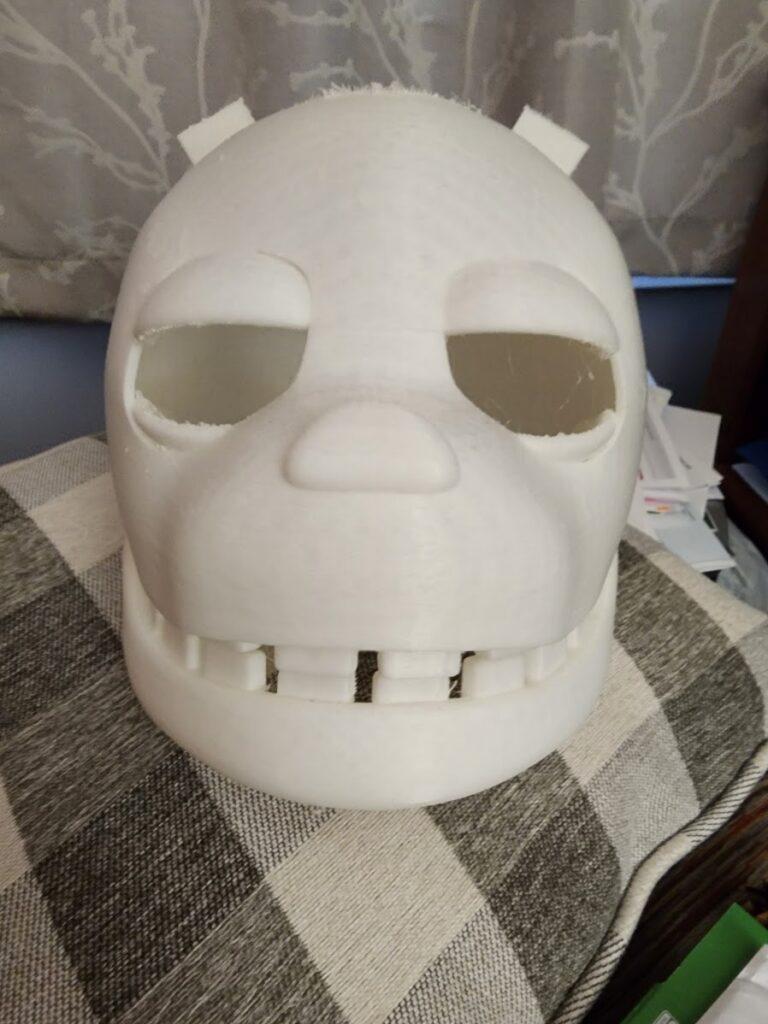
A dramatic cosplay part can look simple once it is finished, but the print may be the easiest part of the job. Fit, assembly, support placement, seam locations, hardware, sanding access, and surface finishing can determine whether a model is enjoyable to use or a headache from the first test fit.
For wearable projects, I would rather solve the fit question early than discover after a 20-hour print that the opening is too narrow or the attachment point lands in the wrong place.
Questions worth answering before printing
- Is the model scaled to the actual wearer or only to a generic size?
- Can the finished piece move, flex, or be removed the way it needs to?
- Where should a large model be split so the seams are easier to reinforce and finish?
- Will magnets, screws, straps, pins, or adhesives be used?
- Which surfaces matter visually, and which surfaces can hide supports or seams?
- Will the prop be displayed, worn for a few hours, packed in a car, or handled repeatedly?
Kevin’s shop note: Large prints tempt people to think in terms of “one big print.” I usually think in terms of interfaces. A well-planned two- or three-piece assembly can be easier to print, easier to repair, easier to transport, and easier to finish than one giant shell.
Personalized Gifts Work Best When the Personalization Has a Job
Putting a name on an object is personalization. Designing the object around the recipient is where it becomes memorable.
A hobby-specific organizer, a display stand shaped for a treasured item, a custom desk accessory, a one-off sign, a family keepsake, or a tool made around someone’s workflow can feel far more intentional than a generic novelty print.
If gifts are the main reason you are here, continue with Personalized 3D Printed Gifts That Can’t Be Bought in Stores. That guide goes deeper into the “batch of one” side of 3D printing.
Four ways to make a custom gift better
- Design around a real interest. A practical accessory for someone’s hobby usually lands better than another decorative object.
- Use dimensions that matter. Make the stand fit the actual collectible, the organizer fit the actual drawer, or the holder fit the actual device.
- Keep text readable. Tiny lettering, thin script, and shallow engraving may look fine on a screen but disappear after slicing.
- Plan the finish early. If a surface needs sanding, painting, or assembly, orient and split the model so you can actually reach it.
Custom Builds: Where 3D Printing Stops Being a Novelty
This is the category I find most useful. A custom build does not need to look futuristic. Sometimes it is a small adapter that fixes an annoying fit problem. Sometimes it is a prototype used to prove an idea before spending more money. Sometimes it replaces a discontinued plastic piece that would otherwise retire an entire product.
That is the same problem-first approach behind my From Broken Part to Better Design guide and the broader custom work on 3D Printing by Kevin.
| Project type | What matters most | Common mistake | Better first move |
|---|---|---|---|
| Cosplay helmet or armor | Fit, split lines, comfort, finishing | Printing full-size before checking dimensions | Print a sizing ring, section, or low-cost fit test |
| Decorative prop | Surface quality, stability, assembly | Chasing maximum detail everywhere | Prioritize visible surfaces and finishing access |
| Personalized gift | Meaning, readability, actual use | Adding a name to an otherwise generic model | Design one useful feature around the recipient |
| Functional custom part | Interfaces, load, environment, tolerances | Choosing material by color or popularity | Define the job and failure consequence first |
Material Choice: Pick for the Job, Not the Buzzword
There is no single “best” filament for unique 3D prints. A display piece, wearable prop, warm vehicle interior, outdoor mount, flexible clip, and shop fixture do not have the same requirements.
PLA can be a practical choice for many indoor display pieces and low-stress projects because it is straightforward to print on a wide range of machines. PETG may make more sense when a project needs more toughness or a higher temperature margin. Other materials can be useful too, but they bring their own printer, ventilation, warping, moisture, and finishing considerations.
The right question is not “What filament is strongest?” It is: What does this part have to survive?
Safety matters during printing and finishing. FDM printing can release ultrafine particles and chemicals, and post-processing can introduce additional dusts, solvents, heat, or sharp-tool hazards. The CDC/NIOSH guide Approaches to Safe 3D Printing covers ventilation, enclosure, filtration, material selection, and work-practice controls for makerspaces and small businesses.
For filament I use and recommend in my own work, you can also browse COEX 3D filament. Use code 3DPRINTINGBYKEVIN for 15% off. This is a partner link, and I may earn from qualifying purchases at no additional cost to you.
Scanning Can Help — but It Is Not a Magic Copy Button
For organic shapes, existing objects, masks, sculpted surfaces, and some reverse-engineering jobs, 3D scanning can be a useful starting point. But a scan is not automatically a clean, dimensionally correct, printable CAD model.
Functional interfaces often still need measurements, rebuilding, cleanup, wall-thickness decisions, tolerances, and test prints. That is especially true where the new part has to snap, slide, screw, clamp, or align with something else.
If scanning is part of your own workflow, 3DMakerpro scanners are one of the scanner lines I follow and work with. For a custom project, you do not need to own a scanner yourself; a photo, sketch, original object, or digital file may be enough to begin evaluating the job.
Use the P.R.I.N.T. Method™ Before You Spend Filament
The same planning system I teach in P.R.I.N.T. It Practical: 3D Printing for Beginners works well for one-off creative builds.
- P — Problem: What are you actually trying to make or solve? “Cosplay helmet” is a category. “A lightweight helmet that fits a 23-inch head and can be packed for travel” is a project.
- R — Requirements: Record size, appearance, weight, durability, finish, quantity, budget, deadline, and the environment where the object will be used.
- I — Interfaces: Identify every place the object touches something else: your head, a shelf, a fastener, a device, a mating part, a strap, a magnet, or another printed section.
- N — Next-Best Materials & Methods: Choose the material, orientation, split strategy, wall structure, finishing process, and whether FDM is the right process at all.
- T — Test & Tune: Prototype the riskiest feature first. Test fit, assembly, lettering, snap geometry, or a critical interface before committing to the full build.
DIY, Download a Model, or Hire the Project Out?
All three can be the right answer.
| Route | Best when… | Watch for… |
|---|---|---|
| Print it yourself | You enjoy the process, already own equipment, and expect to make more projects | Learning time, failed prints, finishing, and material limits |
| Use a licensed existing model | A proven design already matches your needs closely | License terms, scale, printer assumptions, assembly, and required hardware |
| Commission custom design/printing | Fit, uniqueness, deadline, or project-specific geometry matters more than learning the full workflow | Provide clear requirements, measurements, reference photos, and permission to manufacture the design |
A Quick Note About Character Designs, Logos, and Permissions
Cosplay and fan projects can involve intellectual-property questions, especially when a model includes branded logos, protected artwork, or designs being reproduced for sale. Owning a printer or downloading a file does not automatically give someone every right to manufacture or sell what the file depicts.
The U.S. Patent and Trademark Office explains how trademarks identify the source of goods and services. For customer projects, I may ask about ownership, licensing, or permission when the design raises a rights question. That protects the project as much as it protects the shop.
What to Send Me for a Custom Project
You do not need a perfect CAD file before contacting me. The most useful starting information is usually:
- A short description of what you want the finished object to do
- Approximate dimensions or the object/person it must fit
- Photos, sketches, screenshots, or reference measurements
- An STL, STEP, or OBJ file if you already have one
- Desired quantity and color
- How the object will be used, worn, mounted, carried, or displayed
- Your deadline, if there is one
- Any licensing or permission information relevant to the design
I review projects for feasibility, material and process fit, safety, file/design permissions, scheduling, and whether the job belongs in my FDM shop or needs a different manufacturing route.
Have an Idea That Does Not Exist Yet?
Send the project details. You can upload a model if you have one, or simply describe the idea and include photos or measurements.
Start a Project Review Explore the Beginner EbookSubmitting a request does not guarantee project acceptance. I review each job for feasibility, safety, rights/permissions, schedule, budget, and fit with the available process.
Quick Knowledge Check
1. What should you check before printing a full-size wearable prop?
Fit and critical dimensions. A small sizing test or cross-section can reveal a bad scale before you spend hours and a large amount of filament on the complete piece.
2. Is the strongest filament automatically the best material?
No. Material selection should match the actual environment, load, temperature, flexibility, finish, printer capability, and consequence of failure.
3. Does a 3D scan automatically become a finished printable model?
No. Scans can be extremely useful references, but functional geometry often still needs cleanup, measurements, CAD reconstruction, tolerances, and testing.
4. What is the smartest first test for a complicated custom build?
Test the riskiest feature first: the fit, interface, snap, joint, scale, lettering, or assembly detail most likely to force a redesign.
Frequently Asked Questions
Can I order just one custom 3D print?
Yes. One-off work is one of the areas where 3D printing can make the most sense because there is no need to create production tooling for a single object. Feasibility and pricing still depend on the design, size, material, finishing, and modeling work involved.
Can you print a cosplay prop from a file I already bought?
Potentially, yes. I will need to review the file for printability and confirm that the license or permission allows the intended use. A purchased file can still need scaling, splitting, support planning, or modification before it is ready to print.
What if I only have a photo or an idea?
That can be enough to start a project review. Reference photos, sketches, measurements, and a clear description of the desired result often tell me what information is still missing before modeling begins.
What material is best for cosplay props?
There is no universal answer. PLA can work well for many indoor display and costume projects; PETG may be useful when more toughness or temperature margin is needed. Geometry, wall thickness, orientation, attachment design, finishing, and how the prop will be handled matter alongside material choice.
Can a custom print be made stronger than the original design?
Sometimes. If a weak area is understood, the geometry may be revised with more material, a better load path, a different orientation, or a more appropriate filament. A stronger-looking print is not automatically safer, though, so high-consequence parts need a more careful engineering decision.
Do you print resin models?
My in-house work is focused on filament-based FDM printing. If a project truly needs another process, that should be identified during project review rather than forcing the wrong technology onto the job.
The Best Unique 3D Prints Start Before the Printer
A memorable cosplay piece, personal gift, custom prop, or one-off functional build is rarely memorable because the printer moved fast. It works because somebody made good decisions about the person, the fit, the use, the interfaces, and the details that actually matter.
That is the part of custom 3D printing I enjoy most. The printer turns the model into plastic. The real work is turning an idea into a model worth printing.
What would you make if the store shelf was no longer the limit? Tell me about it in the comments, or send the project through my intake form if you want me to evaluate it.
Affiliate disclosure: This article includes partner/affiliate links for COEX and 3DMakerpro. If you make a qualifying purchase through one of those links, 3D Printing by Kevin may receive compensation at no additional cost to you. Recommendations are based on relevance to the project, not commission.
