
Practical household 3D printing guide
The most useful 3D print in your house may never win a design award. It may be the odd-size knob that makes a drawer usable again, the small clip that stops a charging cord from disappearing, or the exact divider that finally fits the junk drawer.
A desktop 3D printer is especially good at solving small, specific problems when the store-bought choice is unavailable, sold only in a multipack, or made for somebody else’s dimensions. The important question is not simply, “Can I print it?” It is, “Can I print it safely, test it, and trust it for this job?”
Affiliate disclosure: This guide contains a small number of relevant affiliate or partner links. If you purchase through one, I may earn a commission at no added cost to you. Recommendations are based on practical fit, not commission.
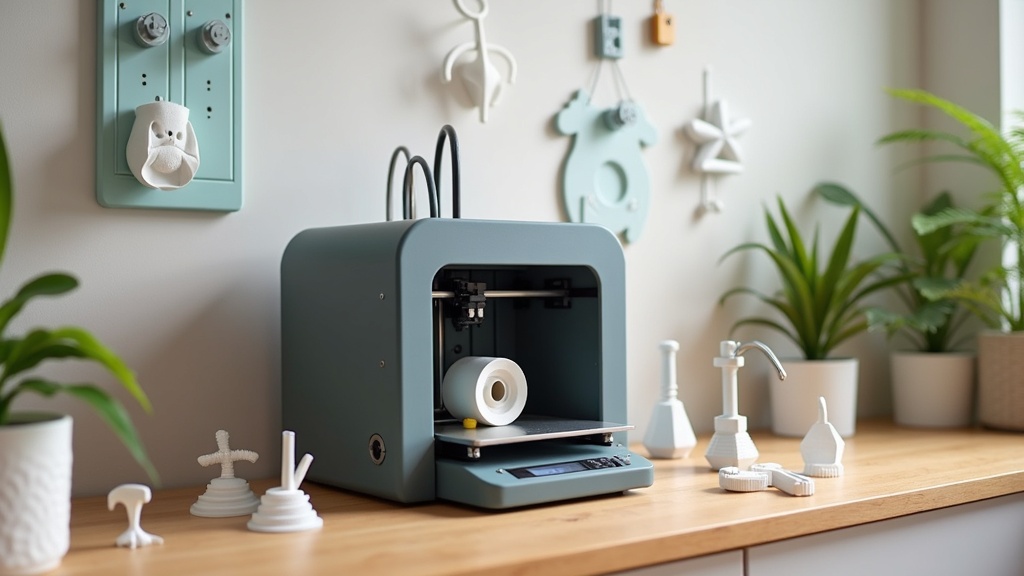
Quick Answer: What Household Problems Can a 3D Printer Fix?
Start with low-risk, low-heat jobs: furniture knobs, low-voltage cable clips, drawer dividers, game pieces, protective feet, flexible door bumpers, remote holders, plant saucers, curtain rings, and noncritical caps or spacers.
Do not casually print mains-electrical parts, smoke-detector components, gas-appliance controls, pressure-bearing pieces, structural hardware, child-safety devices, or anything whose failure could cause injury, fire, flooding, or major property damage. For those jobs, use the correct rated or OEM part.
The 60-Second Print-or-Buy Test
Before downloading a model or opening CAD, sort the job into one of three lanes. This quick decision prevents a clever project from turning into a false economy—or a safety risk.
Print Today
Low load, room temperature, easy to inspect, and harmless if it fails. Examples include labels, dividers, game pieces, and cable guides for low-voltage cords.
Prototype and Test
The part must fit, flex, support a modest load, resist moisture, or survive repeated use. Print a small fit test before making the complete part.
Buy the Proper Part
The job involves mains electricity, fire protection, gas, pressure, hot appliances, structural support, or another consequence-heavy failure.
10 Household Problems Worth Solving With a 3D Printer
These are not promises that one file will fit every house. They are starting points. Check the real dimensions, material, environment, print orientation, and likely failure mode before regular use.
A Drawer or Cabinet Is Missing a Knob
Furniture knobs and light-duty pulls are excellent custom-fit projects because screw spacing and hand clearance are easy to measure. A basic model can also be resized without redesigning the entire piece.
Good starting point: PLA for a dry, room-temperature trial; PETG for greater toughness. Use several walls around the fastener and a washer or embedded nut when the design allows it.
Skip: oven, stovetop, gas-appliance, or other high-heat/control knobs.
Charging Cables Keep Falling Behind the Desk
A small clip can hold each low-voltage charging lead close to the edge without pinching it. Measure the cable diameter and add a little clearance so the wire slides without damaging its jacket.
Good starting point: PETG for a resilient snap clip or TPU for a soft, grippy opening. Print one clip first and test insertion force.
Skip: clips inside outlets, power strips, chargers, or other mains-electrical equipment.
The Junk Drawer Has No Useful Layout
Store-bought organizers waste space when the drawer is unusually narrow or the contents are oddly shaped. Modular trays, dividers, and labeled bins can use the full footprint.
Good starting point: PLA, two or three walls, modest infill, and rounded inside corners that are easy to clean. Print one corner or short divider to verify clearance.
Best design move: Leave finger room; a perfect geometric fit can still be annoying to use.
A Board Game Is Missing One Piece
A pawn, token, tile holder, score marker, or storage insert can keep a complete game in use. Check the original game manufacturer or a model library before drawing a replacement from scratch.
Good starting point: PLA with a fine layer height for visible detail. Match the footprint and function before worrying about an exact cosmetic copy.
Caution: Small printed parts can be choking hazards. Keep them away from young children and pets.
A Furniture Leg Is Scratching the Floor
A nonstructural end cap, glide shell, or TPU foot can cover a sharp tube or replace a missing protective pad. Measure both the leg and available floor clearance.
Good starting point: TPU for grip and impact absorption; PETG for a hard cap paired with a felt pad. Test for rocking and sliding before trusting it.
Skip: replacement legs, structural joints, ladder feet, or anything that must prevent a fall.
A Door Handle Keeps Marking the Wall
A flexible bumper can soften repeated contact, while a floor wedge can hold an ordinary interior door temporarily. Size the face generously so the load is spread over more material.
Good starting point: TPU with a rounded contact surface. For a rigid holder, use PETG and orient the layers so the working force does not split them apart.
Skip: fire doors or doors that form part of an emergency or security system.
The Remote, Keys, or Small Tools Never Have a Home
A purpose-built holder can match the device instead of becoming another generic bin. A freestanding cradle is usually easier to test than a wall-mounted part.
Good starting point: PLA for a desktop cradle; PETG for a tougher shop holder. Add a cable slot or finger notch before printing the full design.
Mounting note: Use suitable hardware for the wall and load; the printed holder does not make the fastener appropriate.
A Plant Pot Leaves Rings on the Shelf
A custom saucer, riser, or drainage spacer can match a planter that does not fit standard trays. Make the footprint larger than the pot and inspect it regularly for cracking or leakage.
Good starting point: PETG, extra walls, and enough bottom layers to create a continuous base. A test over a sink is smarter than assuming a print is watertight.
Placement note: Keep water trays away from electrical outlets and equipment.
A Curtain or Shower Ring Has Snapped
A simple open ring or clip can restore an even hang without replacing the whole set. The print needs enough flex to install without being forced past its limit.
Good starting point: PETG for a resilient clip or TPU for a flexible loop. Round the inner edges to reduce wear on the fabric or liner.
Expect revisions: Ring gap, flex direction, and layer orientation matter more than high infill.
A Small Cap, Spacer, or Adapter Has Disappeared
Odd-size dust caps, shelf-pin sleeves, vacuum-hose adapters, and noncritical spacers are where custom geometry earns its keep. The part may be simple, but both mating interfaces must be measured.
Good starting point: Print only the interface as a short test ring or partial section. When the fit is correct, print the complete part in the material suited to its environment.
Need a discontinued part? See my guide to replacing discontinued plastic parts with 3D printing.
If nothing is broken and you simply want a productive next project, continue with 10 useful things you can print this week. That companion guide focuses on quick project ideas; this article stays centered on repair decisions and household problem-solving.
PLA vs. PETG vs. TPU for Household Fixes
Material choice begins with the environment, not the color. Prusa’s official filament material guide compares mechanical, temperature, chemical, and printing characteristics across common materials. Use your filament manufacturer’s current print profile and technical data as the final reference.
| Material | Best household role | Watch for | Example fixes |
|---|---|---|---|
| PLA | Easy indoor prototypes and low-stress organizers | Lower heat tolerance and brittleness in snap features | Drawer trays, game pieces, remote cradles |
| PETG | Tougher parts, mild flex, moisture exposure | Stringing, overly tight snap fits, surface scarring | Cable clips, shower rings, plant saucers |
| TPU | Flexible, grippy, impact-absorbing parts | Slower printing and harder dimensional control | Feet, bumpers, soft cable guides |
Do not respond to every strength problem by increasing infill. Wall count, print orientation, radii around stress concentrations, fastener design, and the direction of layer forces often matter more. If your printer is not dimensionally consistent, start with my beginner’s calibration guide before tuning a functional fit.
Download a Model, Modify One, or Design From Scratch?
Search First
Look for the object, its brand, model number, and the word “replacement.” Printables is one established model library. Check license terms, recent makes, comments, and dimensional notes.
Measure the Interfaces
Measure screw spacing, holes, shafts, clearances, insertion depth, and surrounding obstacles. My part-measurement guide shows what to capture before opening CAD.
Modify the Simplest Geometry
For basic spacers, dividers, trays, and knobs, Autodesk’s free web-based Tinkercad can be a beginner-friendly starting point.
Print the Smallest Useful Test
A 5 mm slice around a hole or snap feature can answer the fit question with far less time and filament than a complete part. Label each revision so the test results stay useful.
Use the P.R.I.N.T. Method for a Better Household Fix
I use the P.R.I.N.T. Method™ to keep the problem—not the printer setting—at the center of a practical project.
| Step | Question to answer | Write down |
|---|---|---|
| P — Problem | What exactly is broken, missing, messy, or awkward? | One plain-language sentence |
| R — Requirements | What load, heat, moisture, movement, and consequence of failure exist? | Must-have limits and the safest fallback |
| I — Interfaces | Where must the part fit, fasten, slide, or clear another object? | Critical dimensions and tolerances |
| N — Next-Best Materials & Methods | Is PLA, PETG, TPU, an OEM replacement, or another process appropriate? | Material, orientation, walls, and hardware |
| T — Test & Tune | What is the smallest safe test that proves fit and function? | Revision number, result, and next change |
- Photograph the original part and its installed position before disassembly.
- Keep every broken fragment; a cracked edge can still reveal an important dimension.
- Measure the mating object, not only the damaged part.
- Test fit before applying a full load or leaving the part unattended.
- Inspect the first few uses, then check periodically for cracks, creep, looseness, or wear.
Want the Complete Planning System Beside Your Printer?
The Practical Guide to 3D Printing: 2026 Expanded Edition covers setup, slicing, materials, calibration, replacement parts, maintenance, troubleshooting, and the full P.R.I.N.T. Method™ in one 40-page reference.
Explore the Beginner Ebook Start With the Free Beginner GuideWhat If You Need the Part but Not Another Hobby?
If you need one replacement, mount, spacer, or adapter, buying a printer and learning the entire workflow may cost more than having the part evaluated and produced. A project can begin with a photo, sketch, damaged original, or existing 3D file.
Submit the problem through my project-intake page, and I can review the geometry, intended use, material demands, and whether desktop FDM is a practical fit. Based in Independence, Kentucky, I serve Northern Kentucky and the greater Cincinnati area while also reviewing suitable projects from outside the region.
If you decide that owning a printer suits your longer-term plans, you can view the current Creality printer lineup. For USA-made filament, see the COEX partner page and use code 3DPRINTINGBYKEVIN for 15% off.
Quick Knowledge Check
Choose one answer for each question, then check your score.
Frequently Asked Questions
Can a 3D-printed household part be as strong as a store-bought part?
Sometimes, for a specific low-risk job, but the manufacturing process and material are different. Geometry, layer orientation, walls, material, temperature, load, wear, and testing all affect performance. Do not assume equal strength merely because two parts look alike.
Is PLA good enough for useful household prints?
PLA is a practical choice for indoor organizers, prototypes, game pieces, and other low-heat, low-stress objects. Choose another material or the proper commercial part when the job involves sustained load, higher temperature, impact, repeated flexing, weather, or moisture.
Can I 3D print a replacement outlet or light-switch cover?
I do not recommend treating a casual desktop print as a substitute for a properly rated electrical product. Use the correct listed replacement made for the device and installation. Keep printed cable-management parts outside electrical equipment and limited to appropriate low-voltage cords.
Are 3D-printed cookie cutters and kitchen tools food-safe?
Do not assume they are. Filament additives, printer hardware, surface porosity, layer gaps, cleaning, temperature, and repeated use all matter. The FDA Food Code emphasizes that food-contact surfaces must be properly designed, constructed, cleanable, and maintained; a filament label alone does not qualify the finished process. For a food-contact application, use a documented, appropriate process or a commercial food-safe product.
Where can I find files for household replacement parts?
Search reputable model libraries using the product name, model number, part description, and “replacement.” Review the license, designer notes, comments, version history, and photographs of successful makes. Measure your own item because manufacturers may revise a product without changing its familiar name.
How much infill should I use for a functional part?
There is no universal percentage. For many functional parts, additional walls and correct layer orientation improve the working area more efficiently than simply filling the center. Begin with a proven material profile, inspect the slicer preview, and test the actual load in a controlled way.
The Best Household Print Solves the Right Problem
A 3D printer is not a magic replacement-parts catalog. It is a flexible tool for creating geometry that fits one problem, one space, and one set of requirements. That is why the most successful household fix starts with measurement and judgment—not a download button.
Choose a low-risk job, print the smallest useful test, and inspect the result honestly. If the part works, you have restored a useful object and learned something repeatable. If the risk or requirements exceed what a casual FDM print can prove, buying the correct part is not a failure; it is the right engineering decision.
Sources and Further Reading

Tell me what broke, disappeared, or never fit correctly in the comments. Include the material and printer you plan to use, and let’s compare approaches.