
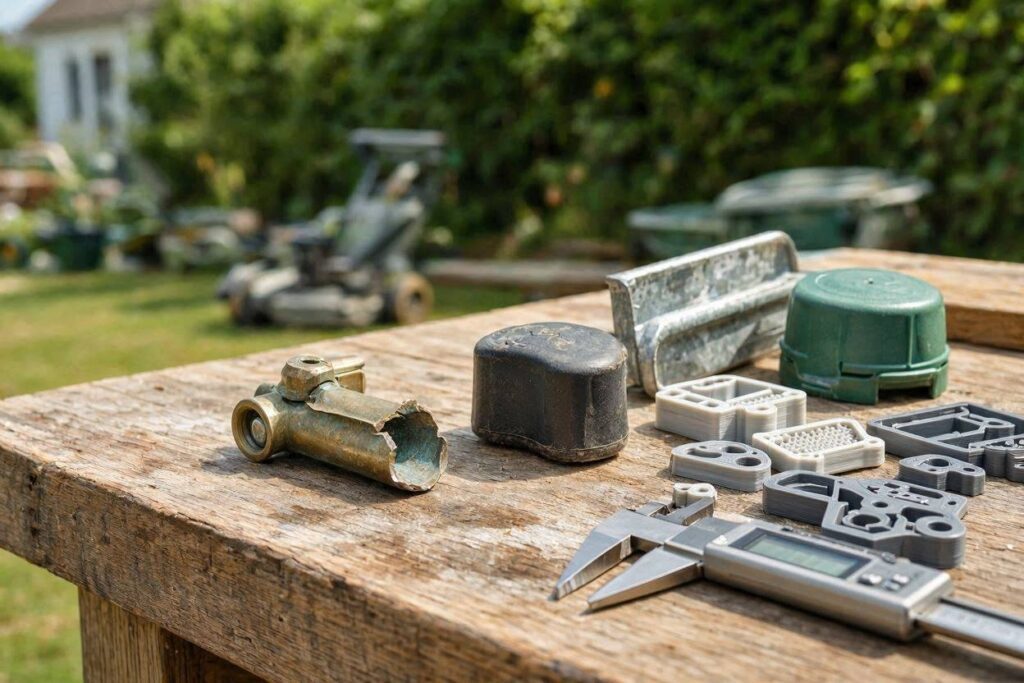
A cracked adjustment knob, missing hose guide, broken cart cap, or damaged sprinkler clip can make otherwise useful equipment frustrating to operate. Some of those pieces may be practical custom 3D-printing candidates. Others protect people from blades, electricity, fuel, heat, or pressure and should never become casual replacement prints.
Can broken lawn and garden parts be 3D printed?
Some can. Promising candidates include non-critical knobs, hose guides, protective caps, sprinkler clips, lightweight brackets, cart accessories, cord holders, equipment feet, and certain discontinued covers. Avoid casually printing blade guards, mower safety controls, fuel-system parts, pressure-regulating components, structural handles, electrical protection, or anything whose failure could cause injury or allow contact with moving machinery.
Start with the job—not the shape
A plastic knob and a plastic safety interlock may be similar in size, but they do not carry the same responsibility. The knob may simply help your hand turn an adjustment shaft. The interlock may prevent equipment from operating in an unsafe condition.
That difference determines whether custom 3D printing is a practical repair method or the wrong shortcut.
3D Printing by Kevin principle: Do not ask only whether the object can be modeled. Ask what the part controls, what conditions it faces, and what happens if it breaks again.
Evaluate outdoor repairs with the P.R.I.N.T. Method™
Lawn and garden equipment faces sunlight, moisture, dirt, heat, vibration, flexing, impacts, and repeated seasonal use. The P.R.I.N.T. Method keeps the decision focused on real operating conditions.
Problem
Identify the broken part and the function that was lost.
Requirements
Consider load, weather, vibration, heat, chemicals, pressure, and safety.
Interfaces
Measure shafts, holes, tubes, clips, catches, screws, and mating surfaces.
Next-Best
Compare an original part, repair, redesign, custom print, or equipment replacement.
Test & Tune
Verify the fit with equipment shut down before returning it to service.
9 lawn and garden parts worth evaluating
Adjustment knobs
A replacement knob may restore comfortable adjustment when the shaft shape, turning force, stop position, and nearby hazards are understood.
Garden-hose guides
A guide can be shaped around a wall, raised bed, post, corner, or hose diameter to reduce kinks and abrasion.
Sprinkler clips and stakes
Some lightweight positioning parts may be recreated when water pressure is not contained by the printed component.
Protective tube caps
Caps can cover garden-cart frames, tool handles, shelving, stands, and exposed tubing while keeping out dirt and water.
Tool and nozzle holders
Custom holders can organize sprayers, hand tools, gloves, nozzles, cords, and repair supplies around the garage or shed.
Garden-cart accessories
Low-risk clips, spacers, caps, and storage attachments may be practical when they do not support the cart’s structural load.
Battery-tool wall mounts
A purpose-built holder may organize compatible tools or batteries when weight, heat, ventilation, and secure engagement are considered.
Cord and extension holders
Custom guides and storage brackets can reduce tangles while keeping cords away from blades, wheels, water, and walking paths.
Discontinued covers and spacers
A small unavailable part may be recreated when it protects against dirt or wear rather than shielding a dangerous moving component.
Comparison: repair, replace, or custom print?
| Option | Best when | Main advantage | Important limitation |
|---|---|---|---|
| Original replacement | The manufacturer still sells the correct part affordably | Known fit and intended function | May be discontinued or bundled with a larger assembly |
| Repair the original | The damage can be restored without weakening the part | Fast and potentially inexpensive | Cracked clips, hinges, and stressed joints may fail again |
| Downloaded model | A verified file matches the exact equipment and revision | Less design work | Dimensions, load, material, and safety assumptions may be unknown |
| Custom 3D-printed part | The component is unavailable or requires a particular fit | Purpose-built geometry and redesign potential | Requires measurements, testing, and material judgment |
| Replace the equipment | The failure affects safety or several systems are deteriorating | Restores the complete intended system | Usually costs more than replacing one small part |
What should not become a casual yard-equipment print?
Guards and safety controls
Blade guards, discharge shields, safety interlocks, brake controls, kill switches, and protective covers require proper manufacturer-approved replacements.
Fuel, heat, and pressure parts
Fuel caps, carburetor components, valves, pressure regulators, high-pressure fittings, and hot-engine parts should not be treated as simple plastic replacements.
Structural and rotating parts
Blades, pulleys, wheel hubs, steering parts, structural handles, axle mounts, and components carrying significant impact or human load require proven solutions.
Safety boundary: Never remove, bypass, or improvise a mower guard, shield, interlock, or blade-control component. Turn equipment off, disconnect its power source, and follow the manufacturer’s service instructions before inspecting or measuring a part.
For additional mower-safety guidance, review the U.S. Consumer Product Safety Commission’s rotary mower safety recommendations .
Outdoor material choice requires more than water resistance
PLA
Useful for fit checks and low-load indoor organization, but summer heat, direct sunlight, and hot sheds or vehicles can make it unsuitable for long-term outdoor service.
PETG
A practical candidate for many non-critical caps, guides, holders, knobs, and clips that need improved moisture and heat tolerance.
ASA
Often worth considering for prolonged sunlight and weather exposure when the printer setup, geometry, load, and failure risk are appropriate.
Material selection is only one part of durability. Print orientation, wall thickness, rounded transitions, screw pressure, vibration, trapped water, chemical contact, and repeated flexing can determine whether the part lasts.
Measure the connection—not just the broken outline
A knob can fit the shaft but turn in the wrong direction. A hose guide can hold the hose but create a damaging kink. A sprinkler clip can look correct while releasing under movement. Functional success depends on the interfaces.
- Measure shaft shape, size, depth, and flat locations.
- Record tube, hose, pole, and handle diameters.
- Measure holes, spacing, slots, hooks, tabs, and catches.
- Document screw size, thread features, and insertion depth.
- Photograph the part installed on the complete equipment.
- Include every broken fragment when possible.
- Explain the expected load, movement, and vibration.
- Note sunlight, rain, heat, chemicals, and storage conditions.
Use How to Measure a Part for 3D Printing before submitting a replacement project.
Try the thirty-second yard-part test
Look at the failed component and choose the description that fits best.
This may be a promising custom-part candidate.
Use an approved original replacement or qualified repair service.
Do not operate the equipment until its function and risk are understood.
Helpful resources for the next step
Original part unavailable?
Read Discontinued Plastic Parts Replaced with 3D Printing to understand the replacement-part process.
Could the weak area be improved?
Explore From Broken Part to Better Design for a function-first approach to redesigning failed components.
Want a repeatable project system?
Continue with P.R.I.N.T. It: Practical 3D Printing for Beginners for structured planning, materials, testing, and troubleshooting.
Readers new to the process can also begin with 3D Printing for Absolute Beginners .
Quick knowledge check
Open each question to test the key decisions before relying on a printed lawn or garden part.
1. Why is a mower adjustment knob different from a blade guard?
A knob may only help the operator turn an adjustment shaft. A blade guard protects people from moving machinery, so its failure carries much more serious consequences.
2. Why is matching the outer shape not enough?
The replacement must also engage the shaft, screw, tube, catch, clip, or mounting surface with the correct clearance, movement, and strength.
3. Why should the equipment be shut down during testing?
A test fit may require hands near mechanisms, wiring, hot areas, or moving components. The equipment should be made inoperable according to its manufacturer’s instructions first.
4. When should an original replacement be preferred?
Prefer it when it is available and affordable, or when the part controls a guard, blade, motor, fuel system, pressure system, electrical function, or structural load.
Frequently asked questions
Can a broken mower knob be 3D printed?
Some non-safety adjustment knobs may be practical to recreate. The shaft geometry, turning force, vibration, heat, stop position, and nearby moving parts must be evaluated.
Can garden-hose fittings be 3D printed?
Hose guides, holders, caps, and some low-consequence adapters may be worth evaluating. Pressure-containing fittings, drinking-water components, and parts whose leakage could cause damage require greater scrutiny.
Is PETG suitable for outdoor garden parts?
PETG can be useful for many non-critical outdoor parts, but suitability depends on sunlight, heat, chemicals, load, geometry, print orientation, and expected lifespan.
Is ASA better for parts left outside?
ASA may be preferable for sustained sunlight and weather exposure. It does not make a safety-critical, poorly measured, or weakly designed part appropriate.
Can a replacement part be designed from photographs?
Photographs help explain the problem, but accurate fit normally requires direct measurements, scale references, broken fragments, or access to the mating equipment.
Can several matching clips or holders be produced?
Yes, but one prototype should be fitted and tested first. A small measurement or clearance error becomes more costly when repeated across a batch.
Have a broken lawn or garden part that is no longer available?
Send clear photographs, dimensions, broken fragments, equipment information, and an explanation of what the part must do. The review will focus on fit, outdoor exposure, vibration, load, safety, material, and whether FDM 3D printing is the right solution.
Project suitability depends on geometry, material, load, heat, sunlight, moisture, vibration, chemicals, pressure, required tolerances, expected lifespan, and the consequences of failure. Do not substitute improvised printed parts for mower guards, blade controls, fuel-system components, pressure-regulating parts, electrical protection, rotating components, structural equipment parts, or other safety-dependent applications.
