
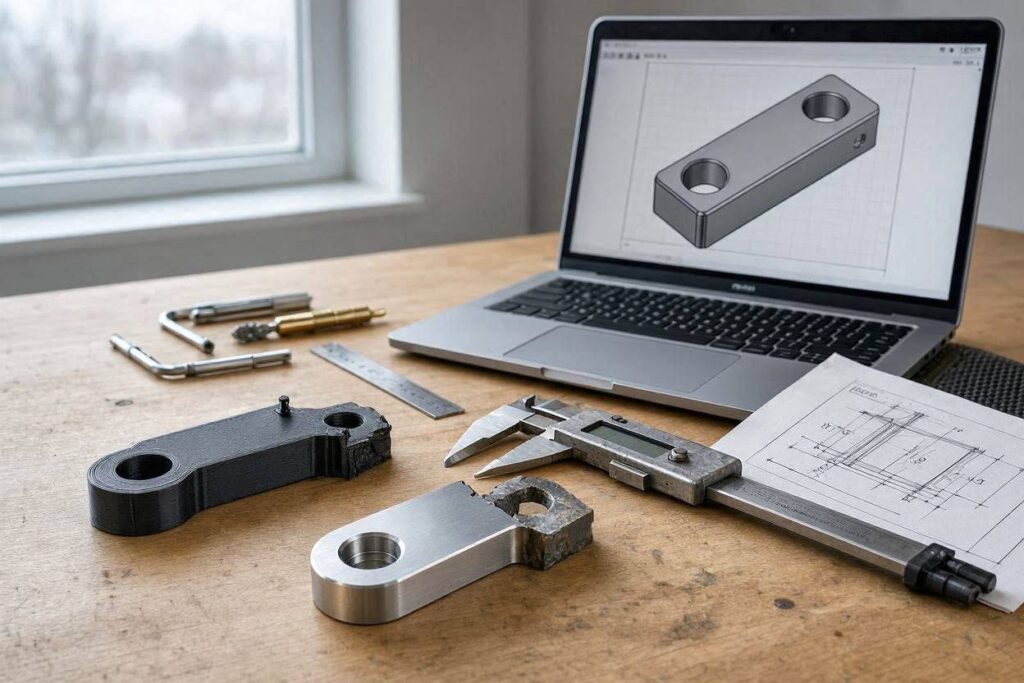
Custom 3D-printing cost depends on more than part weight. A quote may include measuring, CAD work, material selection, printer preparation, supports, print time, cleanup, inspection, test fitting, revisions, and the risk of producing a part that must work with real equipment.
How much does a custom 3D-printed part cost?
There is no reliable universal price based only on grams of filament. Cost depends on whether a usable file already exists, how much design or reverse-engineering work is required, part size, print duration, material, tolerances, supports, cleanup, quantity, test revisions, deadline, and the consequences if the part fails. A ready-to-print file is usually less expensive than recreating a missing part from photos and measurements.
The filament may be the least complicated part of the quote
Imagine a small broken clip that weighs only a few grams. The plastic itself may be inexpensive. But the replacement still has to engage the correct slot, flex in the right direction, clear nearby parts, survive repeated use, and fit the equipment without damaging it.
Before the printer starts, someone may need to study the break, identify the important dimensions, create the model, select an orientation, choose a material, prepare the slicer, print a prototype, inspect the result, and revise the geometry.
3D Printing by Kevin principle: You are not only paying for melted filament. You are paying for a practical path from the problem to a tested part.
How the P.R.I.N.T. Method™ shapes a clearer quote
A strong quote begins by understanding what must be solved—not merely how large the object appears in a photograph.
Problem
Define what is broken, missing, or not working.
Requirements
Identify load, heat, weather, movement, appearance, lifespan, and safety needs.
Interfaces
Measure holes, tabs, slots, clips, shafts, screws, and mating surfaces.
Next-Best
Choose the simplest reliable material, design, orientation, and workflow.
Test & Tune
Prototype, inspect, fit, adjust, and verify before repeating the part.
What usually affects a custom 3D-printing quote?
Design readiness
A clean, printable STEP or STL file requires less preparation than a broken fragment, rough sketch, photograph, or idea.
Part complexity
Curves, clips, threads, thin walls, hidden interfaces, compound angles, and moving features require more design judgment.
Material requirements
Heat, sunlight, flexibility, impact, appearance, chemicals, and long-term load affect material and printer choice.
Print duration
A part may occupy the printer for hours or days, even when its finished weight looks modest.
Prototypes and revisions
Custom-fit parts may need a test piece or geometry adjustment before the final version is ready.
Quantity and finishing
One prototype, fifteen matching parts, support removal, inserts, assembly, labeling, and cleanup create different workflows.
Comparison: the same-looking part can represent different projects
| Starting point | Likely work required | Quote uncertainty |
|---|---|---|
| Print-ready file | File inspection, orientation, slicing, material choice, printing, and cleanup | Usually lower when the file is sound and requirements are clear |
| Editable CAD file | Design review, possible modification, export, slicing, printing, and inspection | Depends on whether changes are needed |
| Complete broken original | Measurement, reverse engineering, CAD, prototype, fit check, and final print | Moderate because critical interfaces can usually be inspected |
| Fragments or damaged original | Reconstruction, missing-feature decisions, measurement, CAD, prototypes, and revisions | Higher because some geometry must be inferred |
| Photos or idea only | Requirement discovery, scale verification, concept design, CAD, prototypes, and testing | Highest until dimensions and function are clarified |
Why one part may cost more than ten copies
The first part carries development work
Measurements, modeling, setup, orientation, prototype decisions, and revisions happen before repeat production begins.
Additional copies share the proven setup
Once the geometry, settings, material, fit, and workflow are verified, repeating the part may require less development per copy.
This does not mean every batch becomes inexpensive. Machine time, filament, cleanup, failure risk, inspection, inserts, packaging, and shipping still apply to every unit.
What can make a quote more affordable?
- Provide a usable CAD or print-ready file when available.
- Send clear photographs from several angles.
- Include a ruler or known-size reference in photographs.
- Measure the features that control fit and attachment.
- Explain exactly what the part must do.
- Identify heat, sunlight, moisture, load, and movement.
- State the quantity before the quote is prepared.
- Separate must-have requirements from appearance preferences.
The guide How to Measure a Part for 3D Printing can help you prepare the most useful dimensions.
Which project are you bringing to the quote?
Choose the description that comes closest. This helps set a realistic expectation before the first review.
The review can focus on printability, material, quantity, orientation, and finishing.
The project may require measurement, reverse engineering, CAD work, and a test fit.
The first step is defining dimensions, interfaces, requirements, and what success looks like.
When buying the original part is the better value
Custom 3D printing is not automatically the least expensive solution. A genuine replacement should usually come first when it remains available, fits correctly, uses the intended material, and costs less than recreating and testing a custom version.
An honest quote may lead to “do not print this.” Replacement may be better when the product has little useful life left, the part is safety-critical, several systems are failing, or the original component is inexpensive and readily available.
Use Should You 3D Print or Replace a Broken Plastic Part? to compare the broader repair options.
Helpful resources before requesting a quote
Discontinued component?
Read Discontinued Plastic Parts Replaced with 3D Printing for the custom-replacement workflow.
Need accurate fit?
Review
Precision 3D Printed Parts
for tolerance, inspection, and project expectations.
Want the complete planning system?
Continue with
P.R.I.N.T. It: Practical 3D Printing for Beginners
for materials, planning, setup, testing, and troubleshooting.
Readers new to the process can also begin with 3D Printing for Absolute Beginners .
Quick knowledge check
Open each question to test the main pricing factors.
1. Why does filament weight not determine the full quote?
The project may also require measurements, CAD work, material selection, printer setup, slicing, prototypes, revisions, cleanup, inspection, and testing.
2. Which starting point usually creates the least uncertainty?
A clean, printable file with clear requirements normally creates less uncertainty than photographs, fragments, or an idea without dimensions.
3. Why can the first part cost more per unit than a batch?
The first part carries the design, setup, prototype, and verification work. Additional copies may share that proven workflow.
4. What information helps produce a clearer quote?
Useful files, clear photographs, measurements, quantity, material needs, operating conditions, attachment details, and a description of the part’s job all help.
Frequently asked questions
Is custom 3D printing priced by the gram?
Material weight may be one factor, but professional custom work also accounts for design, setup, machine time, supports, cleanup, testing, quantity, risk, and revisions.
Does a smaller part always cost less?
No. A small clip with tight tolerances and complex interfaces may require more design work than a larger, simpler object with a ready-to-print file.
Will providing an STL reduce the cost?
It can reduce design work when the STL is correctly sized, printable, and suitable for the intended use. A damaged or unsuitable file may still require repair or redesign.
Why might a prototype be necessary?
A prototype can verify fit, movement, clearance, hole position, flex, and attachment before the final material or full quantity is produced.
Are multiple copies cheaper?
Per-part cost may improve after design and setup are proven, but every copy still uses material, printer capacity, inspection, cleanup, and handling time.
Can I get a quote from photographs alone?
Photographs may support an initial review, but accurate pricing often requires dimensions, scale references, quantity, material needs, and an explanation of how the part fits and functions.
Ready to find out what your part will actually require?
Send the file, broken component, photographs, measurements, quantity, and intended use. The review will focus on the simplest reliable path—not on forcing unnecessary complexity into the project.
Custom-project pricing varies by design readiness, complexity, dimensions, material, machine time, supports, tolerances, quantity, finishing, testing, revisions, turnaround, shipping, and the consequences of failure. Any examples shown elsewhere on the site are illustrative and do not replace a project-specific quote.
