
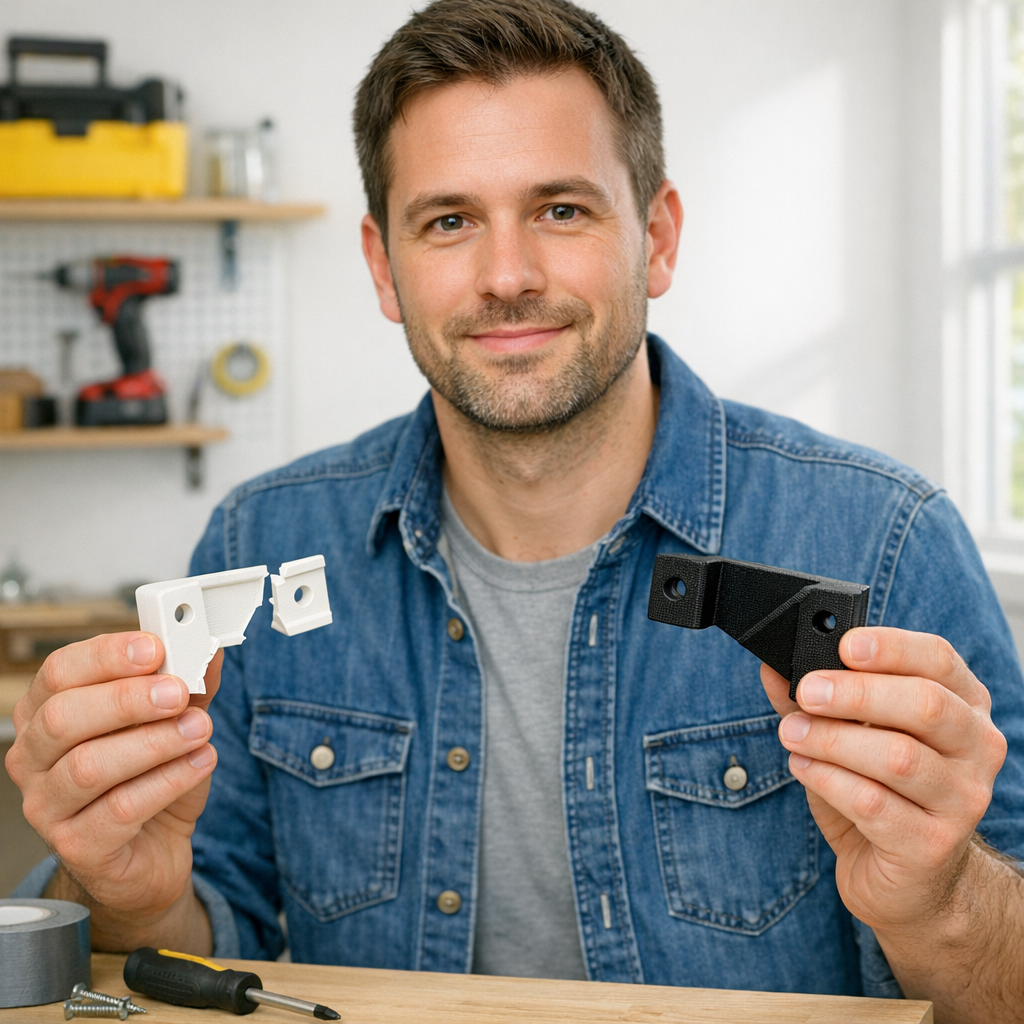
Custom 3D printing can sometimes bring that product back into service—but not every repair is practical, economical, or safe. The best decision begins with the part’s job, available replacement options, required fit, operating environment, and consequences of failure.
Should you 3D print or replace a broken plastic part?
Consider 3D printing when the original part is unavailable, the surrounding product still has useful life, the geometry can be measured or reconstructed, and the replacement is a non-critical bracket, clip, knob, cover, spacer, holder, guide, mount, or similar component. Buy an original replacement when one is affordable and available. Replace or professionally repair the complete product when the damaged component involves electricity, pressure, extreme heat, major structural loads, certification, or serious consequences if it fails.
The cheapest-looking repair is not always the least expensive
A five-dollar plastic clip can disable a much more valuable appliance, tool, machine, piece of furniture, or workshop fixture. Replacing the entire product may feel excessive, especially when the motor, frame, electronics, or main assembly still works.
On the other hand, recreating a simple-looking component can require measurements, modeling, prototypes, material selection, and fit testing. The real comparison is not “a few cents of filament versus a new product.” It is the complete cost and risk of producing a reliable replacement.
3D Printing by Kevin principle: The goal is not to force 3D printing into every repair. The goal is to identify the next practical solution.
Use the P.R.I.N.T. Method™ before choosing the repair
The P.R.I.N.T. Method keeps the decision centered on what the finished part must accomplish—not simply whether a printer can reproduce its visible shape.
Problem
Define what broke and what function has been lost.
Requirements
Consider load, heat, weather, movement, lifespan, and safety.
Interfaces
Measure every hole, tab, slot, clip, shaft, surface, and clearance.
Next-Best
Compare original parts, repair, redesign, printing, and replacement.
Test & Tune
Verify fit and function before depending on the replacement.
3D print, buy the part, repair the original, or replace the product?
| Option | Best when | Advantages | Limitations |
|---|---|---|---|
| Buy the original part | The correct component remains available at a reasonable price | Known fit, original appearance, fast installation, less development | May be discontinued, overpriced, backordered, or sold only in a larger assembly |
| Repair the original | The break is accessible and the original geometry remains intact | Preserves the original fit and may be fast | Adhesive repairs may fail again at stressed clips, hinges, hubs, or thin sections |
| 3D print a replacement | The part is unavailable, measurable, non-critical, and valuable enough to recreate | Custom geometry, low quantities, redesign opportunities, local production | Requires modeling, material selection, testing, and realistic tolerance expectations |
| Replace the product | The product has multiple failures, limited remaining life, or serious safety concerns | Restores full functionality and may include a warranty | Higher purchase cost, more waste, and possible loss of an otherwise serviceable item |
When custom 3D printing is usually worth exploring
The part is discontinued
The manufacturer no longer supplies it, used replacements are unavailable, or the part is sold only with an expensive assembly.
The product still has value
The surrounding equipment works well, remains useful, and is worth preserving after the plastic component is restored.
The geometry is recoverable
The original, broken fragments, matching assembly, photographs, measurements, or surviving interfaces provide enough information.
Common candidates include brackets, clips, knobs, feet, spacers, covers, guides, holders, mounts, caps, adapters, organizers, and low-volume functional parts.
Explore examples on Discontinued Plastic Parts Replaced with 3D Printing and Broken Brackets and Clips Replaced with 3D Printing .
When another solution may be better
An original part is easy to buy
A genuine replacement may cost less than the time required to measure, model, prototype, print, inspect, and revise a custom component.
Failure carries serious consequences
Safety guards, pressure parts, electrical enclosures, medical components, vehicle safety systems, and major structural parts require closer scrutiny.
The entire product is near failure
Recreating one clip may not make sense when the motor, wiring, bearings, housing, or several additional parts are already failing.
A fast repair decision check
Check the manufacturer, authorized parts sellers, repair shops, and reputable used-part sources.
Compare the usefulness and remaining life of the product with the cost of replacing it.
Look for surviving fragments, mounting points, matching parts, product photos, manuals, and measurable reference surfaces.
Consider load, speed, pressure, electricity, heat, chemicals, impact, and nearby people.
The interfaces determine whether the repair works
Customers often focus on the outside shape because that is what they can see. Functional replacements usually succeed or fail at the interfaces: the places where the component screws, clips, slides, rotates, snaps, rests, seals, or aligns with another object.
- Screw-hole diameter, depth, spacing, and edge distance
- Tab length, thickness, hook depth, and flex direction
- Slot width, depth, taper, and operating clearance
- Shaft shape, diameter, insertion depth, and retention
- Mounting-face size, angle, and contact position
- Wall thickness, ribs, transitions, and original weak points
- Movement range, pivot location, and neighboring obstacles
- Heat, moisture, sunlight, vibration, and repeated use
The complete process is explained in How to Measure a Part for 3D Printing .
Comparison: copying the failure or creating the next practical part
Exact-looking copy
An identical reproduction may preserve the original appearance, but it can also recreate the same sharp corner, thin tab, weak hub, or poor load path that failed before.
Function-focused redesign
A practical replacement may use a thicker transition, rounded corner, reinforced attachment, different orientation, hardware, or a more suitable material.
Custom printing is often most valuable when it preserves the required interfaces while improving a known weak point. The goal is not necessarily a perfect visual clone. It is a part that fits and performs the required job.
Material choice begins with the operating environment
A printable material is not automatically an appropriate material. A decorative indoor cover, flexible clip, sun-exposed mount, hot-car accessory, and load-bearing workshop bracket may require very different decisions.
PLA
Useful for visual prototypes, basic indoor parts, and early fit checks. Heat and long-term load can limit its suitability.
PETG
A practical candidate for many brackets, clips, holders, covers, and tougher everyday parts that need more temperature and moisture tolerance.
ASA, ABS, and engineering materials
May be considered for heat, sunlight, weather, impact, or more demanding requirements, but printer capability and part design still matter.
Learn more about fit, tolerance, and project expectations on the Precision 3D Printed Parts page.
What information makes a part easier to evaluate?
You do not need a finished STL or engineering drawing to begin. A useful review can start with the broken piece, clear photographs, basic measurements, and a plain-language explanation of the job.
- Photos of the complete product and broken component
- Images of every surviving fragment
- Overall length, width, height, and wall thickness
- Hole, shaft, clip, slot, tab, and spacing dimensions
- Product make and model when available
- A description of how the part attaches and moves
- Heat, sunlight, moisture, vibration, and load exposure
- Any STL, STEP, OBJ, sketch, drawing, manual, or PDF
Photographs and measurements do not guarantee that every component can be reproduced economically or safely. They provide the information needed for an honest first review.
Continue learning before the next project
New to the process?
Begin with 3D Printing for Absolute Beginners for a practical introduction to printers, materials, files, and common mistakes.
Want a repeatable system?
Explore P.R.I.N.T. It: Practical 3D Printing for Beginners for a structured way to plan useful prints.
Have a broken clip or bracket?
Visit Broken Brackets and Clips Replaced with 3D Printing for the dedicated service path.
Quick knowledge check
Open each question to test the main repair decisions.
1. When should an original replacement part usually come first?
When the correct component remains available, fits the product, and costs less than developing and testing a custom replacement.
2. What makes a discontinued part a strong 3D-printing candidate?
The product still has value, the component is non-critical, the geometry can be recovered, and a printed material can meet the part’s requirements.
3. Why are interfaces more important than the visible outline?
Interfaces determine whether the replacement can screw, clip, slide, rotate, align, support, or fit into the surrounding assembly.
4. Why might an exact copy repeat the original failure?
The original geometry may contain a thin transition, sharp corner, weak tab, poor material choice, or stress concentration that caused the first failure.
Frequently asked questions
Is it cheaper to 3D print a replacement part?
Sometimes, especially when the original is discontinued or sold only with a costly assembly. The total cost still includes measurement, modeling, prototypes, material, printing, inspection, and possible revisions.
Can a replacement be made without the original part?
Sometimes. The surrounding assembly, mounting holes, available space, matching components, product photographs, manuals, sketches, and a clear explanation of the missing part’s job may provide enough information.
Can a cracked clip be stronger than the original?
Potentially. The replacement may use a thicker transition, rounded corner, improved flex geometry, different print orientation, reinforcement, or a more suitable material.
Are 3D-printed parts as strong as molded parts?
Strength depends on material, geometry, print orientation, layer bonding, wall thickness, settings, load direction, temperature, and the original molded design. A printed part should be evaluated for its specific job rather than assumed equivalent.
Can you recreate a part from photographs?
Photographs can provide useful context, especially with a scale reference, but critical interfaces normally need direct measurements or access to the mating assembly.
When should a broken product be replaced instead?
Replacement may be better when several systems are failing, a genuine part is readily available, the product has little useful life left, or the damaged component carries unacceptable safety or property risk.
Have a small broken part holding back an otherwise useful product?
Send photographs, measurements, broken fragments, available files, and a description of what the component must do. The review will focus on fit, material, operating conditions, development effort, safety, and whether custom FDM printing is the right solution.
Replacement-part feasibility depends on available reference information, geometry, required tolerances, operating temperature, material demands, load, movement, exposure, quantity, development cost, expected lifespan, and the consequences of failure. Not every broken component is an appropriate candidate for FDM 3D printing.
