
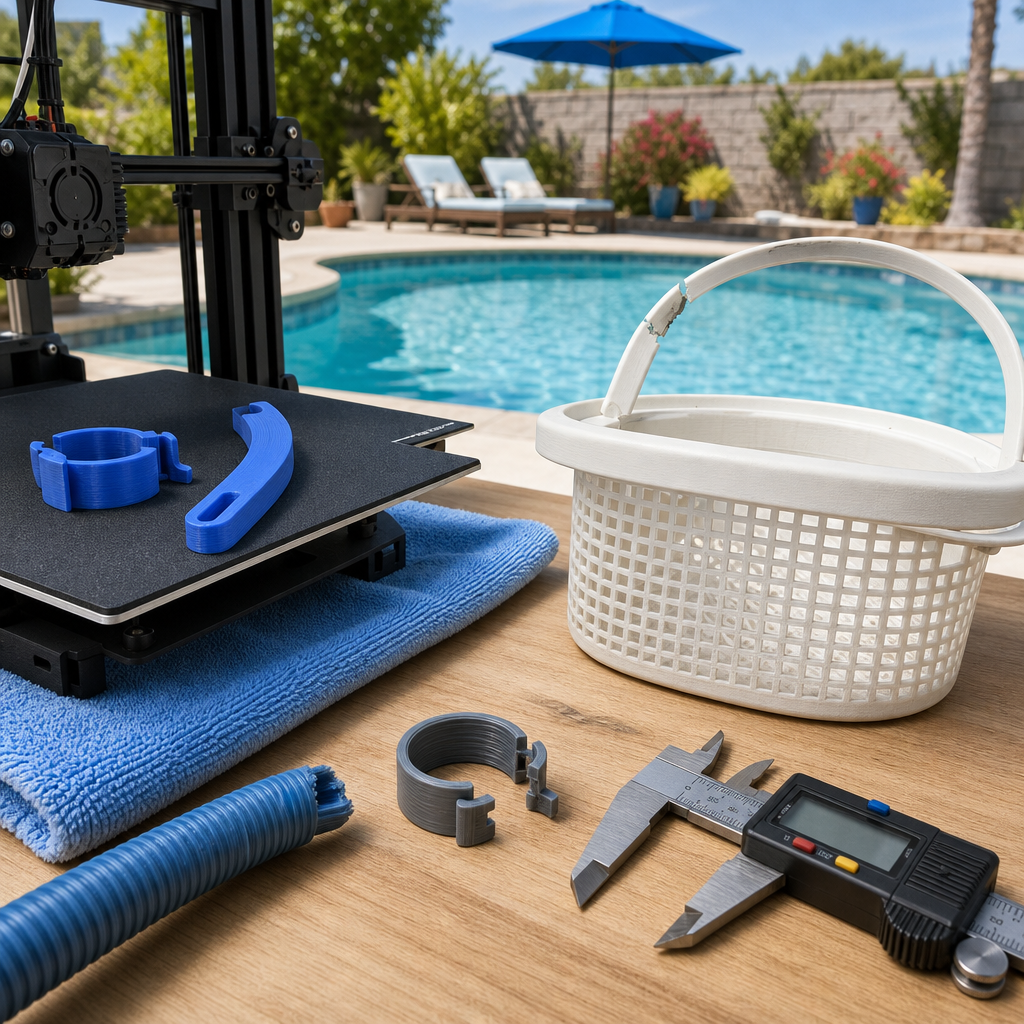
Pool season has a way of finding the weakest plastic piece at the worst possible time. A cracked skimmer handle, missing hose clip, broken cap, or loose adapter can interrupt the day even when the rest of the equipment still works. Some of those parts may be practical 3D-printing candidates. Others are better purchased as original replacements—or left to certified pool professionals.
Can broken pool parts be 3D printed?
Some broken pool parts can be evaluated for 3D printing, especially non-critical plastic items such as skimmer-basket handles, lightweight clips, decorative caps, knobs, covers, spacers, holders, guides, and certain low-pressure accessory pieces. Avoid casual printing for pump housings, filter tanks, pressurized plumbing, electrical parts, drain covers, suction components, ladder supports, handrails, diving components, or anything whose failure could injure someone.
The real question is not “Can this shape be printed?”
A 3D printer can make a shape. That is not the same as making a safe, useful, pool-ready replacement. Around a pool, the part may face sunlight, water, chemicals, heat, flexing, repeated removal, vibration, and careless handling by people who just want the pool to work.
That is why the best first step is to identify the part’s job. A skimmer handle that lifts a basket is very different from a drain cover, pump housing, or ladder component that affects swimmer safety.
Ask these three questions first
- What does it do?
Lift, clip, cover, guide, seal, support, or contain pressure? - Where does it live?
Sun, water, chemicals, heat, shade, storage bin, or pump area? - What happens if it fails?
Minor annoyance, leak, equipment damage, or swimmer risk?
Use the P.R.I.N.T. Method™ before choosing the repair
Pool parts combine practical fit with outdoor exposure. The P.R.I.N.T. Method helps separate a reasonable replacement from a risky shortcut.
Problem
Identify what broke and what function is missing.
Requirements
Consider sunlight, chemicals, water, load, pressure, movement, and safety.
Interfaces
Measure holes, clips, tubes, slots, tabs, threads, hooks, and mating surfaces.
Next-Best
Compare original replacement, repair, redesign, custom printing, or full replacement.
Test & Tune
Verify fit and function away from swimmers before relying on the part.
Pool-part comparison: promising candidates vs. high-caution repairs
| Part | 3D-printing potential | What must be checked |
|---|---|---|
| Skimmer-basket handle | Often worth evaluating | Basket attachment, lifting load, water exposure, sunlight, and repeated flexing |
| Vacuum-tool clip or holder | Often practical | Tube diameter, grip, flex direction, outdoor storage, and removal frequency |
| Decorative cap or cover | Usually a strong candidate | Fit, drainage, trapped water, UV exposure, sharp edges, and seasonal storage |
| Control knob or lightweight lever | Possible after review | Shaft shape, turning force, stop position, heat exposure, and nearby electrical parts |
| Low-pressure accessory adapter | Requires careful testing | Tube size, thread form, seal surface, wall thickness, flow restriction, and leakage consequences |
| Ladder step, rail mount, or diving component | Poor casual-print candidate | Human load, impact, fatigue, fasteners, codes, and injury risk |
| Pump, filter, pressure, drain, suction, or electrical part | Requires specialist evaluation | Pressure, suction, electricity, heat, certification, entrapment risk, and system damage |
The green-light, yellow-light, red-light test
Green light: good to evaluate
Skimmer handles, lightweight clips, caps, holders, guides, small covers, spacers, knobs, and non-critical organizer pieces may be worth a custom-part review.
Yellow light: slow down
Hose adapters, threaded fittings, moving levers, flexing clips, and parts near equipment should be checked for fit, leakage, chemical exposure, and failure consequences.
Red light: do not improvise
Drain covers, suction components, pressure housings, electrical enclosures, ladder supports, handrails, diving parts, and swimmer-safety components need proper certified solutions.
Water resistance is not the same as pool suitability
A printed part may survive a splash and still fail after weeks of sun, chlorine exposure, heat, bending, and repeated use. Material choice matters, but so do geometry, print orientation, wall thickness, drainage, color, fasteners, and how much stress the part carries.
PLA
Useful for quick shape checks and temporary prototypes. It is usually not the first choice for parts left in direct sun, summer heat, or repeated poolside use.
PETG
A practical candidate for many low-risk handles, clips, holders, caps, and guides that need better moisture and heat tolerance than PLA.
ASA
Often worth considering for outdoor sun exposure and weather-facing parts, but it does not make a safety-critical or poorly designed component appropriate.
The interfaces matter more than the outside shape
A replacement handle can look correct and still pull free. A cap can fit once and split later. An adapter can thread on but leak because the sealing surface is wrong. Functional pool parts succeed at the contact points, not just the outline.
- Measure hole diameter, spacing, depth, and edge distance.
- Record tube or hose outside and inside diameters.
- Identify thread size, pitch, direction, and sealing surface.
- Measure clips, tabs, hooks, and engagement depth.
- Document the direction and amount of expected load.
- Check whether water can become trapped inside the part.
- Note sunlight, chemicals, heat, and storage conditions.
- Photograph the part installed in the complete assembly.
Use How to Measure a Part for 3D Printing before submitting a replacement-part project.
Exact copy or better replacement?
Exact-looking copy
A visual duplicate may repeat the same thin hook, sharp corner, weak hinge, trapped-water pocket, or undersized transition that failed the first time.
Function-focused redesign
A better replacement may add drainage, round a stress point, thicken a grip, improve the load path, or use replaceable hardware while preserving the required fit.
The goal is not always to make an identical replica. The goal is to create the next practical part: one that fits, works, and holds up under the conditions it actually faces.
See From Broken Part to Better Design for more about improving failed plastic components instead of simply copying them.
A quick decision path before you request a print
If yes, the manufacturer’s part may be the fastest and safest option.
If it only clips, covers, lifts, organizes, or guides lightly, it may be worth reviewing.
Photos help, but tube sizes, hole spacing, hooks, clips, and thread features must be documented clearly.
If yes, do not treat it as a casual print. Choose a proper replacement or professional repair path.
What to send for a pool-part review
You do not need a completed CAD model to start. Clear photos, broken fragments, measurements, and equipment information can support an honest first evaluation.
- Photos of the complete pool product or accessory
- Close-ups of the broken component and every fragment
- Overall length, width, height, and wall thickness
- Hole, tube, hose, thread, clip, tab, and spacing measurements
- Manufacturer, model, and part number when available
- An explanation of how the component attaches and moves
- Details about water, sunlight, chemicals, heat, and load
- A description of what happens if the part fails
Clear information does not guarantee that every pool part should be printed. It makes the first review more accurate and helps avoid forcing 3D printing into the wrong repair.
Continue with these practical resources
Discontinued part?
Visit Discontinued Plastic Parts Replaced with 3D Printing to understand the custom replacement process.
New to functional printing?
Start with 3D Printing for Absolute Beginners for a clear introduction to files, printers, materials, and common mistakes.
Want a repeatable system?
Explore P.R.I.N.T. It: Practical 3D Printing for Beginners for a structured way to plan useful parts.
Quick knowledge check
Open each question to test the main repair decisions.
1. Why is a skimmer handle different from a ladder step?
A skimmer handle usually lifts lightweight debris. A ladder step supports a person, so failure carries a much higher safety risk.
2. Why is water resistance alone not enough?
Pool parts may also face sunlight, heat, chemicals, flexing, fasteners, trapped water, sustained load, and repeated seasonal use.
3. Which features usually control whether an adapter fits?
Tube diameter, thread size and pitch, insertion depth, sealing surfaces, wall thickness, and operating clearance usually matter more than appearance.
4. When should an original replacement be preferred?
Prefer the original when it is affordable and available, or when the component involves pressure, suction, electricity, structural support, certification, or swimmer safety.
Frequently asked questions
Can a pool skimmer-basket handle be 3D printed?
Often, yes. The attachment points, lifting load, water exposure, sunlight, flex, and basket geometry should be measured before selecting the design and material.
Can a pool vacuum-hose adapter be printed?
Some low-pressure accessory adapters may be possible, but hose diameter, fit, seal, flow restriction, wall thickness, and the consequences of leakage must be evaluated.
Is PETG suitable for pool accessories?
PETG can be a practical candidate for many low-risk handles, clips, holders, caps, and guides. Suitability still depends on sunlight, chemicals, load, geometry, and expected lifespan.
Is ASA better for parts left beside the pool?
ASA may be a stronger candidate for parts exposed to direct sunlight and weather. It does not make an unsafe or poorly designed component appropriate.
Can a cracked pool part be redesigned stronger?
Sometimes. A redesign may add drainage, rounded transitions, thicker walls, improved reinforcement, different fasteners, or a more appropriate material.
Which pool parts should not be casually printed?
Avoid casual reproduction of drain covers, suction components, filter tanks, pump housings, pressure fittings, electrical enclosures, ladder supports, handrails, diving components, and other safety-critical parts.
Have a small broken pool part that is no longer available?
Send photographs, measurements, broken fragments, equipment information, and a description of what the component must do. The review will focus on fit, sunlight, water, chemicals, load, safety, and whether FDM 3D printing is the right solution.
Pool-part feasibility depends on geometry, material, water and chemical exposure, sunlight, temperature, load, pressure, suction, electricity, required tolerances, expected lifespan, and the consequences of failure. Do not use an improvised printed part in place of a certified or safety-critical pool component.
